

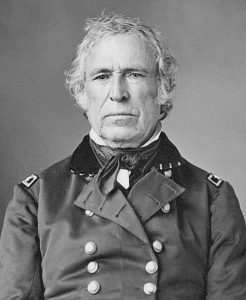
Today, the American electorate is intimately familiar with the phenomenon of the political outsider—the wealthy elite who dons the costume of the “common man,” leveraging their lack of government experience as proof that they alone can fix a corrupt establishment. We see this playbook utilized by modern billionaires and executives who claim to uniquely understand the plight of the working class. But to truly understand the danger and the appeal of the manufactured populist, we must look to the election of 1848 and the nation’s twelfth president, Zachary Taylor. Taylor’s life is a masterclass in political illusion, yet his brief presidency offers a profound lesson in the kind of uncompromising unionism that is desperately missing from today’s hyper-partisan landscape.
The Illusion of the “Common Man” Zachary Taylor achieved national fame during the Mexican War, particularly after the Battle of Buena Vista in 1847, where his green army of volunteers unexpectedly defeated General Santa Anna’s forces. He had previously earned the nickname “Old Rough and Ready” during the Second Seminole War for his willingness to share the grueling hardships of the wilderness with his men. To the public eye, Taylor was a gruff, blunt, bowlegged soldier who spurned military uniforms in favor of rumpled clothes and raggedy hats.
Sensing an opportunity, the Whig party—desperate for a winner after a series of defeats—decided to market him as a humble, unpretentious man of the soil. They actively cultivated his image as an outsider, banking on the fact that he was so divorced from the political establishment that he had never even cast a vote in his life.
The reality of Zachary Taylor’s life, however, was vastly different from the rugged myth. He was not a poor frontiersman, but rather a wealthy Virginia-born aristocrat and gentleman farmer. Benefiting from the army’s generous leave policies, Taylor spent vast amounts of his career buying and managing properties, eventually becoming a highly successful planter who owned multiple plantations and enslaved as many as 300 human beings. His political handlers, including New York operative Thurlow Weed, carefully managed his public statements, successfully shielding his vast wealth and elite status behind a facade of homespun modesty. The outgoing Democratic president, James K. Polk, bitterly recognized Taylor’s lack of qualifications, writing in his diary that Taylor was “uneducated, exceedingly ignorant of public affairs, and I should judge of very ordinary capacity”.
The Reluctant Partisan and the Threat of Secession Taylor’s political appeal lay in his refusal to be bound by strict party ideology. He stubbornly insisted that he was “not a party candidate” and promised that if elected, he “cannot be President of a party, but the President of the whole people”.
However, upon entering the White House in 1849, Taylor was immediately confronted with the most explosive issue in American history: the expansion of slavery into the vast new territories acquired from Mexico. Because Taylor was a Southerner and a major slaveholder, the Southern political establishment naturally assumed he would fiercely champion their cause and demand that slavery be permitted in California and New Mexico.
In a shocking defiance of his own geographic and economic class, Taylor staunchly opposed the expansion of slavery. He concluded that slavery was not economically viable in the arid Southwest and that fighting over the Wilmot Proviso was needlessly tearing the country apart. Consequently, he encouraged California and New Mexico to immediately draft constitutions and apply for statehood as free states, entirely bypassing the territorial phase.
When fire-eating Southern politicians realized that “their” president was orchestrating the admission of free states, they erupted in fury. A delegation of Southern congressmen marched into the White House and threatened secession if they did not get their way. Unlike modern politicians who routinely capitulate to the most extreme factions of their base to maintain power, Taylor met their threats with terrifying, unyielding resolve. Displaying the stubbornness of a combat general, Taylor angrily told the delegation that “if it becomes necessary I’ll take command of the army myself and if you are taken in rebellion against the Union I will hang you with less reluctance than I hanged deserters and spies in Mexico”.
Scandal, Death, and the Unfulfilled “What If” Taylor’s uncompromising defense of the Union was tragically cut short. By the summer of 1850, his administration was heavily burdened by the “Galphin scandal,” in which his own secretary of war legally but controversially accepted a massive, $191,000 payout from a federal claim, causing the president immense personal anguish and stress.
On July 4, 1850, Taylor sat through a blistering, two-hour rhetorical diatribe at the cornerstone ceremony for the Washington Monument. Seeking relief from the oppressive heat, he consumed large quantities of green apples, cherries, and ice-cold milk. He quickly contracted severe gastroenteritis—frequently referred to then as cholera morbus—and succumbed to the infection just five days later, dying on July 9.
His sudden death plunged the nation into a profound “what if” of American history. He was succeeded by Vice President Millard Fillmore, who proved far more pliable to Southern demands. Within months, Fillmore signed the Compromise of 1850, which included the draconian Fugitive Slave Act—a measure historians generally concede Taylor would have vetoed.
In the wake of his death, Senator Thomas Hart Benton astutely observed that Taylor’s unique position as a Southern slaveholder, combined with his immense military reputation, would have given him a power to settle the slavery agitation that no Northern or civilian president could have possessed. Some historians have even speculated that, had Taylor lived to enforce his will and hang those who threatened rebellion, he might have successfully averted the American Civil War entirely.
Ultimately, Zachary Taylor was an enigma: a man elevated to the highest office by a manufactured political machine, yet one who proved utterly immune to partisan capture once in power. He serves as a powerful historical reminder that the republic can survive its darkest crises only when its leaders are willing to place the survival of the Union above the demands of their own political factions and personal wealth.