

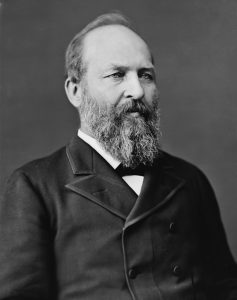
To understand the most alarming vulnerabilities of the modern American republic—the rise of political violence fueled by toxic partisan echo chambers, the paralyzing wars over civil service and the “deep state,” and the catastrophic consequences when elite institutions stubbornly reject established science—one must examine the brief, tragic presidency of James A. Garfield. As the twentieth president of the United States, Garfield’s life and death provide a profound historical mirror for our current era, demonstrating how extreme political factionalism and institutional arrogance can literally destroy the executive branch.
The “Dark Horse” and the Manufactured Self-Made Man In an era where modern politicians constantly deploy armies of consultants to fabricate relatable personas, Garfield’s 1880 presidential campaign was a pioneering exercise in political marketing. Garfield was arguably the most intellectually gifted man to occupy the White House since John Quincy Adams. He was a classics scholar who could reputedly write Greek with one hand and Latin with the other simultaneously. He had served as a major general in the Civil War, routing Confederate forces at the Battle of Middle Creek, and had spent eighteen highly influential years in the House of Representatives, establishing himself as a fiscal watchdog and master parliamentarian.
Yet, when the deadlocked Republican convention of 1880 unexpectedly nominated him as a compromise “dark horse” candidate, his party handlers recognized that his intellectualism would not win a national election. Instead, they ruthlessly marketed his origins. Garfield was the last American president actually born in a log cabin. The Republican machine relentlessly pushed the narrative of the poor farm boy who labored on the Ohio canals, a rags-to-riches story later immortalized by the novelist Horatio Alger in the book From Canal Boy to President.
Garfield also pioneered the “front porch” campaign. Rather than taking to the exhausting campaign trail—which was still considered somewhat undignified—Garfield remained at his Ohio farm, dubbed “Lawnfield” by the press. A telegraph line was run to an outbuilding, and hundreds of delegations and thousands of voters traveled by rail to hear him speak from his porch, allowing him to project a modest, positive image while the party machine waged a vicious, negative war against his Democratic opponent, Winfield Scott Hancock. Garfield narrowly won the presidency by fewer than 2,000 popular votes, the closest margin in American history.
Factional Warfare and the Defiance of the Bosses Upon taking office, Garfield was immediately consumed by a vicious civil war within his own party—a conflict that directly mirrors modern struggles over political patronage and bureaucratic control. The Republican Party was violently split between two factions: the “Half-Breeds,” led by Garfield’s Secretary of State James G. Blaine, and the “Stalwarts,” led by the arrogant, autocratic Senator Roscoe Conkling of New York.
The Stalwarts demanded absolute adherence to the “spoils system,” insisting that government jobs be handed out as rewards to political loyalists rather than based on merit. Conkling effectively demanded total control over the New York Custom House, the largest patronage prize in the country, which collected 75 percent of all federal customs receipts and controlled thousands of jobs.
In a moment of supreme executive courage, Garfield realized that if he capitulated to Conkling, the presidency would be forever subservient to the Senate bosses. Defying Conkling, Garfield appointed an independent reformer to head the Custom House. When Conkling threw a tantrum and stalled the nomination, Garfield boldly declared that he would rather be “dragged by wild horses” than withdraw the appointment. He forced the issue, prompting Conkling to resign from the Senate in protest, a move that effectively ended Conkling’s political career and struck a massive blow for the independence of the executive branch.
The Echo Chamber and the Assassin Tragically, the intense, vitriolic rhetoric of this partisan war infected the mind of a marginalized, delusional man named Charles J. Guiteau. As modern observers study how unhinged individuals are radicalized by extreme political rhetoric, Guiteau serves as the historical prototype.
Guiteau was a failed lawyer and persistent job seeker who desperately wanted to be appointed Consul-General to Paris. He spent his days loitering around the Republican headquarters, absorbing the venomous rhetoric of the Stalwarts. After reading a blistering newspaper exposé dictated by Conkling that painted Garfield as a treacherous liar bent on destroying the Stalwart faction, Guiteau convinced himself that the president’s death was a “political necessity”. He believed that if he assassinated Garfield, the Stalwart Vice President, Chester A. Arthur, would take power, the Republican Party would be saved, and Guiteau would be rewarded with his Paris post.
On July 2, 1881, as Garfield walked through the Baltimore and Potomac train depot in Washington, Guiteau shot him in the back, famously shouting to the arresting officers: “I did it and will go to jail for it. I am a Stalwart and Arthur will be president”.
Institutional Hubris and the Denial of Science However, Charles Guiteau’s bullet did not kill the president. James A. Garfield was killed by the lethal hubris of the American medical establishment.
When modern society grapples with institutional leaders who arrogantly reject established science or issue deceptive public statements to protect their own reputations, they are echoing the catastrophe of Garfield’s medical care. The bullet that entered Garfield’s back completely missed his spinal cord and all vital organs, lodging safely in his muscle tissue—a non-lethal injury that he easily would have survived if simply left alone to rest.
Unfortunately, Garfield’s primary physician, Dr. Willard Bliss, represented the old guard of American medicine. Nearly fifteen years earlier, the British surgeon Joseph Lister had introduced the concept of antisepsis and the germ theory of disease, proving that invisible microbes caused infections and that doctors must wash their hands and sterilize their instruments. Bliss and his American contemporaries stubbornly, proudly rejected “Listerism,” viewing it as an insult to suggest that a gentleman doctor’s hands were unclean.
Over the course of eighty agonizing days, Bliss and a revolving door of consulting physicians repeatedly shoved their unwashed, bare fingers and unsterilized metal probes deep into Garfield’s wound as he lay on a mattress in the White House, frantically searching for the bullet. In doing so, they introduced massive bacterial infections that tunneled through the president’s body, creating massive pockets of pus.
As the president’s condition rapidly deteriorated—his weight plummeting from 225 to a skeletal 130 pounds as he starved to death from the systemic infection—Dr. Bliss engaged in a massive public relations cover-up. He isolated Garfield from the outside world and issued thrice-daily medical bulletins to the press that blatantly lied to the American public, claiming the president was resting comfortably and progressing toward a full recovery. The deception was so profound that even when Garfield began suffering severe rigors, hallucinations, and blood poisoning, Bliss refused to admit his diagnosis was wrong.
Garfield finally succumbed to the overwhelming infections on September 19, 1881, dying after months of unimaginable, medically induced torture.
Conclusion The assassination of James A. Garfield shocked the nation and birthed the modern, non-partisan bureaucracy. Revolted by the fact that the president was murdered over the spoils system, Congress passed the Pendleton Civil Service Reform Act of 1883, ensuring that federal jobs would be awarded by merit rather than political patronage.
Yet, Garfield’s legacy remains a profound “what if” in American history. He was an intellectual pragmatist who intended to use his presidency to launch a massive initiative for universal education to secure the civil rights of newly freed Black Americans. Instead, his death stands as a grim historical testament: it proves that the institutions designed to protect the republic—whether the political parties meant to govern it, or the scientific establishment meant to heal it—can easily become instruments of destruction when consumed by factional hatred and unquestioned arrogance.