

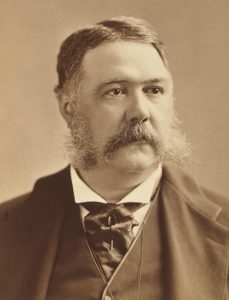
To understand the modern wars over the “deep state,” the relentless efforts by politicians to purge nonpartisan civil servants in favor of loyalists, and the sheer terror of an unqualified political operative suddenly inheriting the immense powers of the executive branch, we must examine the presidency of Chester A. Arthur. For much of his life, Arthur embodied the darkest, most corrupt elements of American politics. Yet, his unexpected ascent to the presidency following a tragic assassination resulted in one of the most astonishing political transformations in United States history. Arthur’s life proves that the American system is deeply vulnerable to the corrupting influence of patronage, but it also offers a profound testament to the capacity of an individual to rise above his own cynical past to protect the republic.
The Gentleman Boss and the Spoils System Before he became the twenty-first president, Chester A. Arthur had never held a single elective office. In his home state of New York, he was known as the “Gentleman Boss”—a moniker that captured both his refined tastes and his ruthless political occupation. While Arthur was highly educated and possessed impeccable manners, wearing tailored suits and socializing with the elite, his true profession was that of a premiere political henchman,.
Arthur was the chief lieutenant to the arrogant, autocratic Senator Roscoe Conkling, the leader of the “Stalwart” faction of the Republican Party,. Following the Civil War, Arthur abandoned the idealistic principles of his youth and embraced politics purely as a partisan game,. He became a master of the “spoils system,” a corrupt framework where government jobs were handed out exclusively as rewards for political loyalty and campaign contributions, rather than for merit or ability,.
His loyalty to Conkling was rewarded with the most lucrative patronage post in the country: Collector of the Port of New York. From this position, Arthur controlled 1,500 political employees, oversaw the collection of millions of dollars in tariffs, and earned a staggering salary of over $20,000 a year. He ruthlessly extracted campaign contributions from federal workers to fuel the Republican machine,. When President Rutherford B. Hayes attempted to clean up the corruption, he fired Arthur in 1878, giving Arthur a national black eye but cementing his status as a martyr among the Stalwart machine politicians.
The Crisis of Succession: “Chet Arthur President! Good God!” When the Republican party nominated James A. Garfield for president in 1880, they added Arthur to the ticket as vice president solely to appease Conkling and the powerful New York machine. But tragedy struck just months into Garfield’s term. On July 2, 1881, a delusional, marginalized job-seeker named Charles J. Guiteau shot President Garfield in the back at a Washington train station,. As Guiteau was arrested, he famously shouted, “I did it and will go to jail for it. I am a Stalwart and Arthur will be president”,.
The nation was plunged into an existential crisis. As Garfield lingered in agonizing pain for eighty days before dying, the American public was consumed by horror and rage,. The idea that Chester A. Arthur—a fired, disgraced political hack—would inherit the White House was viewed as a pending calamity. Former President Hayes confided in his diary that Garfield’s death would be a “national calamity,” writing, “Arthur for President! Conkling the power behind the throne, superior to the throne!”. When the news reached Europe, one diplomat recalled the universal reaction was “stupefaction… ‘Chet’ Arthur President of the United States! Good God!”,. Arthur received death threats and was terrified by the widespread suspicion that he and Conkling had orchestrated the assassination to seize power.
The Voice of the People and the Break with the Machine During this agonizing summer, Arthur retreated to his New York brownstone, deeply shaken,. It was here that he received a remarkable series of letters from a mysterious, invalid woman named Julia Sand,. Acting as the conscience of the nation, Sand bluntly told Arthur what the public thought of him, but she also offered him a path to redemption. “The hours of Garfield’s life are numbered,” she wrote. “The people are bowed in grief; but—do you realize it?—not so much because he is dying, as because you are his successor”,.
Yet Sand urged him to rise to the emergency. “You are free—free to be as able & as honorable as any man who ever filled the presidential chair,” she pleaded. “It is for you to choose whether your record shall be written in black or in gold”,.
When Arthur took the oath of office in September 1881, he shocked the nation—and utterly betrayed his corrupt friends—by choosing gold,. Roscoe Conkling immediately demanded that President Arthur fire the men Garfield had appointed and hand control of the New York Custom House back to the Stalwart machine. In a moment of supreme executive courage, Arthur refused. Recognizing that he was no longer a factional operative but the leader of the entire country, he severed ties with the mentor who had built his career. “For the vice presidency I was indebted to Mr. Conkling,” Arthur explained, “but for the presidency of the United States, my debt is to the Almighty”,.
The Birth of the Meritocracy Arthur’s redemption culminated in the destruction of the very system that had created him. In his 1882 Annual Message to Congress, the former “Gentleman Boss” called for the outright abolition of political assessments and urged the passage of sweeping civil service reform.
On January 16, 1883, President Arthur signed the Pendleton Civil Service Act into law,. This landmark legislation fundamentally altered the American government, requiring that federal jobs be awarded on the basis of competitive, merit-based examinations rather than political loyalty,. By willingly stripping the executive branch of its vast patronage powers, Arthur birthed the modern, nonpartisan civil service. When modern political leaders attack the “deep state” and attempt to replace career bureaucrats with ideological loyalists, they are attempting to drag the republic back to the corrupt, spoils-driven era that Arthur ultimately helped destroy.
Conclusion Chester A. Arthur’s presidency was brief, and his restraint was partially driven by a tragic secret: shortly after taking office, he was diagnosed with Bright’s disease, a fatal kidney ailment. Knowing he was dying, he hid his severe illness from the public to avoid causing another national panic, and he did not aggressively fight for his party’s nomination in 1884,. He left office in 1885 and died the following year,.
Arthur entered the White House as a universally distrusted political operative and left it as a respected statesman,. His legacy is a profound historical warning about the toxic, lethal consequences of extreme partisan factionalism and the spoils system. But it is also a testament to the transformative weight of the presidency. Chester A. Arthur proves that even a leader steeped in the darkest cynicism of machine politics can, when tested by the ultimate responsibility, choose to elevate the stability of the republic above the demands of his political tribe,.