

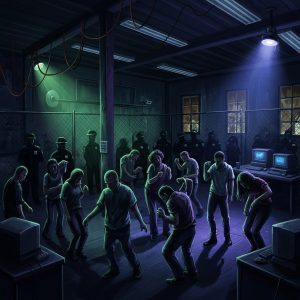
 The passage of the Illicit Drug Anti-Proliferation Act in 2003, specifically targeting producers of raves, stands as a telling chapter in the United States’ long-running “War on Drugs.” While seemingly focused on a niche aspect of drug enforcement, this act, born in the immediate aftermath of the September 11, 2001 attacks, reveals much about the shifting landscape of national security, the expansion of state power, and the persistent use of moral panic to shape public policy. It’s a truth that complex events like 9/11 don’t just trigger direct responses; they create an environment where existing agendas, like the “War on Drugs,” can be significantly amplified and re-prioritized.
The Illicit Drug Anti-Proliferation Act of 2003 directly amended the Controlled Substances Act (CSA), a comprehensive piece of legislation that had, since 1970, governed federal drug policy by classifying drugs into schedules and setting regulatory frameworks. The 2003 Act aimed squarely at those “who knowingly maintain” drug-involved premises, shifting emphasis from merely making or distributing drugs to penalizing the venues where illicit drug use, particularly of synthetic substances like MDMA (ecstasy or molly), was prevalent. MDMA itself had a curious trajectory, gaining initial popularity in the early 1980s before resurfacing in the 1990s within the nightclub and rave scenes, and later, more recently, as “molly”. Senator Joseph Biden, then a senator, articulated the bill’s intent as a means to help prosecute “rogue promoters” who not only knew about drug use at their events but specifically held events for the purpose of illegal drug use or distribution. This legislative move also leveraged the Drug Enforcement Administration’s (DEA) existing authority for temporary scheduling of synthetic drugs, a tool that had been less utilized before 2002 but saw increased application afterwards. Notably, federal prosecutions for drug offenses peaked around FY2002, just as this act was being considered and passed, illustrating a high-water mark in federal enforcement efforts.
To truly grasp the significance of this act, it’s vital to place it within the broader, often contentious, history of the “War on Drugs.” This “war” has consistently been characterized by “massive budgetary expenditure” and a “fiercely punitive treatment of illegal drug users and sellers”. A crucial, and often overlooked, aspect of this campaign is how it has “served powerful economic and political interests” while “disproportionately punished marginalized suppliers, as well as their disadvantaged customers”. The sources reveal a consistent pattern, particularly after the 1970s, where those targeted domestically by drug warriors were “disproportionately African American and Hispanic”.
A key mechanism in prosecuting this “war” has been the cultivation of “moral panics,” which often involve portraying the “source of danger as being external to the group (such as criminals or terrorists)”. This tactic, as exemplified by figures like Harry Anslinger, who led a “massive public relations campaign to demonize illegal drug use” and pushed “anti-marijuana propaganda” in the 1930s, uses fear to generate public support for increasingly draconian measures. The concept of “super-predators” in the 1990s, for instance, which was “inexorably linked to Black children,” illustrates how “demagogic language” can have a “nonrational effect” on the debate, leading to swift, harsh legislation. The “War on Drugs” itself has been explicitly labeled as a “clear signal that liberal democratic norms will be violated to deal with an emergency situation,” allowing politicians to “appeal to the vocabulary of emergency” to “bypass democratic deliberation”. This framing of drug use as an “emergency” allowed for an expansion of state power, leading to policies such as “no-knock warrants” and asset forfeiture laws, which significantly increased law enforcement’s reach and financial incentives.
Furthermore, the “War on Drugs” has often been described as a “war on research”. The “psychedelic wars” are a prime example, where hallucinogenics struggled to fit within the “market-based parameters of the pharmaceutical marketplace,” facing opposition from authorities who deemed them “irredeemable, dangerous drugs”. This politicization of substances, where “science and medical expertise” were “traduced” by “drug warriors” encouraging “moral panics,” is a recurring theme. The sources highlight how “white, middle-class activist parent-citizens groups” successfully fought against cannabis legalization, despite “expert-based evidence on the relatively low risks of cannabis use,” inadvertently leading to the arrests of millions, “disproportionately non-white and non–middle class” individuals. The very notion of a “War on Drugs” has been equated to a “War on Culture”—a direct assault on “countercultural youth”. This targeting of specific subcultures, like raves, aligns with broader “culture wars” seen in attacks on academic freedom or LGBTQ+ identities.
The timing of the Illicit Drug Anti-Proliferation Act, passed in 2003, also cannot be separated from the national mood and policy shifts following the September 11th attacks. While not a direct anti-terrorism measure in the same vein as those targeting al-Qaeda, the post-9/11 era created an environment where an “unconstrained chief executive” could “do whatever he liked to define and respond to the crisis,” with “institutional constraints appear[ing] to vanish”. The intense focus on national security and vulnerability post-9/11 amplified the perceived need for control and surveillance. This contributed to what some describe as “security theater,” where measures might be implemented to manage public anxiety rather than address fundamental issues. The act can be seen as an extension of this heightened security mindset, allowing the government to exert greater control over public gatherings and perceived “disorderly” spaces.
In essence, the 2003 Illicit Drug Anti-Proliferation Act is more than just a specific piece of legislation. It is a microcosm of the larger “War on Drugs,” demonstrating its reliance on moral panics, its disproportionate impact on certain communities and subcultures, and its tendency to frame social issues within a “language of emergency” to justify expanded state authority. It underscores the enduring truth that policies, even those seemingly narrow in scope, are deeply interwoven with broader historical contexts, political interests, and societal narratives.