

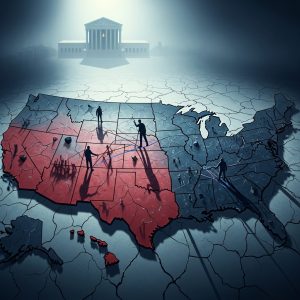
The enduring stability of any republic rests on the citizen’s fundamental belief that their vote is counted fairly, and that the outcomes of elections are determined by the will of the majority. When electoral rules are openly manipulated for partisan gain, that belief corrodes, paving the way for political warfare and institutional decay. The actions surrounding partisan redistricting in 2025, particularly those involving the Trump administration and the judiciary, represent a critical inflection point, formalizing the ascent of minority rule and accelerating the process of democratic backsliding into what scholars term “competitive authoritarianism”.
This year, the practice of redrawing electoral maps, historically an inherently political exercise, was deployed not merely to gain advantage but as an explicit tool of executive power designed to permanently cement partisan control, pushing the boundaries of institutional legitimacy further than ever before.
The Historical Context: The Erosion of Judicial Guardrails
For decades, federal courts served as the primary, albeit often reluctant, referee in conflicts over electoral fairness, stemming from the principle of “one person, one vote” established in the 1960s. However, a major rupture occurred in 2019 when the Supreme Court ruled in Rucho v. Common Cause that complaints regarding extreme partisan gerrymandering constituted nonjusticiable political questions, effectively removing federal judicial oversight from this arena.
This judicial abdication created a permissive environment. As critics rightly pointed out, by declaring partisan manipulation beyond the reach of the law, the Court insulated politicians who now faced few restraints against drawing maps to choose their voters rather than the other way around. This context paved the way for the calculated political aggression observed in the current administration.
The Trump Administration’s Use of State Power
In 2025, the Trump administration took unprecedented steps to weaponize the redistricting process, focusing intensely on states like Texas to manufacture necessary congressional majorities for the Republican Party ahead of the 2026 midterm elections. The imperative was clear: protect a razor-thin House majority deemed vulnerable to scrutiny and democratic challenges.
This effort involved a deeply disturbing blend of partisan coercion and strategic legal subterfuge:
- The Mid-Cycle Attack: The administration successfully pressured state officials in Texas to undertake a highly abnormal mid-decade redistricting. This maneuver was fundamentally political, aimed at securing five additional Republican congressional seats.
- Manufacturing Pretext via the DOJ: Recognizing that explicitly partisan gerrymandering was legally insulated by Rucho, the administration generated a racial pretext to justify its actions. The Department of Justice, under the administration’s direction, sent a letter to Texas officials threatening a lawsuit if the state did not redraw its maps to address existing “unconstitutional race-based congressional districts” (i.e., racial gerrymanders). This tactic was perverse, creating a legal obligation to pursue a partisan goal under the guise of correcting a racial injustice, essentially using the federal civil rights apparatus as a political bludgeon.
- The Mechanism of Disenfranchisement: The resulting map was designed to lock in Republican advantage through classic “packing and cracking,” deliberately diluting the voting power of Black and Hispanic constituents by either forcing them into a few super-majority Democratic districts or scattering them among predominantly white, rural districts.
- Institutional Hardball in the Legislature: When opposition Democratic lawmakers fled the state to deny the legislative quorum necessary to pass the new map, Governor Greg Abbott reacted with extraordinary hostility, seeking civil arrest warrants and attempting to expel the absent legislators, accusing them of abandoning their offices and even violating bribery laws simply for raising funds to pay fines. This approach mirrors historical instances of executive attempts to neutralize legislative dissent by denying political rivals their constitutional rights, transforming legislative protest into a potentially criminal matter.
The Supreme Court’s Unprecedented Intervention
The most alarming development of 2025 came when the judiciary, seemingly intent on facilitating the executive’s partisan strategy, intervened swiftly and decisively. When a federal district court judge initially struck down the new Texas map, calling it an impermissible racial gerrymander, the state immediately appealed to the Supreme Court.
The Supreme Court, in a move that exemplified the weaponization of the federal judiciary, granted the request on its “shadow docket,” issuing a short, unsigned order overturning the lower court’s finding. The dissenting justices noted that the majority overturned the lower court’s comprehensive, 160-page factual findings based only on a perusal of the “cold paper record over a holiday weekend”.
This action was significant not only because it allowed the unconstitutional map to govern forthcoming elections, securing the partisan advantage sought by the administration, but because the timing and legal basis reinforced the perception of the court’s deep ideological alignment:
- The intervention validated the Republican narrative that any challenge to their election procedures, even when rooted in racial discrimination, is merely a partisan plot orchestrated by groups like those led by George Soros and Gavin Newsom, thereby delegitimizing core democratic opposition.
- The abrupt, non-merits-based decision demonstrated the willingness of the conservative majority—many of whom were installed by presidents who lost the popular vote—to act as an “obstacle to democracy”.
- It reinforced the idea that conservative judicial activism would prioritize the aggrieved feelings and political objectives of the Republican base over established legal precedent, transforming statutory interpretation into a perpetual Republican primary.
Historical Implications: Institutionalizing Minority Rule
The gerrymandering conflict of 2025 dramatically illustrates how the American political system, with its inherent structural biases (such as the Electoral College, and disproportionate Senate representation), is being deliberately refashioned to ensure permanent minority rule. The actions taken this year mark a culmination of historical trends, where the systematic dismantling of democratic guardrails—including the weakening of the Voting Rights Act and the refusal of the Supreme Court to police partisan excess—has provided a clear and effective route for one party to seize and maintain power without requiring the consent of the national majority.
The episode proves that the warning delivered by Justice Kagan that partisan gerrymandering “imperil[s] our system of government” has fully materialized, and it is evident that the administration views the legal system, from the DOJ down to the courts, not as impartial institutions but as tactical assets in a war against its political enemies, constituting a profound betrayal of the oath to the Constitution. The resulting political chaos and loss of faith in the integrity of the electoral processes pose an enduring threat, establishing a dark precedent for future administrations seeking to circumvent the democratic will.