

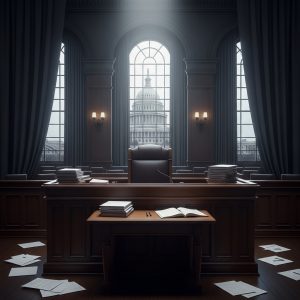
Indeed, the year 2009, marking Barack Obama’s first year in office, presented a stark illustration of the deepening political divisions in the United States, particularly concerning the federal judiciary. The number of judicial vacancies nearly doubled during this period, escalating from 53 to a concerning 100. This was a direct consequence of a deliberate and intensified strategy of obstructionism that significantly curtailed President Obama’s ability to fill critical positions on the federal bench.
To fully understand this dynamic, we must consider the political climate that coalesced around Obama’s election. The desire for a new direction was strong, given the profound uncertainty of 2008 and the widespread sentiment that the “Reagan Era” had “run its course”. However, this yearning for change was met with fierce partisan opposition. Immediately following Obama’s election, a group of young House Republicans, styling themselves as the “Young Guns,” decided to brand the GOP as the “Party of No”. This sentiment was powerfully echoed by Senate Minority Leader Mitch McConnell, who openly declared his “single most important thing” objective in the Senate was “for President Obama to be a one-term president”.
This commitment to obstructionism manifested most clearly in the unprecedented use of the filibuster to block Obama’s judicial and executive branch nominees. While Democrats had themselves increased the use of the filibuster against George W. Bush’s judicial nominees starting in 2003—a move that had “pissed” off Republicans and led them to lament a “crisis of unfilled judgeships”—the Republican approach under Obama was notably aggressive. When Obama took office and Democrats regained control of the Senate, Republicans “changed their tune” and liberally employed the filibuster. Senate rules at the time mandated a 60-vote threshold to overcome a filibuster, effectively granting the minority party immense power to block nominations.
The result of this strategic obstruction was immediate and substantial: more than one in ten seats on the federal bench was empty. This problem was not a fleeting issue but “continued throughout Obama’s first term”. It underscores how judicial nominations had become, in essence, “a wholly political exercise,” moving far beyond the more apolitical approval process that had historically characterized such appointments. For instance, Chief Justice John Roberts, a nominee of President Bush, had been confirmed to the Court of Appeals in D.C. unanimously in 2003 and later secured 78 votes for his Supreme Court nomination in 2005, with the American Bar Association (ABA) rating him “well qualified” both times. This bipartisan support starkly contrasts with the challenges faced by Obama’s nominees.
This environment also highlights the increasing influence of organizations like the Federalist Society, which, since its founding in 1982, had dedicated itself to reshaping the federal and state judiciaries to align with conservative, free-market values. They became “spectacularly effective” in “shaping the ideologies of conservative law students,” providing networking opportunities, and funneling them into prestigious clerkships that could lead to judicial nominations. This well-established pipeline ensured a steady stream of ideologically vetted candidates, further solidifying the partisan nature of judicial appointments.
In effect, the doubling of judicial vacancies in 2009 was not a mere administrative oversight or a lack of qualified candidates; it was a deliberate tactic within a broader strategy of political polarization and obstruction. It significantly constrained Obama’s ability to implement his agenda, particularly given the immediate and formidable challenge of the global financial crisis he inherited. The willingness to leave federal judicial seats empty signaled a profound shift in political norms, illustrating that for the opposing party, preventing the president from governing, even in the face of national crises, outweighed the traditional imperative of ensuring the smooth functioning of government institutions. This set a precedent for future political battles over judicial appointments, transforming the judiciary into a central battleground in the ongoing partisan conflict.