

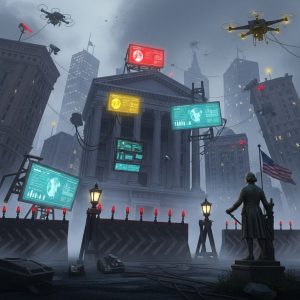
Greetings. As a historian deeply engaged in tracing the echoes of the past in our present, I find myself compelled to analyze the landscape of American democracy in 2025, particularly in light of Donald Trump’s second presidency and the recent Supreme Court ruling granting him immunity for certain actions. It is a critical moment that begs the question: What would the Founding Fathers, those architects of our constitutional republic, make of such developments?
The Founding Fathers, profoundly shaped by their study of ancient democracies and republics, envisioned a system meticulously designed to thwart the very real specter of tyranny. They understood that unchecked power, whether wielded by a single individual or a concentrated group, could dismantle the delicate balance of liberty and law. Their solution was a government of limited powers, carefully divided among legislative, executive, and judicial branches, each serving as a check on the others. The power to make laws, including taxation and tariffs, was explicitly vested in Congress, with the President’s role confined to recommending laws and exercising veto power. Moreover, they understood the importance of protecting individual liberties, notably free speech, though their understanding allowed for post-facto punishment, rendering the First Amendment less of an impenetrable shield than it might appear at first glance. They knew that democracy required a robust exchange of ideas and institutions that could resist arbitrary power. The very structure of federal offices and appointments was designed to prevent the King George III-like abuse of inventing positions and filling them with loyal cronies, a grievance explicitly articulated in the Declaration of Independence.
Now, let us turn our gaze to 2025, a year marked by significant assertions of executive authority. Upon his second inauguration on January 20, 2025, President Trump immediately embarked on a path of aggressive executive action, signing a record number of orders in his first 100 days. His administration has focused on tightening immigration controls, including declaring a national emergency at the southern border, deploying armed forces, and designating drug cartels as foreign terrorist organizations. He revoked previous guidance that prohibited migrant arrests in sensitive locations like courthouses, schools, and churches. Furthermore, he invoked the Alien Enemies Act of 1798 to deport suspected gang members, carrying out these deportations even after a federal judge temporarily blocked the order, raising serious due process concerns.
Economically, President Trump has continued his preference for tariffs, imposing duties on goods from China, Canada, Mexico, and globally, framing these as necessary responses to drug trafficking and trade imbalances. However, courts have repeatedly ruled that the power to levy tariffs rests with Congress, not the President, signaling a fundamental challenge to the separation of powers. This administration has consistently pushed the limits of presidential power, challenging congressional laws and constitutional restraints. We have seen a pattern of appointing individuals to judicial positions whom the American Bar Association (ABA) rated as “not qualified,” suggesting a prioritization of loyalty over merit. The administration has also engaged in the purging and firing of independent inspectors general and federal workers, aligning with the Project 2025 agenda’s goal to drastically reduce the federal workforce and dismantle civil service protections.
A deeply troubling aspect has been the direct targeting of democratic institutions. Universities have faced attacks for perceived “anti-American” or “pro-Hamas” ideologies, with attempts to revoke their certification for international students and freeze research funding, and investigations into hiring practices. President Trump has publicly criticized news organizations, labeling them “criminals,” “sick,” and “fake news,” suggesting they should be investigated for election fraud. This mirrors warnings that leaders would attack the press and question judges’ legitimacy.
Most significantly, the Supreme Court’s recent ruling granting President Trump immunity for his illegal actions stands as a profound moment in American constitutional history. The decision in Trump v. United States (2024) held that the former President was “absolutely immune” from prosecution for actions falling under “core presidential powers,” including “investigative and prosecutorial functions”. This means, for instance, that his efforts to pressure the Department of Justice into launching baseless investigations could not be part of a case against him. The three dissenting Democratic appointees to the Court voiced grave fears for democracy, warning that this ruling could effectively grant a president immunity for ordering assassinations of political rivals, organizing military coups, or even taking bribes in exchange for pardons. This decision, along with others that have slow-walked his immunity appeals, has ensured that no trial on election interference charges could take place before the 2024 presidential election. This pattern reflects the unitary executive theory, which posits that the president should have comprehensive control over the executive branch. The Roberts Court’s increasing use of the “shadow docket”—making significant rulings without full briefing or oral argument—further contributes to a perception of a judiciary willing to overturn long-standing precedent and, as some argue, effectively pick a side.
From the perspective of the Founding Fathers, this Supreme Court ruling and the actions it potentially emboldens would undoubtedly be a source of profound alarm. Their deepest fear was the usurpation of power by a single individual, what they called “tyranny”. The idea of a president being “absolutely immune” for actions deemed “official” echoes precisely the kind of unchecked monarchical power they fought a revolution to escape. Alexander Hamilton’s initial proposal for a president serving for life was swiftly rejected precisely to avoid creating an “elective monarchy”. The 22nd Amendment was later passed specifically to prevent a president from serving more than two terms, a direct response to concerns about concentrated power. This immunity ruling, in effect, could create a “king” for a four or eight-year term, operating above the law for a significant sphere of actions, something anathema to the Founders’ design.
Trump’s repeated attacks on the judiciary, including calls for investigations and even impeachment of judges who rule against him, directly undermines the independent judicial branch envisioned as a crucial check on executive power. The Founders established an independent judiciary to interpret statutes and ensure the rule of law, not to be subservient to the executive’s whims. Similarly, the persistent denigration of the press as “enemies of the American people” and “fake news” conflicts with the spirit of the First Amendment, which, despite its early limitations, was intended to foster a robust public discourse essential for an informed citizenry.
Furthermore, the deployment of military and National Guard troops against American civilians during protests in Los Angeles, labeling these demonstrations as “rebellion” and “insurrection,” represents a grave departure from civil governance. While the Insurrection Act exists, its rare invocation underscores the deeply troubling nature of using military force against one’s own populace. The Founders, who were themselves leaders of a rebellion, would have recognized the dangers of a state defining dissent as insurrection to justify overwhelming force, eroding the right to peaceful assembly and protest.
The Founders’ concern for the separation of powers and the accountability of public officials is glaringly challenged by the current administration’s apparent embrace of financial conflicts of interest and profiting from the presidency. The concept of “emoluments,” explicitly addressed in the Constitution, was meant to prevent precisely the kind of private enrichment from public office that has been alleged. While legal definitions have been narrowed over time, the spirit of accountability would surely weigh heavily on the Founders’ minds.
In essence, the Founding Fathers would likely view the current situation with deep apprehension, recognizing many of the “steps” towards authoritarianism that they diligently sought to prevent. The “thin tissue of convention” that constitutional scholars identify as guarding American democracy is indeed being stretched, and in some areas, torn. While the Constitution was designed to be resilient and adapt, the degree to which its “soft guardrails” of norms and conventions are being eroded presents a profound challenge to the very foundation of the republic they so painstakingly constructed. They understood that a functioning democracy requires not only legal structures but also civic virtues, including a commitment to truth, respect for institutions, and the understanding that power must always be checked.