

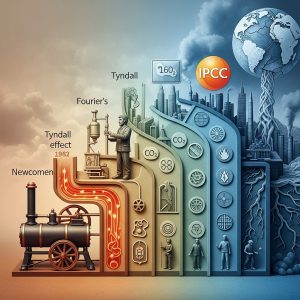
The truth, unvarnished and unyielding, is a historian’s sacred charge. As I previously elucidated, how “gender” has been manipulated into a phantasm by authoritarian regimes to collect and displace anxieties is a calculated maneuver, a distortion of reality to consolidate power. This same insidious pattern, a deliberate inversion of truth to serve specific ends, is glaringly evident in the historical trajectory of climate change: from its nascent scientific understanding to the urgent calls for action, and finally, to the orchestrated campaign of denial that aims to obscure an undeniable threat and leave millions vulnerable.
The story of climate change is not a new one, nor is the contestation surrounding it. Its roots stretch back centuries, long before it became a flashpoint in contemporary political discourse.
The Unfolding Truth: A History of Climate Science
The very bedrock of our understanding of climate change traces back to foundational scientific discoveries. In 1712, Thomas Newcomen’s steam engine heralded the Industrial Revolution, paving the way for industrial-scale coal use, initiating a new chapter in humanity’s impact on its environment. By 1824, Joseph Fourier proposed that Earth would be far colder without an atmosphere, laying the conceptual groundwork for the greenhouse effect. This was further solidified in 1859 when John Tyndall demonstrated that certain gases block infrared radiation, noting that changes in their concentration could alter climate. The late 19th century brought the first calculation of global warming from human CO2 emissions by Svante Arrhenius in 1896, alongside Chamberlin’s model for global carbon exchange.
The 20th century witnessed a rapid acceleration of both human impact and scientific insight. The “second Industrial Revolution” (1870-1910) intensified growth, followed by the opening of vast oil fields in the 1920s, ushering in an era of cheap energy. By the 1930s, a global warming trend since the late 19th century was already being reported. Wallace Broecker introduced the term “global warming” into the public domain in 1975.
A critical turning point for scientific consensus arrived in the latter half of the 20th century, largely spurred by concerns that transcended pure academic curiosity. Cold War concerns, for instance, supported the 1957-58 International Geophysical Year, bringing new funding and coordination to climate studies. In 1965, a US President’s Advisory Committee panel issued a stark warning that the greenhouse effect was a matter of “real concern”. By 1977, scientific opinion began to “converge on global warming, not cooling, as the chief climate risk in the next century”.
The 1980s solidified this understanding with key international and institutional developments. The Montreal Protocol in 1987, though primarily aimed at ozone depletion, significantly impacted greenhouse gas emissions. Most crucially, the Intergovernmental Panel on Climate Change (IPCC) was formed in 1988 to collate and assess climate change evidence. Their 1995 Second Assessment Report definitively concluded “a discernible human influence” on Earth’s climate, a statement often hailed as the first definitive acknowledgment of human responsibility. Subsequent IPCC reports have only strengthened this conclusion, with the Fourth Assessment in 2007 stating it was “more than 90% likely that humanity’s emissions of greenhouse gases are responsible for modern-day climate change”, and the Sixth IPCC report in 2021 warning that “catastrophic outcomes cannot be ruled out”.
The fundamental facts, now “clear and essentially beyond dispute”, remain: carbon dioxide (CO2) is a heat-trapping gas, and human activity, primarily the burning of fossil fuels, is significantly increasing its atmospheric concentration. This increase leads to warming, amplified by “positive-feedback loops” such as increased water vapor and melting ice. We have already surpassed 400 parts per million (ppm) of CO2, a level higher than in millions of years, and mean global temperatures are at their highest in tens of thousands of years.
Striving for Change: The History of Climate Action
As scientific understanding deepened, so too did calls for action, manifesting across international, governmental, and grassroots levels.
International cooperation began to take shape, laying the groundwork for global climate governance. The UN Framework Convention on Climate Change (UNFCCC) was established in 1992, providing a foundation for future agreements. The Kyoto Protocol, agreed upon in 1997, saw developed nations pledge to reduce emissions, although the US Senate immediately declared it would not ratify the treaty. Despite this, the Kyoto Protocol became international law for many countries in 2005. A significant leap occurred with the Paris Agreement in 2015, where nearly all nations pledged to set their own targets for greenhouse gas cuts and report progress, setting a framework to keep warming “lower than the dangerous 3.6°F (2°C) limit”.
Domestically in the United States, action, though often contested, has been visible. The early environmental movement of the 1970s, spurred by events like the Cuyahoga River catching fire, led to the passage of the Clean Air Act and Clean Water Act. Republican administrations, including Nixon, Reagan, and George H.W. Bush, supported regulatory environmental solutions. More recently, executive actions have been crucial. President Obama made “skillful use of the executive branch” to facilitate progress, and President Biden signed legislation investing “$1.2 trillion into the buildout of renewable energy”. States have also taken the lead, with California, Oregon, Washington, and others joining regional initiatives to price carbon emissions.
Grassroots movements and public awareness campaigns have played a vital role in galvanizing support. The first Earth Day in 1970 brought widespread concern about global degradation. Organizations like the Environmental Defense Fund and Natural Resource Defense Council formed in the late 1960s, becoming influential advocates. Al Gore’s 2006 documentary An Inconvenient Truth “reenergized the climate change debate” in the US, winning an Academy Award and further elevating the issue. Massive public demonstrations, like the People’s Climate March in 2014, have demanded action from policymakers. Divestment campaigns, championed by activists like Bill McKibben, target the fossil fuel industry, sending a powerful symbolic message. Public attitudes have shifted “dramatically over the past decade”, with a majority of Americans “alarmed or concerned” and supporting various government policies. Among liberal Democrats, climate change has become a top issue, driving candidates to prioritize it.
The Deliberate Obfuscation: A History of Climate Change Denial
However, the path to climate action has been severely obstructed by a well-funded, orchestrated campaign of denial that, like the manufactured panic around “gender,” actively seeks to “mislead large sections of the American public into thinking that the evidence for human-caused warming [is] uncertain, unsound, politically tainted and unfit to serve as the basis for any kind of political action”. This “war on science” is a strategic effort by “powerful vested interests” to avoid regulation and maintain profitable but environmentally destructive practices.
The playbook for climate denial was honed by the tobacco industry in the 1950s and 60s, a strategy explicitly aimed at manufacturing doubt where scientific consensus existed. Key figures in this network, such as S. Fred Singer and Frederick Seitz, were Cold War physicists who transitioned from defending tobacco to attacking environmental science, including ozone depletion and acid rain. These “all-purpose deniers-for-hire” often founded or were affiliated with “Potemkin village” think tanks—a facade of entities “funded by conservative foundations and industry special interests” like the Competitive Enterprise Institute (CEI) and the Heartland Institute, explicitly tasked with attacking inconvenient science.
The strategies of climate change denial are varied but consistently designed to confuse and delay:
- Outright Rejection: Initially, deniers asserted “It’s Not Happening!”, denying the increase in atmospheric CO2 or claiming a “pause” in warming. This involved cherry-picking data and promoting flawed analyses.
- “It’s Natural!”: As warming became undeniable, the narrative shifted to “Yes, it’s happening . . . but it’s natural!”. This involved pointing to past warm periods like the Medieval Warm Period, inaccurately claiming they were warmer than today, and attacking the “hockey stick” graph which refuted this argument.
- Minimization and Benefits: A further retreat claims the effects “won’t be bad. In fact, they may even be good”. This involves falsely asserting polar bears are thriving or that melting ice sheets will create “lush new continent[s] ripe for human colonization”.
- “Too Expensive to Act!”: A pervasive argument is that climate action “will cost too much”, an assertion contradicted by economists who conclude the “cost of climate change damages are already greater than the cost of reducing emissions”.
- Technological Saviorism: Another form of denial promotes “cheap technofixes” or “geoengineering” schemes, like placing giant mirrors in space, diverting attention from the need for emission reductions.
- Attacks on Science and Scientists: This is perhaps the most insidious tactic. Scientists are subjected to “personal attacks and smear campaigns”, accused of “scientific cleansing”, or targeted with “manufactured scandals” like “Climategate”. This is designed to “erode” public trust in science and create an “aura of uncertainty”. Politicians famously declare, “I am not a scientist,” implicitly refusing to defer to scientific consensus.
- “Never the Right Time”: Critics often employ “Sandy silencing”, arguing that discussing climate links after extreme weather events is “exploiting a tragedy”.
- The “Bizarro World”: Right-wing media outlets, notably Rupert Murdoch’s Fox News and The Wall Street Journal, serve as powerful “mouthpieces for this agenda”, creating a “bubble of misinformation” where “up is down, left is right, and black is white”. They exploit journalistic norms of “false ‘balance'” to create the “perception that there is legitimate doubt”.
Prominent political figures consistently perpetuate this denial. Senator James Inhofe famously called climate change the “greatest hoax ever perpetrated on the American people” and brought a snowball onto the Senate floor as “proof”. Florida Governor Rick Scott banned the terms “climate change” and “global warming” from official state communications. The Koch brothers, inheritors of a vast oil-refining fortune and a staunch anti-Communist ideology, have funneled “more than $100 million since 1997 to groups denying climate change”. Their influence on Republican politics has been profound, as “most of the residents in the ‘Potemkin village’ of climate change denial have received or currently receive Koch funding”. This concerted effort is reflected in Project 2025, which advocates for “rolling back pollution standards across the board” and eliminating “the entire federal government from taking climate change into account when crafting US policy”.
Consequences and Driving Motivations
The consequences of this manufactured denial are dire, ranging from environmental devastation to the erosion of democratic discourse. The most terrifying outcome is the “possibly permanent damage we are doing to Earth, to ourselves, and to every ecosystem”. Climate change, left unchecked, “could herald the sixth major extinction event in geological history” and lead to “continuous, unpredictable chaos”.
Economically, the cost of inaction is enormous, estimated at “about $1.2 trillion a year” globally, potentially rising to 3.2% of global GDP by 2030. Morgan Stanley predicted “$54 trillion in damages worldwide by 2040”. Beyond direct financial costs, climate change is a “threat multiplier” for national security, exacerbating existing tensions and conflicts by creating more competition for diminishing resources like food, water, and land, leading to “environmental refugeeism” and “global conflict”. The health consequences are equally alarming, with estimates of “700,000 additional deaths a year worldwide” by 2030 due to climate change.
The campaign of denial also attacks the very “bedrock practice of science” and “fact-based political discourse”. By promoting a “Bizarro world” of “alternative ‘facts'”, it short-circuits critical thinking, replacing genuine engagement with “slogans and nostalgia”. It prevents a clear understanding of reality, restricting “our range of actions”. This is how a critical issue, “the most important existential challenge humanity has ever faced”, becomes sidelined in national debates, overshadowed by other concerns despite overwhelming public support for action.
The driving motivations behind this denial are rooted in a powerful nexus of economic interest and political ideology. For the fossil fuel industry and their allies, the implications of climate science—the need to stop burning fossil fuels—are simply “inconvenient”. It is about “powerful interests whose salary has very much depended on the public not understanding climate science”. Corporate giants, seeking to maintain their profits and avoid regulation, actively fund a “disinformation campaign to justify an agenda of inaction”. This echoes a broader historical pattern where “laissez-faire appeals often served as strategies for elites to gain control over resources”.
Ideologically, this denial is deeply intertwined with a “dogma” that rejects government intervention and promotes a form of “market fundamentalism”. For many, “political conservatism is linked to skepticism about global warming”. Figures like Fred Koch, an “ultraconservative” and “Cold War hawk”, and his sons, the Koch brothers, embody this fusion of anti-government leanings and fossil fuel interests. This worldview views climate change as a “problem of costs and inefficiencies rather than what it is —an existential threat to the future of humanity”. It is a deliberate effort to defend a status quo that has “siphoned off much of the wealth of the country for itself” while “draining much of our democracy of its vitality”.
In essence, the denial of climate change, much like the phantasm of “gender” in authoritarian narratives, functions as a constructed reality. It is a potent ideological weapon, creating a “dangerous ‘them'”—whether environmentalists, scientists, or even basic facts—against whom a segment of society can be unified and incited. This manufacturing of “outrage”, this deliberate confusion of fact and fiction, serves to demonize struggles for equality (as the impacts of climate change disproportionately affect vulnerable populations), fuel aggressive nationalism (by rejecting global cooperation and embracing an “America First” isolationism), and ultimately leave millions vulnerable to the catastrophic consequences of unchecked destruction. The consistent, relentless attack on climate science is not merely a debate over facts; it is a battle for the very nature of reality, and thus, for who holds power in shaping our collective future.