

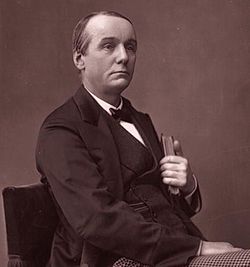
It is certainly a stark indictment that William Edward Baxter, a British Member of Parliament, delivered in 1855 regarding the state of governance in the United States, particularly focusing on New York. His observations offer a crucial snapshot of the pervasive corruption that marked American political life in the mid-19th century.
Baxter, having traveled widely across the United States, articulated a deeply pessimistic view of the prevalent corruption not only in Washington D.C. but also across state and local governments. When writing specifically about New York, he recounted that “offices and favours were there openly bought and sold; that aldermen and councilmen accepted these situations for the avowed purpose of getting quickly rich; and that jobs every week were there perpetrated with impunity which in [Great Britain] would bring disgrace to every person connected with them”. He even went so far as to assert his belief “that as great corruption exists in [New York] as was ever brought to light in the days of the Stuarts”. Such a comparison, particularly from a British perspective, highlights a profound perceived moral and political decay, harking back to a period in English history often associated with royal manipulation and systemic abuse of power.
Indeed, Baxter’s assessment was not an isolated one. The 1850s, as historical evidence overwhelming suggests, were characterized by widespread political corruption, with one historian describing them as “as depraved as any other age and, at least from the evidence available to historians, far more debauched than the 1840s”. Both foreign and domestic critics lamented this rampant venality. For instance, a local newspaper editor visiting Washington D.C. in 1858 was shocked by the open and routinized buying and selling of offices by party leaders in the U.S. Senate, the White House, and various government departments, where the price of an office was as publicly known as the price of dry goods. Similarly, Senator Robert Toombs of Georgia complained in 1858 that he did not believe “there is as corrupt a Government under the heavens as these United States”.
This pervasive corruption, as the sources clearly indicate, was frequently linked to significant government infrastructure projects, such as railroads and canals. Furthermore, land speculation and the burgeoning, professionalized political party machines also contributed significantly to the problem. This systemic corruption was not confined to New York; it was endemic across the U.S. government, including the federal level, and continued into the post-Civil War Reconstruction period, which some historians have even dubbed “The Era of Good Stealings”.
Baxter’s observations speak to what historians refer to as “systematic corruption”—a condition where governing elites wield valuable privileges to solidify their power, and where public offices and favors are openly bought and sold. This contrasts with “venal corruption,” which refers more to individual acts of bribery or embezzlement. The British, who had already seen American states like Maryland and Pennsylvania default on their debts in the 1840s, had a pre-existing view of the U.S. as a land of “cheats, rascals, and ingrates,” a sentiment reinforced by Baxter’s findings. George Peabody, a merchant banker who had helped Maryland resume payments through a “political slush fund” and even bribed Daniel Webster for pro-repayment speeches in the 1840s, had personally witnessed the depths of this perceived American untrustworthiness.
It is worth noting the stark contrast between Baxter’s grim assessment and the earlier attempts at reform, such as Indiana’s 1851 constitution. As we previously discussed, Indiana pioneered in forbidding special or local bills, mandating general laws in areas like corporate charters, to combat perceived legislative favoritism and corruption. This shows that the issue of corruption was very much on the minds of some American reformers, even as the scale of the problem was alarming to observers like Baxter.
While the picture painted by Baxter and his contemporaries in the 1850s is one of deep-seated corruption, it is important to understand that American history reveals a significant, albeit slow and incremental, shift away from such pervasive systemic corruption in the decades that followed. This transformation, spanning generations, ultimately led to the United States ranking among the least corrupt countries in the world, a testament to sustained efforts by both political elites and ordinary citizens. However, Baxter’s 1855 account stands as a powerful historical record of a time when the nation’s political integrity was openly questioned and found severely wanting.