
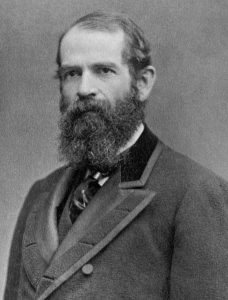
During the late nineteenth century, the rapid expansion of industrialization and the rise of massive corporate monopolies ushered in a period of systemic public and private corruption across the United States. In New York, the political and legal landscape became densely braided with corporate wealth, as buccaneering tycoons frequently utilized bribery, physical intimidation, and collusive rings to capture legislatures and the courts. No figure personified this predatory financial and political manipulation more clearly than the notorious Wall Street magnate Jay Gould. Gould, who amassed a colossal fortune through his sprawling transcontinental rail networks, routinely corrupted state institutions to secure his commercial empires. In the early 1880s, Gould’s efforts to consolidate his hold over the mass transit system of New York City culminated in a sensational, corrupt conspiracy involving high-ranking legal officers: State Supreme Court Justice T. R. Westbrook and State Attorney General Hamilton Ward. The subsequent attempts by a youthful, crusading Theodore Roosevelt to expose their collusion in the New York Assembly marked a watershed moment in the history of American anti-corruption reform.
The Infiltration of the Manhattan Elevated Railroad
The origins of the judicial scandal trace back to a highly orchestrated corporate raid executed by Jay Gould against the Manhattan Elevated Railroad. On December 27, 1881, The New York Times published a damaging exposé accusing Gould of executing a deliberate, covert campaign to artificially depress the railroad’s stock prices before purchasing the company. A close examination of the transaction revealed that the entire hostile takeover had been systematically guided and sanctioned by State Supreme Court Justice T. R. Westbrook and Attorney General Hamilton Ward.
About a year prior to the acquisition, Attorney General Ward had initiated a formal lawsuit against the Manhattan Elevated, declaring the corporation to be completely illegal and fraudulent. However, Ward suddenly executed a radical, highly suspicious about-face, reversing his original suit to merely accuse the railroad of simple insolvency. While Justice Westbrook publicly pretended to agree with the Attorney General’s initial fraud suit, he privately and decisively ruled in favor of the insolvency petition.
Operating on behalf of Gould, Westbrook held court in a series of eccentric and highly compromised locales, including Attorney General Ward’s private suite at the Delavan House in Albany, the financier’s own corporate offices, and “once even in a private bedroom”. In these irregular forums, Westbrook appointed receivers who were already directly on Jay Gould’s payroll. As a direct result of these collusive judicial maneuvers, the stock of the Manhattan Elevated plummeted by an astronomical 95 percent. Once the stock had bottomed out and Gould had successfully swallowed the company at a fraction of its true value, Justice Westbrook suddenly declared the railroad solvent again and officially transferred the entire enterprise to Gould’s control. The most damning evidence of this conspiracy was a confidential, unpublished letter that Westbrook had written directly to Gould, which contained the extraordinary admission: “I am willing to go to the very verge of judicial discretion to protect your vast interests.”
The Discovery of the Conspiracy
The details of this judicial betrayal might have remained buried in corporate vaults had it not been for a parallel corruption inquiry conducted in the spring of 1882. Late in March, New York Assemblyman Isaac Hunt, who was actively investigating the suspicious bankruptcy and insolvency of several New York insurance companies, uncovered evidence of flagrant judicial misconduct. Hunt discovered that court-appointed receivers were systematically milking these insolvent insurance firms of hundreds of thousands of dollars in unwarranted fees and expenses. In every single instance, the lucrative payment orders had been personally issued and approved by Justice Westbrook. Most alarmingly, Hunt discovered that Westbrook’s own son and cousin were employed by one of the highly compensated receivers, and had already pocketed at least $15,000.
Armed with these findings, Hunt approached his young legislative colleague, twenty-three-year-old Assemblyman Theodore Roosevelt, urging him to “pitch into this judge”. Though Roosevelt initially acted with caution, noting that attempting to impeach a Supreme Court Justice was an exceptionally grave matter, the name “Westbrook” triggered his retentive memory. He recalled the New York Times reports regarding the suspicious Manhattan Elevated transaction and immediately launched an independent investigation.
Roosevelt traveled to New York City, visited the city desk of the New York Times, and obtained permission to spend hours poring over the documents in the newspaper’s archives. Still unsatisfied, Roosevelt brought the editor and the files back to his home at 6 West Fifty-seventh Street, continuing his intense questioning until three o’clock in the morning. On March 28, 1882, fully convinced of the conspiracy, Roosevelt informed Hunt that he would introduce a resolution demanding a full investigation of both Justice Westbrook and former Attorney General Hamilton Ward.
The Assembly Resolution and the Stifled Investigation
On March 29, 1882, the piping voice of the young Albany reformer shocked the Assembly chamber as he introduced his formal resolution. The resolution stated:
“Whereas, charges have been made from time to time by the public press against the late Attorney-General, Hamilton Ward, and T. R. Westbrook, a Justice of the Supreme Court of this State, on account of their official conduct in relation to suits brought against the Manhattan Railway, and Whereas, these charges have, in the opinion of many persons, never been explained nor fairly refuted… therefore Resolved, That the Judiciary Committee be… empowered and directed to investigate their conduct… and report at the earliest day practicable to this Legislature.”
Following a fierce legislative battle, the resolution was approved, and the New York Assembly’s Judiciary Committee initiated its formal investigation into Westbrook and Ward. The committee’s probe dragged on throughout the spring, finally drawing to a close on May 30, 1882, just days before the end of the legislative session.
Initially, the investigation appeared to be a triumph for the reformers. Rumors began to swirl through the capital in the early hours of May 31 that the committee’s majority was prepared to officially submit a report recommending the immediate impeachment of Justice Westbrook. Roosevelt and Hunt conducted a straw poll of their colleagues at 3:00 A.M., confirming that the full Assembly was poised to accept the impeachment recommendation.
However, Gould’s “mysterious influences” were already working in the dark to protect the conspiracy. During the final nine hours preceding the official delivery of the report, a frantic campaign of last-minute bribery was unleashed. Three pivotal members of the Judiciary Committee were successfully bribed to withdraw their signatures from the majority impeachment report, receiving a sum of $2,500 each for their betrayal.
This sudden, corrupt intervention completely reversed the committee’s majority, transforming a majority for impeachment into a majority against. When the report was finally presented to the House, the committee chairman conceded that Justice Westbrook had occasionally been “indiscreet and unwise,” but ultimately whitewashed his crimes by declaring that the judge was merely guilty of “excessive zeal” in his efforts to save the Manhattan Elevated from destruction.
Legacy of the Westbrook Clash
Although the 1882 impeachment effort was thwarted by Gould’s financial power, the battle had a profound, lasting impact on American politics. The clash catapulted Theodore Roosevelt into the national spotlight, cementing his reputation as an unyielding enemy of corporate greed and judicial corruption. This early investigative experience directly informed his future leadership, prompting his appointment in 1884 as the chairman of a Special Committee to Investigate the Local Government of the City and County of New York.
The Five-Cent Fare Conflict
The scandal surrounding Gould’s Manhattan Elevated Railroad continued to dominate New York politics for years. In March 1883, the New York legislature, backed by overwhelming popular support and a coalition that included both Theodore Roosevelt and Tammany Hall’s Thomas Grady, passed “the Five-Cent Bill” to legally force Gould to reduce the elevated railway fare from ten cents to five cents. During the debates, Roosevelt openly condemned Gould and his associates as “common thieves” who belonged to “that most dangerous of all classes, the wealthy criminal class,” citing their extensive corruption of the judiciary as the prime justification for legislative intervention.
Although the reform-minded Democratic Governor Grover Cleveland ultimately vetoed the fare-reduction bill on strict constitutional grounds—arguing that the state had previously entered into a contract with the railway that legally permitted Gould to set his own fares—the entire episode proved that the public would no longer tolerate the unchecked, collusive alliance between predatory Wall Street financiers and corrupt judges. Ultimately, the stymied Westbrook investigation of 1882 served as the opening salvo in a decades-long progressive campaign to cleanse the American judiciary and restore the primacy of public interest over corporate power.