
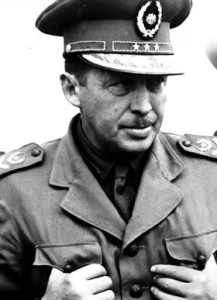
In 1992, in Asunción, Paraguay, a survivor of the regime of former dictator General Alfredo Stroessner stumbled upon five tons of highly classified reports and photographs left over from the state’s secret operations. This massive trove, which came to be known as the Asunción archives, laid bare the dark, hidden mechanics of Operation Condor. Begun in 1975, Operation Condor was a highly coordinated, cooperative effort among the military and police officials of South American dictatorships, including Brazil, Argentina, Chile, Paraguay, Uruguay, and Bolivia. The primary objective of this transnational network was to track, kidnap, torture, and murder political dissidents, labor organizers, and advocates of democracy who sought to challenge their authoritarian rule. While military regimes across Latin America went to great lengths to destroy or conceal the evidence of their joint crimes, the discovery in Paraguay occurred because Stroessner’s secret police failed to hide all of their files before the dictatorship fell. The recovered records provided Spanish human rights lawyer Juan Garcés and Judge Baltazar Garzón with a devastating baseline of evidence to pursue international prosecutions, including the landmark 1998 arrest and extradition proceedings of Chilean General Augusto Pinochet in London.
The core of Operation Condor relied on a seamless cooperative effort among South South American military and police forces. If a dissident fled, military authorities would secretly coordinate across borders to execute the target, as demonstrated by the disappearance of Argentine citizens in Brazil when both nations were under military dictatorship. Under Pinochet, the Chilean military and its secret police unit, DINA (Dirección de Inteligencia Nacional), conducted high-profile international assassinations to eliminate influential opponents. In 1974, DINA agents assassinated General Carlos Prats González, Salvador Allende’s former defense minister, and his wife with a car bomb in Buenos Aires. In 1976, DINA agents under the command of Colonel Pablo Belmar tortured and murdered Carmelo Soria, a United Nations official and Spanish citizen, dumping his body in a Santiago canal to make his death appear accidental. In September 1976, DINA agent Michael Townley slipped under a car in Washington, D.C., to affix a powerful plastic explosive that killed former Chilean Ambassador Orlando Letelier and his American companion, Ronni Karpen Moffitt, just miles from the White House. Pinochet personally ordered the Letelier assassination because he viewed the articulate dissident as a major threat who was using his platform at a Washington think tank to delegitimize the Chilean regime.
The role of the United States in facilitating and shielding Operation Condor remained a tightly held secret for decades. U.S. Army Colonel Robert Thierry actively helped General Stroessner set up his repressive police-state apparatus in Paraguay and directly trained his police officers. Furthermore, the Federal Bureau of Investigation (FBI) actively cooperated with the regimes, supplying Pinochet’s secret police with the names of Chilean citizens in their files, which included individuals like Frank Teruggi, whose bullet-ridden body was subsequently found in the Santiago morgue. American Embassy cables from 1976 documented that U.S. agents worked closely with regional security officials, many of whom had studied counterinsurgency and interrogation techniques at the United States-run School of the Americas (SOA). Prominent SOA graduates involved in state terrorism included Salvadoran death squad leader Roberto D’Aubuisson, who orchestrated the 1980 assassination of Archbishop Oscar Romero, and Chilean DINA officer Pablo Belmar.
When the Argentine military junta launched its brutal “Dirty War” in 1976—which eventually killed at least 30,000 people and left thousands of others “disappeared”—it did so with explicit encouragement from the highest levels of the U.S. government. In June 1976, former Secretary of State Henry Kissinger met with Argentina’s foreign minister and gave the regime the “green light” to press their campaign, asking how long it would take to “clean up the problem”. Backed by this diplomatic shield, Argentine generals carried out a massive killing spree, with General Jorge Videla declaring to his army colleagues in October 1975, “If the Argentine situation demands it, all necessary persons must die to achieve the security of the country”. Under Videla and his successor, General Roberto Viola, the junta systematically tortured political opponents, often machine-gunning victims or pushing them alive out of airplanes into the sea. When the CIA later compiled files documenting Pinochet’s personal culpability and DINA director Manuel Contreras’s role as a paid CIA asset starting in 1975, senior U.S. officials remained completely tight-lipped, preferring to protect their sources and methods over exposing the crimes of their Cold War clients.