

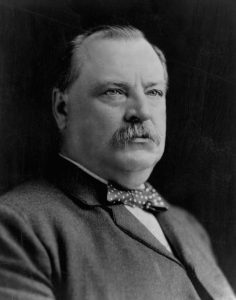
Throughout the Gilded Age, the American presidency was widely understood to be a highly constrained, primarily administrative office, leaving Congress to serve as the dominant policymaking branch of the federal government. Grover Cleveland, however, fundamentally inverted this dynamic. Entering the national arena as a self-made, scrupulously honest reformer, Cleveland conceptualized the executive office not as a co-collaborator with the legislature, but as a robust bulwark protecting the public from special interests and systemic political corruption. This governing philosophy was executed almost entirely through his relentless, unprecedented deployment of the presidential veto. Earning the distinct nicknames of the “Veto President” and the “President Who Said ‘No!’,” Cleveland used his veto pen more aggressively than any executive who came before him, transforming a routine constitutional check into the defining instrument of his political legacy.
Forging the “Veto” Persona: Buffalo and Albany
The foundations of Cleveland’s veto-heavy executive style were established during his rapid ascent in New York state politics. As the reform-minded “veto mayor” of Buffalo in 1882, Cleveland built an immediate reputation for confrontational integrity. His most celebrated mayoral action was vetoing a highly inflated city street-cleaning contract that had been awarded to a high-bidding firm for $422,500—an excess of $109,000 over the lowest bid. In his blunt veto message, Cleveland excoriated the city council, labeling the deal “a most bare-faced, impudent, and shameless scheme to betray the interests of the people”. He systematically dismantled local patronage systems, vetoing the council’s habit of paying the local German press to print legislative proceedings, and even rejecting a taxpayer-funded appropriation for the Grand Army of the Republic’s (GAR) Fourth of July festivities. Though political advisors warned that targeting a powerful veterans’ union was politically suicidal, Cleveland insisted that public funds could only be spent on direct public protections, subsequently leading a private subscription campaign to make up the funds out of his own pocket. Because he maintained just enough supportive allies on the board of aldermen to block overrides, his mayoral vetoes were never successfully reversed.
Elevated to the governorship of New York in 1883, the “veto mayor” seamlessly transitioned into the “veto governor”. Cleveland issued forty-four vetoes during his first year in Albany, showing a complete disregard for intraparty pressures and special-interest legislation. He vetoed a popular bipartisan bill to lower the elevated railroad fare in New York City from ten cents to five cents. While acknowledging the public’s hatred of the railroad’s owner, Jay Gould, Cleveland maintained that the state was constitutionally bound by its original contract permitting the railroad to set fares, arguing that violating the contract violated the state’s honor.
This uncompromising legalism often brought him into direct, volatile confrontations with a young Republican assemblyman named Theodore Roosevelt. When Roosevelt demanded that Cleveland sign a package of New York City reform bills despite highly sloppy, inconsistent drafting, Cleveland landed his massive fist on his desk in a thunderclap, shouting, “Mr. Roosevelt, I am going to veto those bills!”. Cleveland stood firm, forcing the legislature to rewrite the sloppy measures, and publicly remarked that Roosevelt’s original Tenure of Office Bill was “the worst and the most inexcusable” piece of shabby legislation he had ever seen. He similarly defied religious lobbies by vetoing state funding for a Catholic protectory for at-risk children on the strict constitutional ground that public money must never be granted directly to sectarian institutions.
The Imperial Auditor: The Battle over Civil War Pensions
When Cleveland assumed the presidency in 1885, he applied this same exhaustive, narrow audit style to the federal government’s expenditures. During his first term, Cleveland vetoed an astounding 414 bills—more than double the cumulative total of all twenty-one of his presidential predecessors combined. While he approved nearly 90 percent of the private pension bills that reached his desk, he waged a relentless, highly personal war against what he perceived as a fraudulent, politically motivated raid on the federal treasury.
Under the Arrears Act of 1879, Union veterans could claim retroactive payouts, leading to a massive surge in private pension bills filed by congressmen seeking to reward their local voters with federal handouts. Rather than relying on staff summaries, Cleveland insisted on personally reviewing the granular medical and military details of every single claim, a process that left him exhausted and deeply cynical. His resulting veto messages were frequently characterized by a biting, sarcastic disdain for fraudulent applicants.
- In the case of veteran John W. Farriers, who sought an increased pension for eye issues, Cleveland wrote witheringly: “The ingenuity developed in the constant and persistent attacks upon the public Treasury… is exhibited in bold relief by this attempt to include sore eyes among the results of diarrhea”.
- Vetoing another pension for John Hunter, who had broken his leg in a ditch fifteen years after the war, Cleveland noted dryly that the applicant’s injury occurred “while gathering dandelions” and had nothing to do with military service.
- To the Grand Army of the Republic and its allies, Cleveland delivered a blunt, guiding principle: “We are dealing with pensions and not with gratuities”.
In 1887, Cleveland vetoed the Dependent Pensions Act, which would have granted a pension to any veteran who had served ninety days and suffered from any disability, regardless of whether that disability was incurred during military service. Cleveland warned that the bill’s vague, imprecise language would invite a devastating wave of fraudulent claims and bankrupt the Treasury. This aggressive oversight deeply angered the GAR, which mobilized to defeat his 1888 reelection bid. During the 1888 campaign, Republican nominee Benjamin Harrison capitalized on Cleveland’s pension vetoes, famously declaring that the federal government should not “use an apothecary’s scale” to weigh the rewards of the men who saved the Union.
The Texas Seed Veto and the Philosophy of the Limited State
Beyond private pension bills, Cleveland utilized his veto power to actively enforce his classical liberal, Jeffersonian view of the United States Constitution. He firmly believed that the federal government was strictly limited to the specific powers enumerated in the Constitution, and that local, domestic welfare remained the exclusive domain of individual states and private charity.
This philosophy culminated in his landmark Texas Seed Bill veto of February 16, 1887. Following a severe drought in Texas, Congress had passed an appropriation of $10,000 to purchase seed grain for struggling agrarian communities. Cleveland vetoed the bill, writing a message that became the ultimate rhetorical manifesto of late-nineteenth-century conservatism:
“I can find no warrant for such an appropriation in the Constitution, and I do not believe that the power and duty of the general government ought to be extended to the relief of individual suffering… the lesson should be constantly enforced that though the people support the government the government should not support the people”.
Cleveland argued that paternalistic federal interventions ultimately “encouraged the expectation of paternal care on the part of the government and weakened the sturdiness of our national character,” while actively discouraging the organic, private neighborly charity that bound the national brotherhood together.
Tactical Mastery: The Pocket Veto and the Second-Term Defense
Cleveland’s deployment of executive power also relied heavily on the strategic utilization of the pocket veto. By refusing to sign a bill passed during the final ten days of a congressional session, Cleveland could quietly kill legislation without providing Congress the opportunity to override his decision or forcing himself to draft a formal list of objections. Of the 414 vetoes issued during his first term, 110 were executed via this pocket mechanism. This quiet, highly effective tool allowed Cleveland to paralyze legislative actions by simple executive inaction.
During his turbulent second term, which commenced amidst the devastating Panic of 1893, Cleveland’s veto pen remained his primary weapon of defense. In his second term alone, he issued another 170 vetoes, bringing his career total to 584 vetoes—a record that would stand as the highest in American history until it was eventually surpassed by Franklin D. Roosevelt’s 635 vetoes across four terms. Cleveland remained so unyielding in his defense of the gold standard and limited government that even during a two-year period when his own Democratic Party controlled both houses of Congress, he still rejected eighty-one pieces of legislation. Among his final presidential acts in March 1897 was a veto of an immigration bill that sought to prohibit illiterate immigrants from entering the country, with Cleveland arguing that peaceful, hardworking illiterate laborers were infinitely safer to admit than literate, radical agitators who used inflammatory speech to provoke social unrest.
Ultimately, Grover Cleveland’s extraordinary record of 584 vetoes cast him as a unique “reactive activist” of the Gilded Age. While he held a deeply conservative, negative view of federal power, he executed that role with an intense, unyielding moral energy. By transforming the presidential veto from a rare constitutional shield into a routine, everyday instrument of fiscal and administrative discipline, Cleveland permanently expanded the executive branch’s authority over the legislative process, establishing a powerful blueprint of unilateral presidential power that future twentieth-century presidents would eagerly inherit.