
O
n Thursday, July 25th, 2026, while speaking at the Nixon Presidential Library and Museum, Vice President JD Vance made an astonishing historical claim: he likened the Watergate scandal that forced Richard Nixon’s resignation to the efforts to hold Donald Trump accountable, placing the blame for Nixon’s downfall squarely on the “deep state.” Furthermore, Vance suggested that by today’s standards, the Watergate scandal wouldn’t even be much of a story.
Vance’s attempt to extol the virtues of Richard Nixon and sanitize his crimes is not merely a historical gaffe. It is a calculated ideological maneuver designed to legitimize the imperial presidency and finalize a decades-long project by the political right to redefine corruption out of existence. To understand the profound danger of the Vice President’s remarks, we must deconstruct the reality of Watergate, examine the Founders’ original warnings about corruption, and trace how the American legal system has deliberately weakened anti-corruption guardrails since the 1970s.
The Reality of Nixon and Watergate Vance’s characterization of Nixon as a victim of a “deep state” coup is a complete fabrication of the historical record. Richard Nixon was not ousted by a shadowy cabal of bureaucrats; his downfall was the result of a sprawling criminal enterprise orchestrated directly from the Oval Office.
The Watergate scandal began with a botched burglary at the Democratic National Committee headquarters by operatives connected to Nixon’s reelection campaign, but the break-in was merely the tip of the iceberg. Nixon systematically used the machinery of the federal government to target his perceived enemies. He ordered illegal surveillance of journalists and political opponents, and he attempted to use the Internal Revenue Service (IRS) to harass them,. He oversaw a massive slush fund used to pay hush money to the Watergate burglars to buy their silence,.
The “smoking gun” that ultimately forced Nixon’s resignation was a tape recording of the President personally ordering his chief of staff to instruct the CIA to block the FBI’s investigation into the Watergate break-in,,. That is not the work of the “deep state”; that is a textbook case of obstruction of justice and a gross abuse of presidential power, for which the House Judiciary Committee drafted articles of impeachment,. Nixon fundamentally sought to establish an imperial presidency that operated in the shadows, entirely unaccountable to Congress or the courts. When Vance defends Nixon, he is explicitly defending the premise that the president of the United States should be permitted to weaponize the government against political rivals and operate above the law.
The Founders’ Vision of Corruption Vance’s dismissal of Nixon’s criminality violently collides with the foundational principles of the United States. For the Founding Fathers, corruption was not a minor procedural issue; it was the supreme existential threat to the republic.
The Founders viewed corruption in broad, systemic terms. Drawing on classical republican philosophy, they defined corruption as the excessive influence of private interests over the exercise of public power. An act was corrupt when a public official purposefully ignored the public good to serve their own ends. James Madison and Alexander Hamilton warned relentlessly that systemic corruption would subvert the constitutional order, allowing a demagogue to seize power, which would inevitably lead to tyranny and the enslavement of the citizenry,.
Because they feared this organic rot so deeply, the Founders designed the Constitution with prophylactic, structural rules to prevent officials from being tempted by private wealth or foreign influence. They understood that a democracy functions only when the public trusts that its government is acting in the collective interest, and that unchecked corruption would sap the people’s confidence, dragging democratic government “into a ditch”,.
Defining Deviancy Down: The Weakening of Anti-Corruption Law There is, however, one chillingly accurate element in JD Vance’s remarks: if Watergate happened today, it might indeed struggle to gain traction as a career-ending scandal. But this is not because Nixon was innocent; it is because American political deviancy has been systematically defined down over the last fifty years.
Following the Watergate scandal, Congress passed sweeping reforms to enhance transparency and constrain the influence of money in politics. However, the Supreme Court steadily dismantled these protections by fundamentally—and ahistorically—redefining the word “corruption.”
Beginning with Buckley v. Valeo in 1976 and culminating in decisions like Citizens United (2010), the conservative justices on the Supreme Court stripped the moral and systemic meaning from the concept of corruption. They narrowed the definition exclusively to “quid pro quo” bribery—meaning an explicit, transactional exchange of money for a specific official act,,. Under this crabbed legal framework, the Court declared that massive, independent political spending by corporations and billionaires does not even give rise to the appearance of corruption. The Court legally rebranded the purchase of political “ingratiation and access” as mere democratic responsiveness,.
The Court extended this impunity directly to public officials. In the 2016 case McDonnell v. United States, the Court overturned the bribery conviction of a Virginia governor who had accepted $175,000 in luxury gifts, Rolexes, and vacations from a businessman in exchange for arranging meetings with state officials. By deciding that setting up meetings and using the prestige of the office to promote a benefactor’s product did not constitute an “official act,” the Supreme Court made it exceedingly difficult to prosecute politicians for anything short of a signed contract exchanging cash for a specific legislative vote,.
By shrinking the definition of corruption, the judiciary has legalized influence-peddling and neutralized the exact structural guardrails the Founders built.
The Modern Authoritarian Playbook When Vice President Vance claims the “deep state” took down Nixon, he is employing a deliberate rhetorical strategy to justify the Trump administration’s own breathtaking abuses of power. Today’s “deep state” conspiracy theories are weaponized to purge the government of independent, non-partisan civil servants so they can be replaced with political loyalists who will refuse to check the president’s worst impulses (a scheme operationalized under the banner of “Schedule F” and Project 2025),.
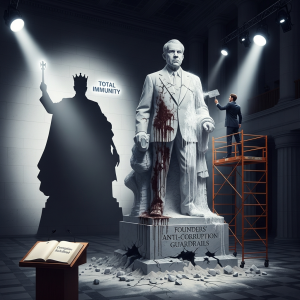
The current administration has realized the imperial presidency that Nixon only dreamed of. Where Nixon operated a secret slush fund to pay off burglars, the Trump administration has openly created a $1.776 billion taxpayer-financed “Anti-Weaponization” slush fund, overseen by political appointees, to compensate the President’s allies and January 6th rioters,. Where Nixon scrambled to hide his misdeeds, Trump has leveraged his office to extract billions in sovereign wealth investments from foreign nations, flaunting the Emoluments Clause while the courts look the other way. And where Nixon was ultimately forced to resign under the threat of prosecution, the modern Supreme Court has preemptively granted the executive branch sweeping absolute immunity from criminal prosecution for official acts, effectively placing the president above the law entirely.
By extolling Richard Nixon and downplaying Watergate, JD Vance is signaling to the American public that the era of executive accountability is over. The administration is openly embracing the corruption that the Founders warned would destroy the republic, confirming that the abuse of public power for private and political gain is no longer a scandal to be hidden, but the official operating principle of the United States government.