

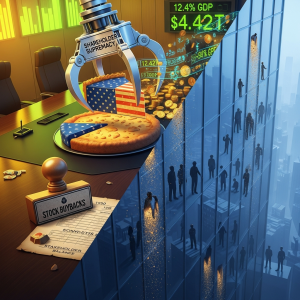
New Commerce Department data revealing that corporate profits have reached an annualized $4.42 trillion—representing a staggering 12.4% of the U.S. Gross Domestic Product—highlights a profound structural crisis in the American political economy. While Wall Street and the Trump administration may celebrate these record-breaking margins, these figures are not a sign of a healthy, functioning economy. Rather, they represent the culmination of a deliberate, decades-long project to transfer wealth from the American working class to a tiny financial elite.
To understand why figures like this alarmed Harry Truman’s aides in 1947, and why they should terrify Americans today, we must look at how the basic rules of American capitalism have been rewritten.
The Era of the Corporate Statesman When corporate profits surged in the wake of World War II, President Harry Truman and his aides viewed the concentration of corporate wealth with intense suspicion. Truman despised monopoly power, having witnessed how financial titans had nearly ruined the country during the Great Depression. Truman bluntly declared that “legislation that favored the greed of monopoly and the trickery of Wall Street was a form of corruption” that did immense harm to the country. He believed firmly that “there is no more serious problem affecting our country and its free institutions than the distortions and abuses of our economic system which result when unenlightened free enterprise turns to monopoly”.
Due to the persistent threat of New Deal-style regulation, strong antitrust enforcement, and a highly unionized workforce, the business leaders of the mid-20th century adopted a remarkably different posture than today’s executives. CEOs in the 1950s saw themselves as “corporate statesmen” whose job was to balance the needs of society, not just enrich investors. Frank Abrams, chairman of Standard Oil of New Jersey, typified this era in 1951 when he proclaimed that “the job of management is to maintain an equitable and working balance among the claims of the various directly affected interest groups stockholders, employees, customers, and the public at large”.
Because of this “stakeholder capitalism,” the prosperity of the post-war era was widely shared. For three decades, the average hourly compensation of American workers rose in lockstep with national productivity gains.
The Reagan Revolution and the Shareholder Supremacy This equitable arrangement was violently dismantled beginning in the 1980s. Fueled by deregulation and a wave of hostile takeovers orchestrated by corporate raiders like Michael Milken and Carl Icahn, the purpose of the American corporation was radically redefined. The corporate statesmen of the past were replaced by executives whose exclusive, obsessive focus was to maximize short-term shareholder value.
To achieve the massive 12.4% profit margins we see today, corporations have relied on three primary mechanisms to siphon wealth away from workers and consumers:
1. The Crushing of Labor In the 1950s, 35 percent of all private-sector workers in the United States were unionized; today, that number has plummeted to just 6.4 percent. Payrolls typically constitute 70 percent of a corporation’s costs, so the most direct way to boost profits and share prices is to suppress wages. By fighting unionization, moving jobs overseas, and relying on contract workers, corporations severed the link between productivity and pay. Since 1979, the nation’s productivity has risen 65 percent, but workers’ median compensation has increased by just 8 percent. Research from MIT and NYU reveals that between 1989 and 2017, the vast majority of the increase in share values came directly from “reallocated rents to shareholders and away from labor compensation”. The American economic pie has continued to grow, but the working class is only getting crumbs.
2. The Stock Buyback Scheme Perhaps the most egregious driver of today’s corporate profits is the stock buyback. For decades, it was illegal for a company to purchase its own stock on the open market, as it was properly recognized as market manipulation that contributed to the Great Depression. But in 1982, an unelected Reagan administration bureaucrat named John Shad made the practice legal.
Today, instead of taking record profits and reinvesting them into research, new factories, or higher wages for workers, executives use corporate cash to buy up their own stock. This artificially reduces the number of shares, boosting the stock price and triggering massive bonuses for the executives themselves. Following the Trump tax cuts, companies like Walmart laid off thousands of workers while simultaneously plowing $20 billion into stock buybacks. Today, major companies spend only 94 cents on physical equipment and innovation for every dollar they spend buying back their own stock.
3. Unchecked Monopoly Power Finally, the abandonment of antitrust enforcement has allowed corporations to consolidate vast swaths of the economy. Corporate concentration allows companies to jack up prices on everything from baby formula to gasoline without fear of losing customers to competitors, while simultaneously suppressing wages because workers have fewer employers to choose from.
The 2026 Reality: Socialism for the Rich The staggering $4.42 trillion in corporate profits reported for Q1 2026 is the direct result of these systemic failures, supercharged by the second Trump administration. As the President continues his frenzy of deregulation and massive corporate tax cuts, corporate profits have soared to their highest portion of the national economy since 1929.
While the administration points to a booming stock market as proof of economic success, this is a dangerous illusion. The richest 10 percent of American families own 87 percent of all stock market wealth, meaning these record profits and buybacks flow almost entirely into the pockets of the ultra-wealthy. Meanwhile, average citizens are left to suffer the consequences of Trump’s sweeping tariffs, which economists warn act as a massive tax on the middle class, driving up inflation and the cost of daily goods.
Ultimately, a system where corporate profits consume 12.4% of the GDP while average household incomes stagnate is not a free market—it is an oligarchy. We are witnessing what has accurately been described as “socialism for the rich” and “harsh capitalism for the rest”. Unless the United States actively checks corporate monopolies, restores the bargaining power of labor, and bans the manipulative practice of stock buybacks, this engineered upward transfer of wealth will inevitably destabilize both the American economy and its democratic institutions.