

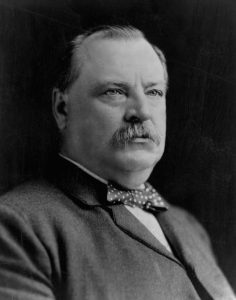
To understand the deepest anxieties of modern American democracy—the tension between partisan loyalty and political integrity, the use of executive power during times of severe economic depression, the ethics of federal intervention in labor disputes, and the staggering lengths to which an administration will go to conceal a president’s failing health from the press—one must examine the unique, unparalleled career of Stephen Grover Cleveland. Other than Trump, he remains the only chief executive in American history to serve two non-consecutive terms, rendering him the nation’s twenty-second and twenty-fourth president. He was also one of only three presidents—alongside Andrew Jackson and Franklin D. Roosevelt—to win the popular vote in three consecutive elections.
Yet, despite these monumental achievements, Grover Cleveland has largely faded from public memory. This historical amnesia is profoundly unjust, because Cleveland’s presidency offers a masterclass in the virtues of uncompromising moral courage, as well as the catastrophic political costs of absolute inflexibility.
The Rapid Rise of the Ombudsman in Chief Grover Cleveland did not look, sound, or behave like a traditional president. Hulking and oxlike, he resembled a foundry foreman more than a statesman, and he was thoroughly unimpressed by the pretensions of politics. In the course of just three years, Cleveland was elevated from the obscurity of a Buffalo law practice to the presidency of the United States on the basis of a single, unyielding principle: his incorruptible integrity.
He viewed the executive branch not as a vehicle for grand, visionary leadership, but as an ombudsman—a fiduciary mechanism designed to administer the government efficiently, cleanly, and without granting special favors to any class or faction. Cleveland was the final Democratic president to embrace classical liberalism; he believed in a strictly limited federal government, a narrow interpretation of the Constitution, and sound money.
This philosophy manifested in his ruthless use of the veto pen. Over the course of his two terms, Cleveland vetoed an astonishing 584 bills—more than all twenty-one of his predecessors combined. Many of these were private pension bills for Civil War veterans, which Cleveland personally scrutinized and frequently found to be fraudulent. His strict constitutionalism was perhaps best articulated in 1887, when Congress passed a bill appropriating $10,000 to buy seed grain for drought-stricken Texas farmers. Cleveland vetoed it, famously declaring: “I can find no warrant for such an appropriation in the Constitution, and I do not believe that the power and duty of the general government ought to be extended to the relief of individual suffering… though the people support the Government the Government should not support the people”.
Yet, despite his aversion to federal expansion, Cleveland was also the first president to place an American industry under federal regulation when he signed the Interstate Commerce Act of 1887 to oversee the railroads. However, as critics noted, corporate lawyers quickly realized the commission could be utilized to satisfy popular clamor for regulation while remaining entirely nominal, effectively shielding the monopolies.
“Tell the Truth” vs. The Medical Cover-Up Cleveland’s reputation for honesty was tested by two massive scandals—one which he navigated with legendary candor, and another which he buried in a brazen cover-up that foreshadowed the modern era of executive deception.
During the 1884 presidential campaign, a Buffalo minister published a sensational exposé revealing that Cleveland, during his bachelor days, had fathered a child out of wedlock with a woman named Maria Halpin. While his political handlers panicked, Cleveland famously telegraphed them with a simple directive: “Whatever you do, tell the truth”. He admitted to the affair and his financial support of the child, and his remarkable candor turned a potentially crippling sex scandal into a demonstration of unshakeable integrity.
However, Cleveland abandoned this transparency during his second term. Just weeks after his inauguration in 1893, Cleveland was diagnosed with a cancerous tumor on the roof of his mouth. The nation was already descending into the Panic of 1893—a catastrophic economic depression marked by collapsing railroads and plunging stock prices. Fearing that news of his cancer would shatter the already fragile financial markets, Cleveland orchestrated a massive deception.
Under the guise of a summer fishing trip, Cleveland boarded the Oneida, a yacht owned by his wealthy banker friend E. C. Benedict. There, in a makeshift operating room bolted to the floor of the yacht’s saloon, a covert surgical team removed a large portion of the president’s upper jaw and palate while sailing up the East River. The president was fitted with a vulcanized rubber prosthesis to preserve his normal speech and appearance.
When an intrepid investigative journalist named E. J. Edwards (writing under the pen name “Holland”) discovered the truth and published a highly accurate, front-page exposé in the Philadelphia Press detailing the secret surgery, the administration went on the offensive. Rather than admitting the truth, Cleveland’s inner circle orchestrated a vicious smear campaign, branding the reporter a liar and a “disgrace to journalism” to protect the president’s political standing. The cover-up was so successful that the true nature of the operation was not publicly confirmed by his surgeons until decades later.
The Price of Principle: Economic Collapse and Partisan Fracture Grover Cleveland’s second term was consumed by the Panic of 1893 and the bitter, deeply sectional war over the nation’s currency. Western and Southern populist factions desperately wanted the government to coin silver to inflate the money supply and help debt-ridden farmers. Cleveland, an unyielding “goldbug,” believed this was legislated alchemy that drained the Treasury’s gold reserves and terrified foreign investors.
Displaying his characteristic stubbornness, Cleveland called a special session of Congress and ruthlessly forced the repeal of the Sherman Silver Purchase Act. In doing so, he saved the gold standard but utterly alienated the agrarian, populist wing of his own party. Unlike a modern politician willing to negotiate or pander to his base, Cleveland refused to yield. His absolute inflexibility split the Democratic Party in two. The political backlash was apocalyptic: in the 1894 midterms, the Democrats lost 125 seats in the House of Representatives, the largest such defeat in American history—a massacre described by future Speaker Champ Clark as “the greatest slaughter of innocents since the days of King Herod”.
Labor Strikes and Anti-Imperial Restraint Cleveland’s second term also saw a dramatic expansion of federal police power during the Pullman Strike of 1894, which paralyzed the nation’s rail network. Believing the strike was obstructing the U.S. mail and flirting with anarchy, Cleveland overreacted. Over the furious objections of Illinois Governor John Peter Altgeld, who insisted the state could handle the unrest, Cleveland deployed federal troops to Chicago. The military intervention crushed the strike and sent labor leader Eugene V. Debs to prison, but it permanently alienated the working class from the Cleveland administration.
Yet, for all his heavy-handedness domestically, Cleveland displayed an extraordinary, principled restraint abroad. In an era when the United States was beginning to flex its imperial muscles, Cleveland staunchly opposed expansionism. When he discovered that American business interests and diplomats had illegally orchestrated a coup to overthrow the Hawaiian monarchy, Cleveland withdrew the treaty of annexation from the Senate, declaring the American actions an “act of war” against a peaceful kingdom. He similarly resisted immense public pressure to intervene in Cuba, refusing to be dragged into a war with Spain. Cleveland sacrificed the easy political popularity of imperial conquest because he believed imperialism fundamentally violated American ideals.
Conclusion Grover Cleveland left office in 1897 as one of the most unpopular men in America, reviled by labor, abandoned by his party, and blamed for an economic depression. Yet, history has vindicated his character. When he died in 1908, his final words were: “I have tried so hard to do right”.
Today, it has become fashionable to view character as a superfluous trait in political leaders, focusing purely on partisan outcomes. Grover Cleveland stands as a monolithic rebuke to that cynicism. He proved that the American executive can be a figure of supreme moral courage, willing to suffer catastrophic political defeat rather than compromise a core conviction. While his stubbornness decimated his political party, his administration proves that a republic occasionally requires a leader whose moral compass cannot be bought, bullied, or bent by the popular passions of the day.