

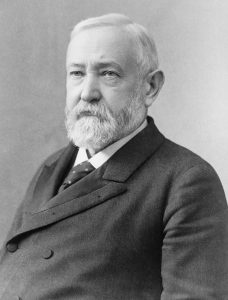
In The Education of Henry Adams, the brilliant American historian and descendant of presidents concluded that Benjamin Harrison “was an excellent President, a man of ability and force; perhaps the best President the Republican Party had put forward since Lincoln’s death”. Yet, Harrison is frequently dismissed by the public as a mere historical placeholder, the man who occupied the White House between Grover Cleveland’s two non-consecutive terms.
This historical amnesia obscures a highly consequential administration. To understand the modern American political landscape—the ongoing battles over corporate monopolies, the struggle to secure minority voting rights against state-level suppression, the birth of the United States as a global superpower, and the evolution of the president from a passive administrator into a prime legislative architect—one must examine the administration of the twenty-third president. Benjamin Harrison fundamentally expanded the boundaries of presidential activism and pointed the way toward the modern executive branch.
The “Human Iceberg” and Executive Independence Harrison possessed a wealth of assets for the presidency: he was a brilliant lawyer, a devout Christian, a Civil War general, and the scion of a venerable political family, being the grandson of the nation’s ninth president, William Henry Harrison. Yet, he also possessed a remarkably reserved and introverted personality. Because he believed that a president should act formal and dignified rather than as a backslapping politician, he was saddled with the nickname the “Human Iceberg”.
What his critics saw as coldness was actually a fierce determination to separate his personal feelings from his official responsibilities. In an era dominated by corrupt political machines, Harrison boldly resisted the dictation of party bosses when making patronage appointments, risking his own political future for the sake of presidential independence. When a procession of party chieftains journeyed to Indianapolis to demand cabinet positions, Republican national chairman Matthew S. Quay noted with frustration that Harrison was “all ears and no tongue,” recognizing no obligations or bargains. Harrison knew he alone bore the ultimate accountability for his administration, and he refused to surrender the executive branch to factional bosses.
The “Billion-Dollar Congress” and the Antitrust Movement Unlike his predecessor, Grover Cleveland, who viewed the federal government mostly through a negative, veto-wielding lens of laissez-faire restraint, Harrison harbored a philosophy of government that emphasized possibilities. He was not a devotee of laissez-faire; instead, he advocated for vigorous government action on a wide variety of fronts to promote the prosperity of the people.
Because of this, Harrison became one of the most engaged legislative presidents in the late nineteenth century, actively intervening in congressional deliberations to achieve his policy goals. He presided over the Fifty-first Congress, which became famously and derisively known by its critics as the “Billion-Dollar Congress” due to its unprecedented level of legislative activism and spending.
Most significantly for modern Americans grappling with the immense power of corporate conglomerates, it was under Harrison that the federal government first attempted to rein in monopolies. In his first annual message to Congress, Harrison warned the nation’s “great corporations” to scrupulously observe their legal obligations, noting that their illicit behavior would lead the public to believe that “convenience or a supposed class interest is a sufficient cause for lawlessness”. Consequently, he signed the landmark Sherman Anti-Trust Act, a law designed to prevent big companies from making secret agreements to artificially keep prices high.
He also signed the Sherman Silver Purchase Act—which favored Western silver interests—and a highly protectionist tariff bill. These massive pieces of legislation highlight the eternal, agonizing dilemma of the presidency: policies designed to help certain demographics inevitably alienate others. For instance, the revenue raised by the tariff allowed the government to support aging Union veterans from the North, but offered nothing to former Confederate soldiers in the South. The silver act helped Western states but horrified Eastern bankers. (Both landmark acts were named after John Sherman, an Ohio politician who tried and failed to become president three times, proving that one does not need to win the White House to author some of the most important laws in American history).
The Fight for Voting Rights Perhaps Harrison’s most noble, and tragically unfulfilled, legislative battle was his attempt to secure the civil rights of African Americans. Since the end of Reconstruction, white supremacist governments in the South had systematically utilized violence and fraud to strip Black Americans of their right to vote.
Harrison refused to ignore this democratic subversion. He urged Congress to pass legislation to afford greater protection for the right to vote, arguing that “no power vested in Congress or in the Executive to secure or perpetuate [the right to vote] should remain unused upon occasion”. He strongly supported a federal elections bill—often called the “Force Bill” by its Southern detractors—to provide federal supervision of elections. Though the bill ultimately succumbed to the obstructionist tactics of Southern Democrats and their silverite allies, Harrison’s aggressive advocacy demonstrated a profound executive commitment to enforcing the Fourteenth and Fifteenth Amendments, foreshadowing the great civil rights battles of the twentieth century.
The Dawn of the Global Empire Harrison’s administration also marked a crucial transitional period in American foreign policy. Prior to his presidency, American diplomacy was largely defensive and insular. Harrison, however, began to shape events to enhance the nation’s standing and influence in the world.
Because his Secretary of State, James G. Blaine, was frequently absent due to failing health, Harrison carried much of the diplomatic load himself, applying his lawyerly mastery of detail to international affairs. He pushed for the construction of a modern, stronger navy and secured postal subsidies to put the American flag upon the seas and expand the nation’s share of world commerce. He guided the nation through international crises, including a dispute with Great Britain over the Bering Sea, tensions with Chile, and early maneuvers regarding the annexation of Hawaii. Traveling extensively on a cross-country tour, Harrison took the presidency directly to the people, announcing that the United States had come to a “new epoch” with “opening portals to trade and influence and prestige such as we have never seen before”.
Conclusion Despite his monumental legislative achievements, the political tides turned against Harrison. The public—particularly farmers and laborers—grew disillusioned with the activism and extravagance of the “Billion-Dollar Congress,” and laborers revolted against the protective tariff. To compound his political struggles with unimaginable personal tragedy, his beloved wife Caroline fell gravely ill and died just two weeks before the 1892 election. Unable to campaign, Harrison was defeated by Grover Cleveland—the very man he had unseated four years earlier.
Yet, Benjamin Harrison’s legacy profoundly outlasted his single term. He left behind the antiquated model of a passive chief magistrate and actively wielded his power to shape legislation, combat monopolies, defend voting rights, and project American strength abroad. When future presidents like William McKinley and Theodore Roosevelt utilized the White House as a powerful engine for national and global policy, they were walking through the doors that Benjamin Harrison had forced open.