

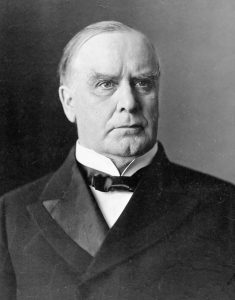
To understand the deepest anxieties of the modern American political landscape—the overwhelming influence of corporate money in our elections, the sophisticated manipulation of targeted voting blocs, the enduring debate over global trade, and the terrifying realities of an American empire that stations troops across the globe—one must study the life of the twenty-fifth president, William McKinley. Frequently overshadowed by the charismatic, bull-moose personality of his successor, Theodore Roosevelt, McKinley is too often dismissed as a mere puppet of wealthy industrialists. Yet, this is a profound historical distortion. McKinley was a brilliant, highly calculating leader who fundamentally transformed the United States. He ran the first truly modern presidential campaign, engineered a massive political realignment that dominated the nation for decades, and reluctantly, but decisively, transformed a continental republic into a global, imperial superpower,,.
The Invention of the Modern Corporate Campaign The election of 1896 remains one of the most consequential in American history. The nation was gripped by the devastating Panic of 1893, and the electorate was fiercely divided over the economy and the currency. The Democrats nominated the young, fiery populist William Jennings Bryan, the “Great Commoner,” who raged against Wall Street and the gold standard, demanding the free coinage of silver to inflate the money supply and help debt-ridden farmers,.
To counter this populist uprising, McKinley and his political manager, the wealthy iron and coal magnate Mark Hanna, invented the modern, money-driven political machine,. Realizing that they needed unprecedented resources to combat Bryan’s appeal, Hanna maneuvered patronage deals and essentially invented the corporate “assessment” model of campaign finance. Banks and massive corporations were assessed a percentage of their capital—for example, banks paid 0.25 percent of their capital—to fund McKinley’s campaign. Critics blasted this as a “corruption fund,” and newspapers depicted McKinley as a puppet of the trusts, but the strategy was devastatingly effective,.
Furthermore, McKinley’s campaign applied ruthless, modern business practices to politics. His manager in Chicago, Charles G. Dawes, utilized competitive bidding for campaign materials, hired bookkeepers to track cash, and established specialized outreach groups to target specific demographics: veterans, first-time voters, black voters, and immigrant groups. It was a campaign of persuasion on an industrial scale, distributing millions of pieces of literature in multiple languages to educate and convert the electorate,.
The Front-Porch Strategy vs. The Populist Crusader The contrast in campaigning styles between McKinley and Bryan laid the groundwork for how modern elections are fought. Bryan embarked on a frantic, exhaustive whistle-stop tour, traveling enough miles to circle the globe three-quarters of the way and delivering over six hundred formal speeches to millions of people,.
McKinley, conversely, recognized that such manic travel lacked dignity and message control. Instead of going to the people, he made the people come to him, launching his famous “Front-Porch Campaign”,. Hundreds of highly orchestrated delegations, totaling roughly 750,000 people, traveled by train to McKinley’s home in Canton, Ohio,. The campaign thoroughly researched local colors and economic facts, ensuring McKinley delivered highly tailored, heavily prepared remarks from his porch that were instantly captured by the press and wired across the nation,.
Through this controlled messaging, McKinley outmaneuvered Bryan. While Bryan focused almost exclusively on the “Free Silver” issue, McKinley broadened his appeal,. Earning the nicknames the “Advance Agent of Prosperity” and the “Napoleon of Protection,” McKinley argued that protective tariffs and “sound money” (the gold standard) were the true friends of the working man,,. He successfully warned laborers that Bryan’s inflationary silver would destroy the purchasing power of their wages, effectively peeling Catholic and immigrant industrial workers away from the Democratic Party,. This strategic pivot broke the post-Civil War political deadlock and forged a massive, diverse Republican coalition of owners and workers that dominated American politics for nearly forty years.
The Reluctant Imperialist While McKinley secured his political power on domestic economic issues, his presidency fundamentally altered America’s role in the world. By the late 1890s, American factories and farms were producing more than the domestic population could consume. As the Department of State warned, finding foreign markets had become a “serious problem of statesmanship,” and business leaders began clamoring for an overseas commercial empire.
Simultaneously, the Spanish Empire was faltering, and the American public was whipped into a moral frenzy over Spain’s brutal suppression of a rebellion in Cuba. The sensationalist press, eager for circulation, portrayed Cuba as a distressed victim and demanded American intervention. McKinley, the last veteran of the Civil War to occupy the White House, initially resisted the push for war,. “I have been through one war,” he somberly told a friend. “I have seen the dead piled up. I do not want to see another”.
However, in February 1898, the USS Maine mysteriously exploded in Havana harbor, killing 262 American sailors,. Though the explosion was likely caused by a spontaneous coal fire, the press and expansionists like Theodore Roosevelt cried “dirty treachery,” and the battle cry “Remember the Maine!” swept the nation,. Bowing to the overwhelming pressure of public sentiment, the press, and the business community—which realized that securing American economic influence required removing Spain—McKinley asked Congress for a declaration of war,.
The ensuing Spanish-American War lasted just ten weeks, but its consequences were eternal. Commodore George Dewey annihilated the Spanish fleet in Manila Bay, and American forces swept through Cuba. When the smoke cleared, McKinley orchestrated the acquisition of the Philippines, Guam, and Puerto Rico, and signed a joint resolution annexing Hawaii,. The United States was no longer a republic isolated by two oceans; it was a global empire.
The Anarchist’s Bullet Tragically, the massive wealth inequality and industrial consolidation that McKinley’s economic policies fostered ultimately led to his demise,. On September 6, 1901, while shaking hands at the Temple of Music at the Pan-American Exposition in Buffalo, New York, McKinley was shot in the abdomen by Leon Czolgosz, a self-declared anarchist,. Before he was executed, Czolgosz explicitly stated his motive, rooted in the bitter class warfare of the Gilded Age: “I killed the President because he was the enemy of the good people—the good working people”,.
McKinley died eight days later, elevating the young, aggressive imperialist Theodore Roosevelt to the presidency,. In the wake of the tragedy, Congress mandated that the Secret Service formally protect the chief executive, forever altering the physical accessibility of the American president.
William McKinley’s life provides an indispensable framework for understanding the modern American state. He proved that the presidency could be captured by utilizing highly disciplined organizations funded by massive corporate wealth,. Yet, he also demonstrated that a leader must unite a divided country with a message of broad, national prosperity. Above all, McKinley’s administration stands as the pivotal turning point in American history: the moment the United States abandoned the cautious, defensive posture of its Founders and stepped onto the world stage to claim the violent, permanent burdens of a global empire,,.