

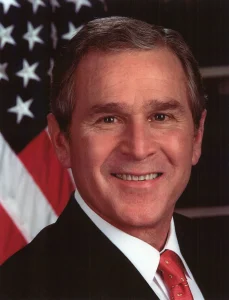
To understand the defining constitutional, geopolitical, and economic transformations of twenty-first-century American democracy—the dramatic expansion of executive authority, the prosecution of prolonged foreign conflicts in the Middle East and Central Asia, the creation of a pervasive national security apparatus, the polarization of the domestic electorate, and the management of catastrophic financial panics—one must examine the eight-year presidency of George Walker Bush. Serving as the forty-third chief executive from 2001 to 2009, Bush occupied the White House during a monumental historical threshold. The eldest son of the forty-first president, George H. W. Bush, he earned degrees from Yale University and Harvard Business School, served in the Texas Air National Guard, built a career in the oil industry, and achieved national prominence as general managing partner of the Texas Rangers major-league baseball franchise. Elected Governor of Texas in 1994 and re-elected in 1998, Bush cultivated a reputation as a pragmatic “compassionate conservative,” a persona that propelled him to the 2000 Republican presidential nomination. The 2000 presidential election against Democratic Vice President Al Gore proved to be one of the most bizarre and contested contests in American history. Although Gore won the national popular vote by hundreds of thousands of votes, the electoral outcome hinged on the razor-thin margin in Florida, leading to an intense legal battle that was ultimately halted by the United States Supreme Court in the landmark Bush v. Gore decision.
Bush took office in January 2001 inheriting an American republic at the peak of its global prestige and economic strength. The federal budget ran a multi-billion-dollar surplus, the national debt stood at 56.4 percent of gross domestic product, military spending was at a generational low of 3 percent of GDP, and national unemployment stood at 4 percent. Initially focusing his administration on domestic priorities, Bush adopted a top-down, corporate-style management model, viewing himself as the chief executive officer of the federal government. In his first months in office, Bush mobilized unified Republican control of Congress to enact the Economic Recovery Tax Act of 2001, a massive supply-side tax reduction program that lowered marginal income tax rates across all brackets. Concurrently, he forged a notable bipartisan alliance with liberal Democratic Senator Edward Kennedy to pass the No Child Left Behind Act (NCLB) in January 2002. Designed to increase accountability in public education through mandatory annual testing in reading and math, the law reflected Bush’s commitment to eliminating what he famously termed the “soft bigotry of low expectations”. He also pushed for the creation of the White House Office of Faith-Based and Community Initiatives, championed federal immigration reform, and established the nation’s first prescription drug benefit under Medicare (Part D) for senior citizens.
The trajectory of the Bush presidency was irrevocably transformed on September 11, 2001, when nineteen al-Qaeda terrorists hijacked four commercial airliners, orchestrating suicide attacks against the World Trade Center in New York and the Pentagon in Washington, D.C.. President Bush received news of the second plane striking the South Tower while visiting the Emma E. Booker Elementary School in Sarasota, Florida, where he was reading The Pet Goat to a classroom of children. In the immediate aftermath of the tragedy, which claimed nearly three thousand civilian lives, Bush experienced a profound personal and presidential transformation, embracing the global “War on Terror” as a sacred, God-given mission. Addressing a joint session of Congress on September 20, 2001, Bush framed the struggle in absolute, moralistic terms of good versus evil, declaring, “Our war on terror begins with al Qaeda, but it does not end there. It will not end until every terrorist group of global reach has been found, stopped, and defeated”. Congress swiftly passed the Authorization for Use of Military Force (AUMF), granting the president sweeping authority to deploy military power against those responsible for the attacks.
In October 2001, the United States launched Operation Enduring Freedom, a massive air and ground campaign in Afghanistan that successfully ousted the ruling Taliban regime and dismantled al-Qaeda training bases. Domestically, Bush put the nation on a permanent war footing, signing the USA PATRIOT Act to expand federal surveillance capabilities and enacting legislation in November 2002 that created the Department of Homeland Security—the largest reorganization of the federal government in over fifty years. As the initial campaign in Afghanistan evolved into a prolonged counterinsurgency, the administration articulated a radical new foreign policy directive known as the “Bush Doctrine”. Departing from the Cold War doctrines of containment and deterrence, the Bush Doctrine asserted the inherent right of the United States to launch unilateral, preemptive military strikes against rogue states or terrorist organizations deemed to pose an potential threat to national security. In his January 2002 State of the Union address, Bush formally identified North Korea, Iran, and Iraq as an “Axis of Evil,” warning that the world’s most dangerous regimes would not be permitted to threaten the nation with weapons of mass destruction.
The culmination of the Bush Doctrine occurred in March 2003, when President Bush ordered the invasion of Iraq to overthrow dictator Saddam Hussein, citing intelligence reports alleging that Iraq possessed active stockpiles of chemical and biological weapons and was pursuing nuclear capabilities. Although U.S. forces captured Baghdad in weeks, enabling Bush to deliver his famous “Mission Accomplished” speech aboard the aircraft carrier USS Abraham Lincoln in May 2003, no weapons of mass destruction were ever found. The collapse of the Iraqi state unleashed a violent, sectarian civil war and a deadly anti-American insurgency that trapped U.S. military forces in an exhausting occupation. Facing mounting military casualties and widespread public disillusionment over Iraq, Bush stubbornly resisted demands for withdrawal, instead ordering a major 2007 military “surge” of over twenty thousand additional troops under General David Petraeus to stabilize Baghdad.
Parallel to his foreign military operations, President Bush executed an unprecedented expansion of executive power that sparked intense constitutional debate. Operating under an expansive interpretation of the commander-in-chief clause and the “unitary executive” theory, the White House routinely bypassed statutory restraints. Bush issued hundreds of presidential signing statements, effectively asserting a unilateral line-item veto by declaring that the executive branch would interpret or refuse to enforce legislative provisions he deemed unconstitutional. His administration established secret CIA “black site” prisons around the world, engaged in extraordinary rendition, authorized warrantless domestic electronic surveillance by the National Security Agency (NSA), and implemented “enhanced interrogation techniques”—including waterboarding—against terrorism suspects. When the Justice Department and White House legal counsel Alberto Gonzales dismissed the Geneva Conventions’ protections against cruel treatment as “quaint,” and when military detention facilities at Guantanamo Bay and Abu Ghraib were engulfed in abuse scandals, domestic civil liberties advocates and international human rights organizations fiercely condemned the administration for violating international law.
Despite the fierce polarization generated by the war, Bush mounted a successful re-election campaign in 2004, defeating Democratic nominee John Kerry with 51 percent of the popular vote. Declaring in his victory address that he had earned “political capital” that he intended to spend, Bush embarked on a second term aimed at privatizing Social Security and restructuring federal tax codes. However, his domestic political momentum collapsed in the summer of 2005 following the catastrophic impact of Hurricane Katrina on the Gulf Coast. The tardy, incompetent federal response to the flooding of New Orleans exposed severe administrative deficiencies within the Federal Emergency Management Agency (FEMA), shattering the administration’s reputation for crisis management competence and sending Bush’s public approval ratings into a steep, permanent decline. Democrats swept both houses of Congress in the 2006 midterm elections, repudiating his conduct of the Iraq War.
Amid these domestic and foreign setbacks, Bush achieved a historic global legacy through his international humanitarian initiatives. In his 2003 State of the Union address, Bush proposed the President’s Emergency Plan for AIDS Relief (PEPFAR), an unprecedented $15 billion commitment to combat the HIV/AIDS pandemic in sub-Saharan Africa and the Caribbean. Reauthorized in 2008 for $48 billion to fight AIDS, tuberculosis, and malaria, PEPFAR funded life-saving antiretroviral treatments for millions of individuals, representing one of the largest humanitarian endeavors conducted by any nation in human history.
The final year of Bush’s presidency was dominated by a historic domestic economic catastrophe. The collapse of an overleveraged housing bubble triggered a systemic credit crisis across Wall Street, causing major financial institutions to fail and threatening the collapse of the global financial system. Setting aside his free-market convictions, Bush acted with remarkable decisiveness in the autumn of 2008. He successfully persuaded a reluctant Congress to pass the $700 billion Emergency Economic Stabilization Act, creating the Troubled Asset Relief Program (TARP) to inject federal capital directly into failing banks, while deploying emergency executive funds to rescue the collapsing American automobile industry. Although TARP averted a total collapse of the banking system, unemployment rapidly climbed to 9.3 percent, two million Americans lost their homes to foreclosure, and the federal budget deficit exploded to $1.4 trillion. By the time Bush departed office in January 2009, national debt had climbed to 83.4 percent of GDP, military outlays accounted for 20 percent of federal spending, and the nation remained deeply entangled in two distant wars.
George W. Bush departed the White House as one of the most consequential and divisive chief executives in modern American history. Through his judicial appointments—elevating conservatives John Roberts as Chief Justice and Samuel Alito to the Supreme Court—Bush permanently reshaped American jurisprudence. His administration’s expansive assertions of presidential war powers, aggressive surveillance programs, and unilateral foreign policy doctrines fundamentally altered the constitutional boundaries of executive authority. From the enduring legal battles over executive privilege and civil liberties to the ongoing geopolitical struggles across the Middle East, the structural precedents established during the presidency of George W. Bush continue to define the parameters of contemporary American politics and power.