

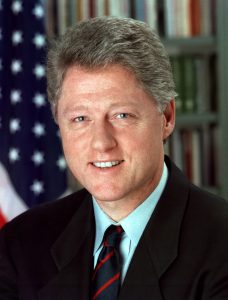
To understand the defining economic, political, and institutional realities of contemporary American democracy—the globalization of trade, the deregulation of financial markets, the ideological restructuring of the welfare state, the escalation of weaponized partisan warfare, and the constitutional boundaries of presidential accountability—one must examine the two-term presidency of William Jefferson Clinton. Serving as the forty-second chief executive from 1993 to 2001, Clinton was the first baby boomer to reach the White House, embodying the generational shift from the Cold War era to the age of global economic integration. A figure of extraordinary political talent, policy intellect, and deep personal flaws, Clinton steered the Democratic Party away from its traditional post-New Deal liberalism toward a centrist “Third Way”. In doing so, he presided over the longest economic expansion in American history and achieved the first federal budget surpluses in thirty years, yet his administration was continually engulfed by relentless personal scandals, culminating in only the second presidential impeachment in United States history.
The Boy from Hope and the Pursuit of Power Born William Jefferson Blythe III in Hope, Arkansas, in 1946—months after his biological father died in a car accident—the future president took the surname of his alcoholic, abusive stepfather, Roger Clinton. Elevated as the golden child of his family by his mother, Virginia, young Clinton displayed an early, insatiable hunger for political life and public approval. A pivotal moment occurred in the summer of 1963 when, as a sixteen-year-old delegate to Boys Nation, Clinton shook hands with President John F. Kennedy in the Rose Garden, an iconic encounter that cemented his ambition to pursue a career in public service.
Clinton attended Georgetown University’s School of Foreign Service, where he was deeply influenced by Professor Carroll Quigley’s historical philosophy of “future preference”—the belief that society progresses when individuals sacrifice present gratification for a better future. Winning a Rhodes Scholarship to Oxford University in 1968, Clinton managed his draft status amid the turmoil of the Vietnam War, securing a high lottery number (311) and writing a famous letter to University of Arkansas ROTC Colonel Eugene Holmes in which he expressed his deep opposition to the war while seeking to maintain his political viability. He went on to earn his law degree from Yale Law School, where he met fellow student Hillary Rodham, forming an intellectual and political partnership that would reshape American politics for decades.
Returning to Arkansas, Clinton lost a 1974 congressional race against Republican incumbent John Paul Hammerschmidt, but he quickly bounced back to win election as State Attorney General in 1976 and Governor in 1978 at the age of thirty-two, becoming the youngest governor in the nation. After suffering a devastating re-election defeat in 1980 to Republican Frank White, Clinton partnered with political consultant Dick Morris to pioneer the “permanent campaign”. Broadcasting a televised apology for raising vehicle license fees, Clinton reclaimed the governorship in 1982 and served for the next decade. During his second act as governor, he championed statewide education standards and teacher testing while serving as chairman of the Democratic Leadership Council (DLC), a coalition of moderate, mostly Southern Democrats dedicated to pulling the national party back toward the political center.
“Putting People First” and the 1992 Realignment Launching his presidential campaign in late 1991 at the Old State House in Little Rock, Clinton presented himself as a “New Democrat” who offered a “New Covenant” uniting opportunity with personal responsibility. Despite facing severe campaign turbulence over draft avoidance and allegations of extramarital affairs, Clinton outmaneuvered his rivals through disciplined communication and policy mastery. Guided by campaign strategist James Carville’s famous internal slogan, “It’s the economy, stupid,” and his “Putting People First” platform, Clinton targeted middle-class economic anxieties amid the 1990–1991 recession. In a three-way race against incumbent President George H. W. Bush and populist billionaire Ross Perot, Clinton won the 1992 election with 43 percent of the popular vote, breaking twelve years of Republican control of the White House.
Upon taking office in 1993, Clinton faced immediate resistance over his attempt to lift the ban on gay service members in the military, resulting in the controversial “Don’t Ask, Don’t Tell” compromise. To tackle the mounting national debt inherited from the Reagan-Bush era, Clinton made a pivotal strategic decision to prioritize deficit reduction over immediate middle-class tax cuts or massive public investments. His 1993 Omnibus Budget Reconciliation Act passed without a single Republican vote, raising marginal income tax rates on high earners while expanding the Earned Income Tax Credit. The fiscal discipline enforced by the 1993 budget laid the groundwork for lower interest rates, a surging bond market, and rapid economic growth.
However, Clinton suffered a catastrophic domestic defeat over health care reform. He appointed First Lady Hillary Clinton to chair the President’s Task Force on National Health Care Reform, which crafted a complex, 1,300-page proposal for universal coverage. The effort collapsed under intense opposition from small businesses, insurance lobbies, and congressional Republicans, who successfully framed the plan as an unwieldy bureaucratic expansion.
The Republican Revolution, Triangulation, and the New Economy The failure of health care reform, combined with conservative anger over the 1993 budget and federal gun control legislation, sparked a political backlash. In the 1994 midterm elections, House Republicans led by Newt Gingrich enacted their “Contract with America,” capturing majorities in both houses of Congress for the first time in forty years. Stripped of his legislative majorities and facing questions about his political relevance, Clinton adopted the strategy of “triangulation” engineered by Dick Morris. By positioning himself between traditional liberal Democrats and hardline conservative Republicans, Clinton co-opted popular conservative issues while defending core social safety programs.
In his 1996 State of the Union address, Clinton famously declared that “the era of big government is over,” signaling a dramatic ideological shift. Later that year, over the furious objections of liberal Democrats and civil rights leaders, Clinton signed the Personal Responsibility and Work Opportunity Reconciliation Act, fulfilling his campaign pledge to “end welfare as we know it” by replacing Aid to Families with Dependent Children (AFDC) with block grants and work requirements. He had previously signed the Violent Crime Control and Law Enforcement Act of 1994, which expanded federal death offenses, funded 100,000 community police officers, and incentivized mass incarceration.
Furthermore, Clinton embraced the neoliberal economic consensus. He fought fiercely against labor unions to secure congressional passage of the North American Free Trade Agreement (NAFTA) in 1993, backed the creation of the World Trade Organization (WTO), normalized trade relations with China, and supported sweeping deregulation of Wall Street and the financial services sector. He appointed business-friendly, Chicago School-influenced jurists Ruth Bader Ginsburg and Stephen Breyer to the Supreme Court. Driven by booming technology sectors, low inflation, and federal fiscal restraint, the American economy experienced unprecedented growth, generating millions of jobs and producing federal budget surpluses by the end of his second term.
Foreign Policy and Post-Cold War Interdependence In foreign affairs, Clinton sought to navigate a post-Cold War landscape defined not by superpower confrontation, but by global interdependence and market integration. However, his administration initially struggled with post-Cold War regional conflicts. Following the tragic death of eighteen American soldiers during a 1993 peacekeeping mission in Mogadishu, Somalia, Clinton withdrew U.S. forces and subsequently demonstrated fatal hesitation during the 1994 Rwandan genocide.
Gradually, Clinton asserted a more active military posture. He deployed U.S. forces to restore democratically elected President Jean-Bertrand Aristide in Haiti in 1994 and brokered the 1995 Dayton Accords to end the bloody war in Bosnia. In 1999, Clinton led NATO in a 78-day bombing campaign against Serbia to halt Slobodan Milošević’s ethnic cleansing of Albanians in Kosovo. In diplomatic arena, Clinton actively mediated international disputes, facilitating the 1993 Oslo Accords between Israel and the Palestine Liberation Organization and helping negotiate the historic 1998 Good Friday Accords in Northern Ireland.
Concurrently, his administration faced the rising threat of transnational terrorism. Following the 1998 al-Qaeda bombings of U.S. Embassies in Kenya and Tanzania, Clinton ordered cruise missile strikes against terrorist training camps in Afghanistan and a pharmaceutical facility in Sudan. Through Presidential Decision Directive 62 (PDD-62), Clinton elevated counterterrorism coordinator Richard Clarke and placed increased focus on neutralizing Osama bin Laden, though intelligence and operational constraints prevented bin Laden’s elimination before Clinton left office.
Scandal, Impeachment, and the Legacy of Partisanship Throughout his presidency, Clinton’s domestic achievements were shadowed by a relentless series of legal investigations and personal scandals. What began as an inquiry into an unsuccessful 1970s Arkansas real estate venture known as Whitewater expanded into a wide-ranging federal investigation led by Independent Counsel Kenneth Starr. Simultaneously, Clinton faced a federal civil rights lawsuit brought by Paula Jones, who alleged that Clinton had made improper sexual advances toward her in an Arkansas hotel room in 1991. In the landmark 1997 decision Clinton v. Jones, the Supreme Court unanimously rejected the president’s claim of temporary immunity from civil litigation while in office, allowing the suit to proceed.
During a sworn deposition in the Jones case in January 1998, Clinton denied under oath having a sexual relationship with a twenty-two-year-old White House intern named Monica Lewinsky. When evidence of the affair surfaced, First Lady Hillary Clinton publicly denounced the allegations as the product of a “vast right-wing conspiracy,” while the president publicly insisted, “I did not have sexual relations with that woman”. However, after DNA evidence confirmed the relationship, Clinton was forced to admit the affair during grand jury testimony in August 1998.
In December 1998, the Republican-controlled House of Representatives voted to impeach President Clinton on two articles: perjury before a federal grand jury and obstruction of justice. Clinton became only the second president in history to be impeached. During the Senate trial in early 1999, house managers argued that the president had violated his oath of office and subverted the rule of law. Clinton’s defenders argued that his private misconduct did not rise to the constitutional threshold of “high crimes and misdemeanors” required to overturn a national election. In February 1999, the Senate acquitted Clinton on both counts, failing to reach even a simple majority on either charge, far short of the two-thirds threshold required for removal.
Conclusion Bill Clinton departed the presidency in January 2001 with a 65 percent approval rating, the highest exit rating for any outgoing president since World War II. He left behind an American republic experiencing remarkable material prosperity, budget surpluses, and global power. Yet his presidency permanently altered the American political fabric. By embracing market-based economic policies, welfare reform, and fiscal restraint, Clinton proved that a Democratic executive could govern successfully in a conservative era. However, the fierce personal and legal battles that defined his tenure entrenched a culture of deep partisan hostility and institutional distrust that continues to divide American democracy today.