

The Birthright Citizenship Ruling and the Faltering 14th Amendment
On the final day of its term, June 30, 2026, the United States Supreme Court handed down its decision in Trump v. Barbara, addressing one of the most foundational promises of the American republic: birthright citizenship. The Court’s majority struck down President Donald Trump’s Executive Order 14160, which had attempted to deny citizenship to the children of unauthorized immigrants and temporary foreign visitors. While the ultimate outcome preserved the Constitution’s guarantee that those born on American soil are American citizens, the margin of the decision is nothing short of a scandal. Birthright citizenship survived by a single vote in a 5-4 ruling, revealing that a once-fringe, nativist legal theory is terrifyingly close to dismantling the bedrock of the Reconstruction Amendments. As civil rights advocates accurately noted, “This should have been a 9-0 decision”.
To understand the sheer radicalism of the four dissenting justices, one must understand the historical context of the Fourteenth Amendment. Before the Civil War, the United States lacked a unified constitutional definition of citizenship. This catastrophic ambiguity allowed the Supreme Court to issue its odious 1857 decision in Dred Scott v. Sandford, where Chief Justice Roger Taney ruled that Black Americans, whether enslaved or free, were an “inferior class” who possessed “no rights or privileges” and could never be citizens. Dred Scott violently replaced the traditional English common law principle of jus soli (the “right of the soil,” where citizenship is established by birthplace) with a system of blood and racial caste.
Following the Civil War, the Reconstruction Congress deliberately mobilized to permanently destroy the Dred Scott ruling. They passed the Civil Rights Act of 1866 and subsequently ratified the Fourteenth Amendment in 1868, explicitly enshrining the principle of jus soli into the nation’s highest law. The Citizenship Clause dictates: “All persons born or naturalized in the United States, and subject to the jurisdiction thereof, are citizens of the United States”. The framers of the amendment intended this language to be a universal, anti-caste engine that guaranteed equal citizenship to everyone born on U.S. soil, with only narrow, traditional exceptions for the children of foreign diplomats or hostile occupying armies. Three decades later, the Supreme Court unequivocally confirmed this in the landmark 1898 case United States v. Wong Kim Ark, holding that a child born in the U.S. to Chinese immigrant parents was an American citizen from birth, despite the draconian Chinese Exclusion Act of that era.
For more than a century, this understanding was settled law. Even in the dark days of 1942, amidst intense anti-Japanese fervor and the internment of Japanese Americans, federal courts quickly shut down lawsuits attempting to argue that children of Japanese descent born in the U.S. were “enemy aliens” ineligible for birthright citizenship. The Supreme Court declined to even hear the appeal, viewing the challenge as an absolute non-starter.
However, during Donald Trump’s political ascent, a fringe academic theory began gaining traction within the conservative legal movement. This theory argued that the phrase “subject to the jurisdiction thereof” did not mean simply being subject to U.S. laws, but rather required “domicile” or primary political allegiance to the United States. Under this twisted interpretation, unauthorized immigrants and temporary visitors remain “subject to a foreign power,” and therefore their U.S.-born children do not qualify for constitutional birthright citizenship. On January 20, 2025, President Trump codified this fringe theory into law by issuing an executive order cutting off citizenship for the children of unauthorized and temporary immigrants.
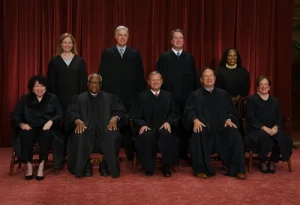
In Trump v. Barbara, Chief Justice John Roberts, joined by Justice Amy Coney Barrett and the three liberal justices (Sotomayor, Kagan, and Jackson), struck the order down. Roberts’s majority opinion meticulously traced the history from the English common law through the ratification debates, confirming that any child born on U.S. soil—excepting narrow diplomatic or tribal exclusions of the era—is automatically a citizen, regardless of their parents’ immigration status.
But four conservative justices—Clarence Thomas, Samuel Alito, Neil Gorsuch, and Brett Kavanaugh—signaled their willingness to gut this fundamental constitutional right. Justice Kavanaugh concurred in the judgment only because he believed the executive order violated an existing federal immigration statute (8 U.S.C. §1401(a)), but he explicitly dissented on the constitutional issue, arguing that the Fourteenth Amendment does not guarantee citizenship to the children of unauthorized immigrants. Justices Thomas and Gorsuch wrote that the Citizenship Clause required “domicile”—a permanent legal home—meaning the children of temporary or unlawful visitors are excluded. Justice Alito argued that the amendment only applies to those who owe “complete allegiance” to the U.S. and are not “subject to any foreign power”.
The implications of the dissenters’ views are nothing short of dystopian. If these four justices had secured just one more vote, the Supreme Court would have authorized the creation of a permanent, hereditary caste of non-citizens born and raised within the United States. As legal commentators have pointed out, the implementation of this scheme would be ghastly: the government would be required to deploy federal agents to maternity wards to interrogate new parents, verify their immigration status and “allegiance,” and potentially deport infants shortly after birth to countries they have never known. Those who evaded deportation would live permanently in the shadows, rendered stateless and stripped of the right to legally work, vote, or exist as equal members of society.
As Justice Ketanji Brown Jackson eloquently noted in her concurring opinion, the Reconstruction Amendments were designed as “an anticaste, antisubordination reset for the Nation”. The dissenting conservative justices’ willingness to ignore this history and repurpose the Fourteenth Amendment into a tool for exclusion is a profound betrayal of that legacy.
The fact that Donald Trump came within one vote of legally redefining the American citizenry demonstrates a terrifying reality: the conservative supermajority on the Supreme Court is entirely willing to entertain legal arguments designed to constitutionalize the administration’s authoritarian and nativist agenda. The survival of birthright citizenship should be a moment of relief, but the 5-4 margin serves as a blaring siren that none of the republic’s foundational rights are safe from the forces of democratic regression.