

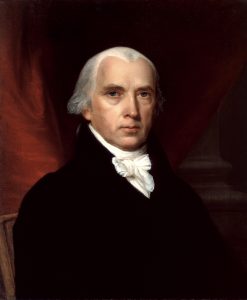
In 1827, a Philadelphia lawyer named Charles Ingersoll gave a public toast proclaiming that if George Washington was the father of the country, James Madison was entitled to be considered the “father of that Constitution”. History has largely cemented this title, remembering Madison as the brilliant, bookish theorist who designed the American government. Yet, to understand the current crises engulfing the United States—the paralysis of Congress, the rise of the imperial presidency, the deluge of political disinformation, and the extreme polarization tearing the electorate apart—we must view Madison not merely as a constitutional philosopher, but as America’s first true national politician. Madison’s life demonstrates that the survival of the republic was designed to rely on the gritty, often frustrating machinery of politics and compromise, a machinery that today is breaking down.
The Extended Republic and the Antidote to Faction When Madison arrived at the Constitutional Convention in 1787, he brought with him the Virginia Plan, a radical redesign of the American government. Before the convention, Madison had obsessively studied the history of ancient and modern confederacies, concluding that an imperium in imperio—a government of governments—was a “solecism in theory” that inevitably substituted violence in place of law. He recognized an essential, ancient problem: in a democracy, people are inherently selfish, and a majority faction will inevitably use its power to oppress a minority and enrich itself.
Prior political philosophers believed that republics could only survive in small, homogenous territories where citizens shared common interests. Madison famously flipped this conventional wisdom on its head in his essay Federalist 10. He argued that a small republic was actually more dangerous because a single faction could easily take control. His solution was the “extended republic.” By expanding the nation across a vast territory, society would be broken down into a greater variety of interests, religious sects, and economic classes. In such a diverse nation, no single faction could form a majority to dominate the others; instead, they would be forced to check one another, negotiate, and ultimately compromise to find common ground.
Today, this Madisonian vision is in grave peril. The modern practices of extreme partisan gerrymandering and the rise of digital algorithms have effectively undone the extended republic. By packing voters into safe, hyper-partisan districts and informational echo chambers, modern politicians have recreated the exact “small republics” Madison feared—homogenous environments where dominant factions rule without ever needing to bargain, negotiate, or compromise with those who hold different views.
The Fear of the Executive and the Birth of Partisanship In Federalist 51, Madison articulated his famous doctrine of checks and balances, declaring that “ambition must be made to counteract ambition”. He believed that dividing power across three branches would prevent any one ambitious politician from becoming a tyrant. However, he grossly underestimated the eventual power of the presidency.
During the 1790s, Madison watched in horror as Alexander Hamilton, the Secretary of the Treasury, used his position to aggressively consolidate power. Madison suspected Hamilton of trying to emulate the British constitution by using financial patronage and executive power to corrupt the legislature and buy votes. To Madison, Hamilton’s vision of a strong executive guiding the nation was profoundly anti-republican. Madison believed that the legislature, as the direct representative of the people, should be the guiding force of government, and he abhorred the idea of an executive who operated above the law or favored a wealthy elite.
To combat this executive overreach, Madison effectively invented modern partisan opposition. Recognizing that “Public opinion is the real sovereign in every free” government, Madison and Thomas Jefferson established a partisan newspaper, the National Gazette, to expose what they saw as Hamilton’s monarchical plots and to mobilize the citizenry. Madison also championed the Postal Service Act of 1792, which subsidized the delivery of newspapers so that citizens across the vast republic could inform themselves about their government.
This history provides a stark contrast to the modern era. Where Madison utilized the press and public opinion as a vital check against authoritarianism and the centralization of executive power, today’s political leaders routinely demonize the free press and flood the public sphere with disinformation. Furthermore, the modern presidency has amassed powers that would have terrified Madison. When the current executive branch claims absolute immunity or bypasses Congress to unilaterally launch foreign strikes, it realizes the exact monarchical nightmare that Madison spent the 1790s fighting to prevent.
The Presidency and the Limits of Ideology Madison’s own presidency (1809–1817) revealed the severe limitations of his strict republican ideology. Madison did not share Hamilton’s belief in a “vigorous Executive” who actively intervened in congressional affairs. When faced with British depredations against American shipping, Madison relied on commercial coercion—such as the Nonintercourse Act—believing that the United States could dictate terms to European powers simply by withholding trade.
This proved disastrously wrong. Forced into the War of 1812, Madison became America’s first wartime president, leading a nation utterly unprepared for conflict. Decades of Jeffersonian and Madisonian insistence on small government had left the military gutted, the militia incompetent, and the credit markets too weak to fund a war.
Yet, Madison’s true greatness lay in his pragmatic ability to learn from his failures. Following the war, he abandoned his most rigid ideological constraints and called for a stronger national defense, the chartering of the Second Bank of the United States, and federal support for domestic industry. He brilliantly merged Hamiltonian economics with Madisonian politics, ensuring that the government facilitated national economic development in a fair, evenhanded manner that did not privilege one aristocratic faction over another.
The Defense of the Union and the Blind Spot of Slavery Like many of the Founders, Madison’s legacy is deeply marred by the paradox of human bondage. Despite his immersive education in the Enlightenment and his dedication to human liberty, he remained an enslaver throughout his life. He viewed non-whites as “savages” incapable of sustaining free government, and while he recognized intellectually that slavery was wrong, it never truly pricked his conscience enough to prompt him to use his vast political power to dismantle the institution.
However, in his final years, Madison fiercely defended the structural integrity of the American Union against the rising threat of states’ rights extremism. During the Nullification Crisis of the late 1820s and early 1830s, Southern politicians like John C. Calhoun claimed that individual states had the right to void federal laws or secede. Madison entered the public debate one last time to utterly demolish this theory. He argued that the Constitution was a binding compact that created “one people for certain purposes,” and that allowing a minority to thwart the rule of the majority by withdrawing from the compact would be fatal to the republic. In his final message, “Advice to My Country,” Madison warned Americans that the enemies of the Union should be regarded “as the Serpent creeping with his deadly wills into Paradise”.
Conclusion James Madison’s life serves as a profound historical lens for diagnosing the ailments of modern America. He engineered a republic that did not rely on the inherent goodness of its leaders, but rather on a structural balance where competing ambitions and diverse factions would be forced to negotiate. Today, as political factions refuse to compromise, as the executive branch operates with unchecked impunity, and as extreme partisanship replaces the pursuit of the general welfare, the United States is experiencing a catastrophic failure of the Madisonian design. Madison taught us that a republic can span a continent, but only if its leaders and citizens commit to the exhausting, equitable, and necessary work of politics.