

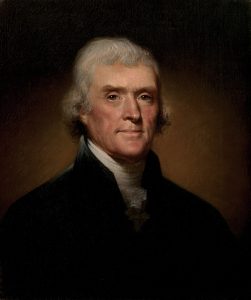
If George Washington established the dignity of the American executive and John Adams demonstrated its vulnerability to partisan paranoia, Thomas Jefferson embodies both the highest ideological aspirations and the darkest, most profound contradictions of the American republic. To understand the current crises of our modern era—the fragility of the peaceful transfer of power, the weaponization of executive authority, the bitter wars over press freedom, and the fierce cultural battles over how we teach the history of race and slavery—one must look intimately at the third president. Jefferson was a visionary whom historians have aptly called a “Futurist”, yet he was also a politician who compromised his own strict principles when wielding federal power, and a philosopher of human liberty who perpetuated human bondage.
The “Revolution of 1800” and the Peaceful Transfer of Power Jefferson referred to his election as the “revolution of 1800,” believing that his victory over John Adams was as real a revolution in the principles of government as 1776 was in its form. Yet, unlike the bloody revolutions of Europe, this one was achieved peacefully at the ballot box. When Jefferson took the oath of office in March 1801, the young nation had just survived a grueling, hyper-partisan election that severely tested the new Constitution.
Rather than arriving in a gilded carriage to project monarchical authority, the fifty-seven-year-old Jefferson dressed plainly and simply walked—or strolled—from his boarding house to the unfinished Capitol building in Washington, D.C.. His first inaugural address remains a masterclass in democratic forbearance and the necessity of unity after a bitter election. Rejecting the impulse to purge his political enemies or criminalize the opposition (as Adams had done with the Alien and Sedition Acts), Jefferson sought to heal the nation’s hyper-partisanship. “We are all republicans, we are all federalists,” he declared.
In a direct rebuke to authoritarianism, he established a foundational American doctrine regarding the tolerance of dissent: “If there be any among us who would wish to dissolve this Union or to change its republican form, let them stand undisturbed as monuments of the safety with which error of opinion may be tolerated where reason is left free to combat it”. At a time when modern politicians frequently threaten to jail their rivals or refuse to accept electoral defeat, Jefferson’s commitment to a peaceful, tolerant transition of power stands as a vital democratic anchor. Furthermore, despite his massive popularity, Jefferson voluntarily retired after two terms, honoring the precedent set by Washington and warning that without such term limits, the presidency “will in fact become for life”.
Freedom of the Press and the Crucible of Scandal Jefferson’s commitment to tolerating “error of opinion” was severely tested by a vicious, unrestrained press. If modern leaders complain of “fake news,” they face nothing compared to the partisan artillery leveled at Jefferson. During his first term, a vengeful scandalmonger named James Thomson Callender—whom Jefferson had previously supported—turned on the President and published sensational, scandalous allegations.
Callender broke the story of “Dusky Sally,” alleging that the President kept a slave concubine at Monticello named Sally Hemings and had fathered several children with her. Callender also publicized the “Walker affair,” revealing that a younger Jefferson had once made improper advances toward the wife of his friend John Walker. These intensely personal, humiliating attacks were gleefully amplified by Federalist newspapers across the country, particularly in New England, where clergymen and politicians denounced Jefferson as an atheist and an immoral “wretch”.
Yet, how did Jefferson respond? Unlike modern executives who threaten to alter libel laws, revoke broadcast licenses, or utilize the Justice Department to punish critics, Jefferson relied on a “dignified silence”. Though he privately admitted the Walker indiscretion to close aides, he never publicly dignified the attacks. More importantly, he refused to use the power of the federal government to crush the journalists who tormented him. In his second inaugural address, he noted that despite the “artillery of the press” leveling falsehoods against him, he had left discussion wholly free, relying on the “censorship of public opinion” and the good sense of the electorate to judge the truth.
The Expansion of Empire and the Malleability of Power In theory, Jefferson was a “strict constructionist” who believed the federal government possessed only the exact powers explicitly written in the Constitution. In practice, however, the responsibilities of the presidency forced him to bend his own rules, demonstrating how executive power invariably expands.
His greatest achievement, the Louisiana Purchase of 1803, doubled the size of the United States and secured the Mississippi River. Jefferson believed this vast territory would provide land for generations of yeoman farmers, creating an “empire of liberty”. However, the Constitution contained no provision authorizing the President to buy foreign territory. Jefferson initially drafted a constitutional amendment to legalize the purchase, but when his advisers warned that delays might cause Napoleon to back out of the deal, Jefferson quietly dropped his scruples and pushed the treaty through. He pragmatically concluded that “the laws of necessity, of self-preservation, of saving our country when in danger, are of higher obligation” than strict adherence to written law.
This pragmatic expansion of power took a darker, more authoritarian turn during his second term with the Embargo Act of 1807. Desperate to keep the U.S. out of the raging war between Britain and France, and furious over the British impressment (kidnapping) of American sailors, Jefferson convinced Congress to ban all American vessels from sailing to foreign ports. To enforce this peacetime embargo, Jefferson assumed unexampled executive authority, deploying the military against American civilians who tried to smuggle goods, and dictating the economic affairs of individuals to an unprecedented degree. The philosopher who championed laissez-faire and minimal government ended his presidency utilizing draconian federal force to crush the economic liberties of his own citizens, proving that even the most liberty-loving leaders can succumb to the temptations of state coercion during a crisis.
The Great Contradiction: Slavery and American Memory Finally, one cannot understand the modern culture wars over American history without confronting Jefferson’s relationship with slavery. As the author of the Declaration of Independence, he penned the immortal words: “We hold these truths to be self-evident, that all men are created equal”. Yet, when he wrote those words, he owned hundreds of enslaved Black people.
Modern efforts by right-wing lawmakers to ban critical examinations of race, or the Trump administration’s “1776 Commission,” attempt to erase or sanitize this contradiction, presenting Jefferson in hagiographic terms as a dignified planter while rendering the human beings he enslaved invisible. Conversely, initiatives like the 1619 Project argue that to understand America, we must place this paradox at the center of our national origin story.
Jefferson was profoundly aware of his own hypocrisy. In his Notes on the State of Virginia, he admitted that slavery was a moral and political depravity, famously writing: “I tremble for my country when I reflect that God is just; that his justice cannot sleep forever”. Yet, his practical needs and ideological blind spots kept him an enslaver throughout his life. He calculated the economic value of enslaved people with chilling precision, noting that a “woman who brings a child every two years is more profitable than the best man of the farm” because her children were an “addition to capital”.
The reality of the Hemings family at Monticello makes this history profoundly intimate. The enslaved woman Sally Hemings, who was by all accounts the half-sister of Jefferson’s deceased wife, bore several children whose descendants claim Jefferson as their father. While Jefferson agonized over the institution of slavery, he ultimately gave up on the expectation of any early emancipation. Believing that a multi-racial democracy was impossible due to deep-rooted prejudices, he advocated for “colonization”—the idea that enslaved people should be freed but immediately deported to Africa.
Conclusion Thomas Jefferson once wrote to James Madison that “the earth belongs in usufruct to the living,” arguing that the dead have no right to bind succeeding generations with massive debts or obsolete laws. He fiercely opposed the accumulation of national debt, recognizing that placing the financial burdens of the present onto the shoulders of the unborn was a form of tyranny.
As we navigate an era of exploding national debt, extreme political polarization, and bitter disputes over the nature of American democracy, Jefferson’s legacy requires us to do exactly what he advised: look to the living. We cannot rely on a sanitized, mythical version of the Founding Fathers to save us. Jefferson left us the most powerful articulation of human equality the world has ever known, even as he himself failed to live up to it. His presidency proves that the American experiment is vast, messy, and fundamentally reliant not on flawless demigods, but on the vigilance, reason, and ongoing struggles of the people.