

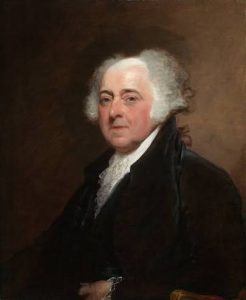
To understand the current crisis of American democracy—marked by the weaponization of the justice system, the demonization of the press, and the invocation of archaic laws to justify mass deportations—one must look back to the presidency of John Adams. While George Washington established the vital precedent of the peaceful transfer of power by voluntarily stepping down, it was his successor, John Adams, who first demonstrated how quickly a highly educated, patriotic leader could succumb to authoritarian impulses when faced with intense partisan division.
The Burden of Succession and the Anxious Executive When John Adams was sworn in as the second president of the United States in March 1797, following the first contested presidential campaign in American history, he faced an impossible task. Any president who followed Washington was doomed to seem illegitimate for a time, a mere “pretender to the throne”. The 1796 election had been razor-thin; Adams narrowly edged out Thomas Jefferson by 71 electoral votes to 68, resulting in a fractured administration where his bitter political rival served as his vice president.
Temperamentally, Adams was the exact opposite of his predecessor. Where Washington possessed the “gift of silence” and immense self-command, Adams was short, paunchy, highly articulate, and fiercely argumentative. He was a farsighted prophet of independence and a brilliant political thinker, but he was also deeply insecure and envious. Benjamin Franklin perfectly captured Adams’s brilliant but volatile nature, observing that he “means well for his Country, is always an honest Man, often a Wise One, but sometimes, and in some things, absolutely out of his senses”.
Throughout Washington’s administration, Adams had served as vice president, a role he absolutely despised. He famously complained to his wife, Abigail, “My country has, in its wisdom, contrived for me the most insignificant office that ever the invention of a man contrived or his imagination conceived”. Adams was tormented by the fear that history would reduce him to a minor footnote, while Washington and Franklin would be glorified as the sole protagonists of the American founding. He bitterly joked that future historians would simply write that “Dr. Franklin’s electrical rod smote the earth and out sprung General Washington,” and that those two alone conducted the Revolution.
Partisanship and the Descent into Paranoia When Adams finally achieved the presidency, he inherited a nation tearing itself apart over foreign policy and domestic factionalism. Like Washington, Adams viewed himself as an incorruptible figure who could rise above the bane of political parties, but his political enemies relentlessly tagged him as a monarchist and an elitist Federalist. Stranded between political extremes, Adams complained that “All the Federalists seem to be afraid to approve anybody but Washington,” while the opposition’s “Jacobin papers damn with faint praise and undermine with misrepresentation and insinuation”.
Adams was equally suspicious of his vice president, Thomas Jefferson. Dismissing Jefferson’s claims of philosophical detachment from politics, Adams saw a man ruthlessly plotting for power. “He is as ambitious as Oliver Cromwell,” Adams fumed, declaring that Jefferson’s soul was “poisoned with ambition”.
The Alien and Sedition Acts: A Historical Warning This toxic cocktail of profound personal insecurity, a hostile press, and deep partisan animosity culminated in the darkest chapter of the Adams presidency—an episode that provides vital historical context for the abuses of executive power we see today.
In 1798, amidst growing geopolitical tensions and the threat of an undeclared naval war with France, Adams sought to consolidate his power and crush his domestic critics. Driven by fear, the Federalist-controlled Congress passed, and President Adams signed, the Alien and Sedition Acts—a series of four laws that fundamentally suppressed political opposition and tightened the President’s unilateral control over immigration.
The legislation was a blatant weaponization of the law designed to destroy the Democratic-Republican party led by Thomas Jefferson. The Sedition Act essentially criminalized dissent, making it illegal to publish “false, scandalous, and malicious writing” against the government or the president. Under this draconian law, the Adams administration actively prosecuted and jailed opposition newspaper editors and political adversaries simply for criticizing the president’s policies.
Simultaneously, the administration targeted immigrants, who were largely perceived to be sympathetic to the French and reliable voters for Jefferson’s party. One of these four laws was the Alien Enemies Act, which purported to allow the president to unilaterally detain and deport non-citizens from a hostile nation without due process. This architecture of state-sanctioned xenophobia and censorship was justified under the guise of “national security,” but its true purpose was to establish total political dominance for the Federalist Party.
The Echoes in the Present The history of John Adams and the Alien and Sedition Acts is not merely a piece of eighteenth-century trivia; it is a blaring siren for the modern era. When the current administration labels the press the “enemy of the people,” threatens to revoke broadcast licenses of critical networks, and seeks to punish political opponents using the Department of Justice, it is utilizing the exact authoritarian playbook pioneered during the Adams administration.
Even more alarmingly, the modern executive branch’s threats to execute mass deportations of immigrants and bypass constitutional due process frequently rely on the invocation of the very same 1798 Alien Enemies Act passed under Adams.
John Adams was a genuine patriot who risked his life for American independence, yet his presidency proves that even the most brilliant architects of a republic are capable of dismantling its liberties when consumed by partisan paranoia and a desire to silence their critics. His legacy serves as a profound warning that the temptation to weaponize the government against political adversaries, criminalize journalism, and scapegoat immigrants is deeply woven into American history—and that the survival of democracy requires constant, vigilant resistance against these tyrannical impulses.