

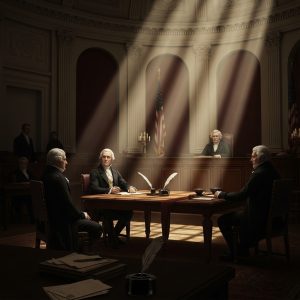
When the framers drafted the U.S. Constitution, the text was entirely silent on whether the Supreme Court had the authority to strike down laws, a power no English court possessed. The resolution to this massive constitutional ambiguity came out of a fierce partisan dispute during the early days of the Republic.
Following the bitter election of 1800, defeated incumbent John Adams and the Federalist party sought to retain their influence by packing the judiciary with loyalists before Thomas Jefferson’s Democratic-Republican administration took over. John Marshall, serving simultaneously as Adams’s Secretary of State and the newly appointed Chief Justice of the Supreme Court, failed to deliver several of these “midnight” commissions before Adams’s term expired. One frustrated appointee, William Marbury, sued the new Secretary of State, James Madison, demanding his commission. Marbury filed his suit directly in the Supreme Court, seeking a writ of mandamus (a court order compelling a government official to act) based on a provision in the Judiciary Act of 1789.
Chief Justice Marshall faced a perilous political trap: if he ordered the Jefferson administration to deliver the commission, they would almost certainly ignore the order, exposing the Court’s impotence. Furthermore, there was a real threat that Jefferson’s allies in Congress might try to impeach the Federalist justices if they attempted to force the executive branch’s hand.
Marshall’s 1803 decision navigated this minefield with unmatched political brilliance. He began by affirming that Marbury did have a legal right to the commission and that the laws of the country afforded him a remedy. However, Marshall ruled that the Supreme Court could not issue the writ because the law Marbury relied on to bring the case directly to the Supreme Court—the Judiciary Act of 1789—was unconstitutional. Marshall argued that the Act impermissibly expanded the Supreme Court’s original jurisdiction beyond the strict limits established by Article III of the Constitution.
By denying Marbury his commission, Marshall gave Jefferson the immediate political victory he wanted, avoiding a direct confrontation. But in doing so, Marshall claimed a vastly greater power for the Court: the power of judicial review over legislative acts. Marshall famously declared, “It is emphatically the province and duty of the judicial department to say what the law is”. He reasoned that because the Constitution is the superior and paramount law, any ordinary legislative act repugnant to the Constitution must be void, and the courts are bound to govern cases by the Constitution rather than by conflicting statutes.
This landmark decision fundamentally transformed the American legal system by asserting the doctrine of judicial supremacy. It ensured that the Constitution functions as the supreme law of the land, and it cemented the federal judiciary’s role as its ultimate expositor. In a single stroke, an unelected branch of government asserted the ultimate authority to interpret the Constitution and invalidate the acts of democratically elected legislatures, permanently altering the balance of power in the Republic.