

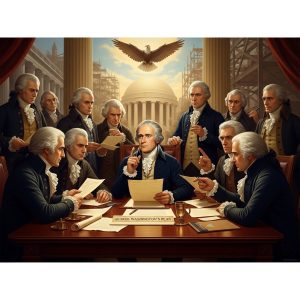
When George Washington appointed Alexander Hamilton as the first Secretary of the Treasury in 1789, the new nation was struggling under the weight of massive Revolutionary War debts and a fractured, primitive economy. Hamilton, who had served as Washington’s aide-de-camp during the war, understood intimately that a nation’s military and political survival depended on its economic strength. He recognized that “power without revenue is a bubble” and believed that for the United States to survive in a dangerous world, it needed a robust architecture of foreign commerce, sound money, and reliable government revenue.
To achieve this, Hamilton designed a brilliant, comprehensive system of political economy. While he admired the financial machinery of the British Empire, he adapted it to achieve uniquely American political, economic, and social ends—what he called rearing the “superstructure of American greatness”. His financial plan consisted of several interlocking parts: refunding the national debt, assuming the debts of the individual states, establishing a national bank, and generating revenue through moderate tariffs and excise taxes.
At the core of Hamilton’s architecture was a starkly realistic view of human nature and power. He believed that for the new federal government to survive, it had to explicitly ally itself with the wealthiest elements of society. In his 1790 Report on the Public Credit, Hamilton argued that if all public creditors received their payments from a single national source, they would be bound together in support of the government’s fiscal arrangements. He famously declared, “No society could succeed which did not unite the interest and credit of rich individuals with those of the state”. By having the federal government assume state debts and guarantee their repayment, Hamilton transformed the debt into liquid capital that could be traded and used for private investment, expanding the nation’s credit. Far from seeing debt as a burden, Hamilton famously argued that “A national debt, if it is not excessive, will be to us a national blessing. It will be a powerful cement of our union”.
To manage this new system, Hamilton proposed the First Bank of the United States in 1790, modeled closely after the Bank of England. The Bank would serve as the official depository of all federal funds and issue paper bank notes that could circulate as a reliable national currency.
However, Hamilton’s grand design horrified figures like Thomas Jefferson and James Madison, sparking the first great political crisis of the new republic. To these men, Hamilton’s system looked exactly like the “systematic corruption” that had decayed the British constitution. In eighteenth-century Britain, the Crown had used a national debt, a central bank, and corporate patronage to enrich a wealthy elite and buy the political loyalty of Parliament. Jefferson and Madison feared that Hamilton was acting as an aspiring Prime Minister, using his position at the Treasury and his newly erected “monied interest” to corrupt the legislature and pave the way for an American monarchy.
The opposition was fierce and ideological. Jefferson argued that the Constitution did not grant Congress the power to create a bank, warning that doing so opened up a “boundless field of power”. Hamilton countered with the doctrine of “implied powers,” arguing that a national bank was necessary to execute the government’s other constitutional duties. Jefferson ultimately viewed the Hamiltonian financial system as an existential threat, later writing that “a private central bank issuing the public currency is a greater menace to the liberties of the people than a standing army”. The Virginia legislature echoed this dread, formally petitioning Congress that concentrating such a large “moneyed interest” would result in “the prostration of agriculture at the feet of commerce” and prove “fatal to the existence of American liberty”.
Furthermore, to pay for this system, Hamilton utilized measures like the Whiskey Tax, which disproportionately hurt small, rural farmers. When desperate farmers in western Pennsylvania took up arms in 1794 to rebel against the tax, Hamilton personally led federal troops to crush the insurrection, proving that his new financial state possessed the coercive power to enforce its will.
Ultimately, Hamilton’s financial architecture was enacted, and it succeeded brilliantly in its primary goals: it established impeccable American credit, created a unified national market, and birthed the capitalist machinery that would propel the United States to global dominance. However, the profound ideological rift his policies caused—between those favoring a centralized financial empire and those fighting for an agrarian republic free from elite corruption—birthed the nation’s first political parties and set the stage for an enduring struggle over who truly controls the American economy.