

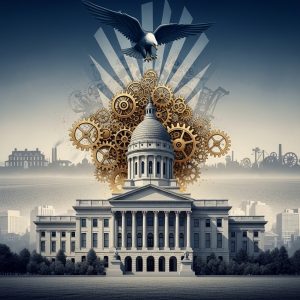
While the U.S. Constitution is universally revered as a political blueprint for a new republic, it is equally important to understand it as a foundational economic document. When the framers gathered in Philadelphia in 1787, they were not only attempting to forge a national government; they were seeking to protect property, establish credit, and stabilize an economy wracked by post-Revolutionary debt and popular uprisings. To achieve this, they had to confront a delicate dilemma: how to create a government derived from the people while simultaneously protecting the nation’s wealth from the potential whims of a democratic majority.
The framers harbored a deep fear that an unchecked populace could be easily swayed by populists. Alexander Hamilton warned in the Federalist Papers that those who overturn the liberties of republics often begin “by paying an obsequious court to the people; commencing demagogues, and ending tyrants”. To prevent a demagogue from capturing the presidency, the framers designed the Electoral College as a strict gatekeeping mechanism. Hamilton reasoned that this body of electors would act as a filter, ensuring the presidency would “seldom fall to the lot of any man who is not in an eminent degree endowed with the requisite qualifications,” effectively screening out politicians possessing mere “talents for low intrigue, and the little arts of popularity”. Similarly, the Constitution insulated the legislative and judicial branches from direct popular will: Senators were to be chosen by state legislatures, not the voters, and Supreme Court justices were appointed for life.
In structuring this new government, the Constitution systematically dismantled elements of “early democracy” that had been common in colonial America and early state constitutions. For centuries, early democratic practices heavily relied on binding “mandates” or “instructions”—legal directives issued by constituents that dictated exactly how their representatives must vote. The framers abandoned this practice, arguing that it destroyed the possibility of deliberation and allowed public passions to dictate policy. Furthermore, the Constitution replaced the traditional practice of annual elections with two-year terms for the House and six-year terms for the Senate. This transition established “modern democracy,” a system where political participation is broad but strictly episodic, creating a deliberate distance between the public and the levers of power.
This insulated structure was intentionally designed to protect private property from the demands of the masses. As the historian Charles Beard observed, the Constitution was largely drafted by men of wealth—manufacturers, moneylenders, land speculators, and slaveowners—who had a direct economic interest in establishing a strong federal government to protect their assets. James Madison bluntly acknowledged this in Federalist No. 10, writing that “the various and unequal distribution of property” was the primary source of factional disputes. Madison argued that the Constitution’s expansive, representative structure would successfully prevent a majority faction from enacting “a rage for paper money, for an abolition of debts, for an equal division of property, or for any other improper or wicked project”.
Tragically, the most consequential and heavily protected form of property in this new constitutional order was human beings. To secure the ratification of the Constitution, Northern and Southern delegates reached a series of compromises that deeply embedded the institution of chattel slavery into the nation’s legal framework, even as they carefully omitted the words “slave” or “slavery” to shroud their hypocrisy. The Constitution contained numerous clauses explicitly defending the property rights of enslavers. It prohibited the federal government from banning the international slave trade for twenty years. It included a Fugitive Slave Clause that forced free states to return enslaved people who had escaped bondage. Furthermore, it authorized Congress to summon militias to suppress “insurrections”—a provision Southerners demanded to ensure federal backing in the event of slave rebellions.
Most profoundly, the Three-Fifths Compromise counted each enslaved Black person as three-fifths of a citizen for the purpose of representation, despite granting them absolutely no rights. This mathematical formula granted slaveholding states outsized political power in both Congress and the Electoral College, essentially ensuring that pro-slavery advocates controlled the presidency and national policy until 1860.
Ultimately, the U.S. Constitution was a masterpiece of legal engineering that succeeded in its primary economic goals: it created a vast, integrated national market, established a stable system of credit, and aggressively protected property rights. However, by treating human beings as property and fiercely insulating the political system from the immediate will of the people, these constitutional compromises fundamentally shaped the American economic trajectory, cementing a racial and economic caste system that would eventually tear the nation apart.