

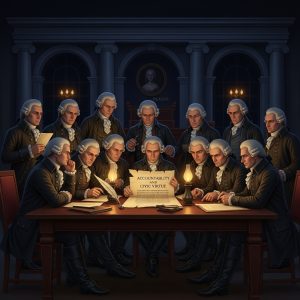
When the framers gathered in Philadelphia in 1787 to draft the U.S. Constitution, they were haunted by the historical collapse of ancient republics and the perceived decay of the British Empire. For the founding generation, the greatest threat to a republic was not necessarily foreign invasion, but an internal, organic cancer eating at the vitals of the body politic: corruption. Specifically, the framers were fixated on preventing what was known as “systematic corruption”. In eighteenth-century political thought, systematic corruption occurred when a central executive or a small faction deliberately manipulated the economy—granting monopolies, corporate charters, and economic privileges—to buy the political support of legislators. The founders deeply feared the British model, where the King used wealth and the promise of lucrative government jobs (patronage and “placemen”) to suborn the independence of Parliament and consolidate power. They believed that if politicians were allowed to serve private interests at the public’s expense, the American experiment would inevitably degenerate into a tyranny or an oligarchy. As Virginia delegate George Mason warned during the Constitutional Convention, “If we do not provide against corruption, our government will soon be at an end”.
To solve this crisis of human nature and governance, the framers relied heavily on the Enlightenment political philosophy of the French thinker Baron de Montesquieu. Montesquieu’s The Spirit of the Laws (1748) served as the chief authority and fountainhead of belief for the Constitutional Convention. Montesquieu argued that a successful democratic republic required “virtue,” which he defined as a passionate love of the laws and the country, and a constant preference for the public interest over private self-interest. However, Montesquieu and his American disciples were not naive idealists; they recognized that human nature is susceptible to greed and ambition. The framers rejected the purely cynical view of human nature championed by philosophers like Thomas Hobbes, believing instead that citizens were capable of being both self-regarding and publicly oriented. James Madison famously summarized this dual reality of human nature in Federalist No. 51: “If men were angels, no government would be necessary”.
Because men are not angels, the framers intentionally designed the U.S. Constitution as an architectural defense mechanism to curb the temptations of self-interest. Following Montesquieu’s theories, they instituted a strict system of checks and balances and a separation of powers, treating constitutional design as an engineering problem where ambition must be made to counteract ambition. To prevent the executive from acting like a corrupt British monarch, the Constitution carefully divided the power to appoint public officers between the president and the Senate, and strictly barred elected representatives from simultaneously holding appointed civil offices. The framers also divided the legislative branch into two distinct bodies—the House and the Senate—believing that the differing “genius” and size of the two chambers would make it vastly more difficult for corrupt, sinister combinations to take hold across the entire legislature.
Beyond the separation of powers, the founders relied on scale and ultimate accountability to thwart systemic corruption. Madison argued in the Federalist Papers that a large, extended republic would act as a buffer, making it much harder for wealthy individuals or foreign powers to buy off enough representatives to control the national government. Alexander Hamilton and his colleagues also designed the Electoral College as a gatekeeping mechanism to filter out demagogues who might use the “little arts of popularity” to win elections and rule as tyrants. Finally, as the ultimate safeguard against an executive who might subvert the constitutional order for personal or financial gain, the founders armed Congress with the power of impeachment.
The U.S. Constitution was not written under the assumption that politicians would always be perfectly virtuous. Rather, it was a pragmatic blueprint intended to align private self-interest with the public good, deliberately structuring the government so that the inevitable temptations of power could be checked, balanced, and ultimately restrained before they could destroy the republic.