

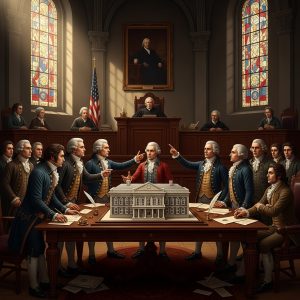
We now turn to a defining clash over the boundaries of federal and state power. While the framers of the Constitution had meticulously designed a system of dual sovereignty, the practical realities of governing quickly exposed deep fault lines. The most explosive of these early conflicts centered on the Second Bank of the United States, an institution that would prompt the Supreme Court to unequivocally define the hierarchy of American governance in the 1819 landmark case, McCulloch v. Maryland.
Following the War of 1812, the United States endured severe economic turmoil, prompting Congress and President James Madison to charter the Second Bank of the United States in 1816 to stabilize the nation’s credit and currency. However, the Bank failed to solve the country’s financial woes; in fact, many citizens and state governments blamed the Bank’s monetary policies for aggravating a crippling economic depression. State governments were particularly infuriated when the national Bank began aggressively calling in loans owed by the states. In retaliation, several states adopted punitive laws designed to cripple or expel the Bank’s operations within their borders. The state of Maryland took aggressive action, passing a law that required any bank not chartered by the state legislature to pay a prohibitive annual tax of $15,000, or a 2 percent tax on all its notes, which had to be printed on special stamped paper. When James McCulloch, the cashier of the Bank’s Baltimore branch, flatly refused to pay the tax, the state of Maryland sued him, catapulting the dispute to the U.S. Supreme Court.
The case forced Chief Justice John Marshall to confront a constitutional dispute that had been simmering since the earliest days of George Washington’s administration: Did Congress possess the authority to create a national bank in the first place? When the first Bank was proposed in 1790, Secretary of State Thomas Jefferson and Attorney General Edmund Randolph fiercely opposed Treasury Secretary Alexander Hamilton, arguing that the Constitution did not explicitly grant Congress the power to charter a corporation, and that doing so would usurp state prerogatives.
Marshall, writing for a unanimous Court, dismantled the Jeffersonian strict-constructionist argument. He acknowledged that the enumerated powers of Article I did not expressly include the establishment of a bank or the creation of a corporation. However, Marshall pointed out that the Constitution also did not contain any phrase excluding incidental or implied powers. Instead, he looked to the “Necessary and Proper” Clause, which empowers Congress to make all laws necessary and proper for carrying out its enumerated duties. Counsel for Maryland had argued for a rigid interpretation of this clause, insisting that “necessary” meant only those laws that were absolutely indispensable to the government’s functioning, thus severely limiting the choice of means available to Congress. Marshall rejected this restrictive view, arguing that it would be an “extraordinary departure from the usual course of the human mind” to interpret the word so narrowly as to cripple the legislature’s ability to choose the best methods to execute its powers. Consequently, the Court held that the Bank was constitutional, firmly establishing the doctrine that Congress possesses broad, implied powers to achieve its legitimate ends.
Having validated the Bank’s existence, Marshall then turned to the second existential question: Could a sovereign state tax a federal institution? Marshall unequivocally ruled that “the government of the United States, then, though limited in its powers, is supreme; and its laws, when made in pursuance of the constitution, form the supreme law of the land”.
To allow Maryland to tax the Bank would be to allow a subordinate entity to destroy a creation of the supreme government. Marshall famously articulated this danger by declaring, “That the power to tax involves the power to destroy”. He reasoned that the power to create implies a power to preserve, and that a state’s power to destroy a federal institution is fundamentally hostile and “repugnant” to the Constitution’s mandate of federal supremacy. As Marshall noted, if a state could tax the Bank of the United States, it could theoretically tax the mail, the mint, patent rights, or the federal courts themselves to an excess that would completely defeat the ends of the national government.
The American people, Marshall concluded, did not design a national government that was entirely dependent on the mercies of the states. In a resounding defense of federal supremacy, the Court ruled that the states “have no power, by taxation or otherwise, to retard, impede, burden, or in any manner control, the operations of the constitutional laws enacted by congress”. By striking down Maryland’s tax, McCulloch v. Maryland not only saved the Bank but permanently fortified the architecture of American federalism, ensuring that federal institutions would forever be protected from state-level destruction.