

When most people envision the United States, they picture a contiguous union of states bounded by the Atlantic and Pacific oceans, alongside Canada and Mexico—a familiar silhouette that political scientist Benedict Anderson called the “logo map”. However, this map is deeply misleading, as it excludes the reality of the “Greater United States,” a vast imperial entity that historically included massive territorial holdings, island colonies, and millions of disenfranchised subjects. The story of how this Greater United States was assembled is one of relentless territorial expansion, justified by a potent mix of political ideology and legal maneuvering.
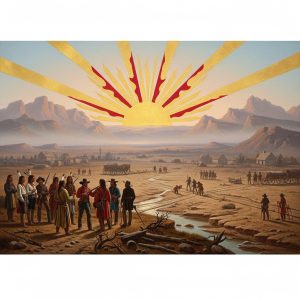
The ideological engine for this expansion was perfectly captured in 1845 when the United States Magazine and Democratic Review coined the phrase “manifest destiny”. The magazine declared that it was the nation’s “manifest destiny to overspread the continent allotted by Providence for the free development of our yearly multiplying millions”. However, this continent was not empty. To achieve this destiny, the U.S. government used a ruthless combination of deceptive diplomatic treaties and devastating warfare to displace Native Americans who already controlled the land.
Following the American Revolution, U.S. statesmen recognized Native nations as sovereign entities with the authority to govern themselves and occupy their territory, initiating diplomacy through agreements like the 1785 Treaty of Hopewell. These treaties recognized Native territorial sovereignty on paper but explicitly subordinated tribal nations to the “protection” of the United States, drawing strict geographical boundaries between Indigenous peoples and white Americans,,. Yet, these boundaries were almost immediately and continually violated by white squatters and settlers, whom the federal government often claimed it was powerless to stop,.
When diplomacy failed to secure land fast enough for white expansion, the U.S. turned to military force and mass expulsion. In 1830, President Andrew Jackson championed the Indian Removal Act, arguing that replacing a country “covered with forests and ranged by a few thousand savages” with an “extensive Republic” was a benevolent and “generous” act,,. Jackson’s political allies, such as Secretary of War Lewis Cass, provided the intellectual justification, arguing that “a barbarous people… cannot live in contact with a civilized community” and that their removal was necessary for the “progress of civilization”. The result was a series of brutal, forced migrations, most notoriously the Cherokee Trail of Tears, where thousands of Indigenous people died of exposure, disease, and starvation under military guard,. This ethnic cleansing was not merely about land hunger; it was directly tied to the expansion of American capitalism, intentionally opening up vast tracts of the American South for the highly profitable, slave-based cotton kingdom,.
As the nation pushed westward, expansion also meant war with rival nations. In 1846, President James K. Polk deliberately provoked a war with Mexico by ordering U.S. troops into disputed territory along the Rio Grande. The subsequent U.S. victory allowed the nation to annex a third of Mexico, including present-day California, Utah, Nevada, Arizona, and New Mexico,. Notably, while the U.S. military could have taken all of Mexico, politicians intentionally avoided annexing the heavily populated southern regions to prevent incorporating a large non-white population,. As Senator John C. Calhoun argued on the Senate floor, the U.S. had “never dreamt of incorporating into the Union any but the Caucasian race,” establishing a precedent of seizing valuable territory while refusing to absorb its inhabitants as equal citizens.
Having reached the Pacific Ocean, the American imperial drive did not stop; it merely moved offshore. It began modestly with the Guano Islands Act of 1856, which allowed U.S. citizens to claim uninhabited islands in the Caribbean and Pacific to mine their valuable bird fertilizer, legally establishing that the borders of the U.S. need not be confined to the continent,. By the end of the 19th century, the U.S. sought a much larger global footprint. Following the Spanish-American War of 1898, the U.S. claimed the bulk of Spain’s overseas empire, purchasing the Philippines and seizing Puerto Rico and Guam, while simultaneously annexing the independent nation of Hawaii,. By the time these treaties were ratified, the United States had gained an overseas empire of more than seven thousand islands and 8.5 million people.
This new “Greater United States” posed a profound legal and political dilemma: Did the U.S. Constitution apply to these new, heavily populated colonies? In 1901, the Supreme Court addressed this in a series of landmark rulings known as the Insular Cases. The government successfully argued that a “great world power” must not be bound by strict constitutional rules when governing colonies, asserting that the people of these new territories were subjects, not citizens,. The Supreme Court ruled that the Constitution did not automatically follow the flag; Congress possessed the power to “incorporate” territories slated for eventual statehood (like the western territories), while leaving overseas colonies “unincorporated”.
This legal framework formally legalized an American empire where millions of colonized subjects lived without full constitutional protections or democratic representation, existing in what the Chief Justice called an “intermediate state of ambiguous existence”. By recognizing the U.S. as a “Greater United States,” it becomes clear that Manifest Destiny was not merely a domestic policy of frontier settlement, but a continuous imperial project that fundamentally shaped the political boundaries, legal systems, and racial hierarchies of the nation.