

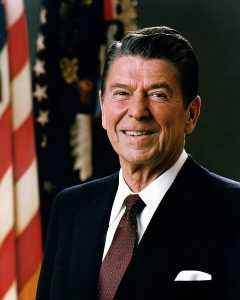
To understand the core tenets of modern American conservatism—the enduring skepticism toward federal regulation, the gospel of supply-side tax cuts, the realignment of working-class white voters, the influence of the Christian Right, and the ongoing debate over executive war powers and national security—one must examine the eight-year presidency of Ronald Wilson Reagan. Serving as the fortieth chief executive from 1981 to 1989, Reagan fundamentally reshaped the American political landscape. Rising from small-town Midwestern poverty and a career in Hollywood entertainment to become a two-term governor of California and a transformative president, Reagan launched a conservative movement that dismantled the post-New Deal consensus and redefined the relationship between the citizen and the state.
Born in Tampico, Illinois, in 1911, Reagan came of age during the Great Depression as an ardent admirer of Franklin D. Roosevelt and an active New Deal Democrat. His early career as a sports broadcaster and Warner Brothers film actor eventually led to his election as president of the Screen Actors Guild (SAG) during the turbulent Hollywood Red Scare of the late 1940s. During his tenure as a corporate spokesman for General Electric in the 1950s, Reagan underwent a dramatic political evolution, reading extensively in conservative literature and embracing a fierce anti-communist, free-market philosophy. His nationally televised 1964 speech on behalf of Barry Goldwater, titled “A Time for Choosing,” catapulted him to the forefront of the conservative movement. Elected Governor of California in 1966, Reagan established his political brand by taking a hard line against campus anti-war protesters at UC Berkeley, pushing welfare reform, and proving that an ideological conservative could govern pragmatically.
Capitalizing on national disillusionment over stagflation, energy shortages, and the Iran hostage crisis under President Jimmy Carter, Reagan won the presidency in a 1980 landslide. Campaigning on a promise to restore national pride and launch a “national crusade to make America great again,” Reagan forged a powerful new political coalition. He united traditional economic libertarians with social conservatives, evangelical Christians represented by the Moral Majority, and working-class “Reagan Democrats” alienated by racial busing and cultural shifts. In his memorable 1981 inaugural address, Reagan established the core doctrine of the Reagan Revolution, famously declaring that “in this present crisis, government is not the solution to our problem; government is the problem”.
At the center of Reagan’s domestic agenda was “Reaganomics,” a supply-side economic program aimed at curbing inflation, slashing tax rates, and reducing federal domestic spending. In 1981, following a near-fatal assassination attempt that dramatically boosted his public standing, Reagan pushed the historic Economic Recovery Tax Act through Congress, lowering individual income tax rates across the board. That same year, when over twelve thousand federal air traffic controllers (PATCO) staged an illegal strike, Reagan took an uncompromising stance, firing the striking workers and decertifying their union—a decisive action that signaled a sharp shift against organized labor across the private sector. Although the nation suffered a severe recession in 1981–1982, the economy subsequently embarked on a prolonged peacetime expansion. However, this economic growth was accompanied by staggering federal budget deficits and a nearly tripling of the national debt, driven by unprecedented peacetime defense spending and major tax reductions.
Reagan’s social policies and judicial appointments permanently altered the American legal and cultural landscape. To fulfill campaign promises to conservatives, his administration sought strict constructionist jurists, appointing Sandra Day O’Connor as the first female Supreme Court Justice, elevating William Rehnquist to Chief Justice, appointing Antonin Scalia, and nominating Robert Bork, whose fiery 1987 Senate rejection initiated modern ideological battles over judicial confirmations. Concurrently, his administration faced intense criticism from civil rights leaders for opposing key civil rights measures and from public health advocates for its slow, delayed response to the emerging HIV/AIDS epidemic during the 1980s.
In foreign affairs, Reagan rejected the post-Vietnam policy of détente in favor of an assertive posture designed to confront and roll back Soviet communism. He labeled the Soviet Union an “evil empire” and initiated a massive military buildup, which included the development of the Strategic Defense Initiative (SDI)—a proposed space-based missile defense shield dubbed “Star Wars”. Under the Reagan Doctrine, his administration provided covert military and financial aid to anti-communist insurgencies across the globe, including the Mujahideen in Afghanistan and the Contras in Nicaragua. In October 1983, following a Marxist coup, Reagan ordered a successful military invasion of the Caribbean island of Grenada, signaling a willingness to deploy American force directly.
The most severe crisis of Reagan’s presidency erupted during his second term with the exposure of the Iran-Contra affair in late 1986. Senior National Security Council officials, including Lieutenant Colonel Oliver North and Admiral John Poindexter, orchestrated secret, illegal arms sales to the hostile regime in Iran to secure the release of American hostages held in Lebanon. The proceeds from these illicit weapons transactions were secretly diverted to fund the Nicaraguan Contras in direct violation of the congressional Boland Amendment. The ensuing Tower Commission investigation exposed a disengaged executive management style, severely damaging Reagan’s public credibility and triggering his approval ratings’ steepest decline.
Despite the Iran-Contra scandal, Reagan achieved a historic diplomatic breakthrough in his final years in office. Recognizing that the new, reform-minded Soviet General Secretary Mikhail Gorbachev sought genuine economic restructuring (perestroika) and openness (glasnost), Reagan engaged in a series of historic summit meetings in Geneva, Reykjavik, Washington, and Moscow. Overcoming objections from conservative hardliners within his own party, Reagan and Gorbachev signed the landmark Intermediate-Range Nuclear Forces (INF) Treaty in 1987, eliminating an entire class of nuclear missiles. Standing before the Brandenburg Gate in West Berlin in June 1987, Reagan delivered his famous challenge: “Mr. Gorbachev, tear down this wall!”. Within months of Reagan leaving office in 1989, the Berlin Wall fell, and the Soviet bloc collapsed, peacefully concluding the Cold War.
Ronald Reagan left office in January 1989 with a 63 percent approval rating, having succeeded in restoring national self-confidence and cementing a conservative philosophy that governed American politics for decades. Whether through his tax policies, deregulation, judicial selections, or foreign interventions, Reagan left an indelible stamp on the presidency. His legacy established the foundational parameters of contemporary American politics, leaving an enduring debate over the proper role of government, market capitalism, and American power in the modern world.