

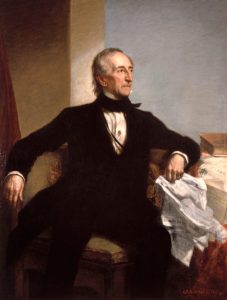
To understand the defining crises of the modern American presidency—the executive branch’s use of secret taxpayer slush funds, the brazen bypassing of Congress to wage war and enact policy, the weaponization of racial fear, and the ultimate willingness of a leader to betray the republic to cling to power—one must examine the administration of the tenth president, John Tyler. While he is often dismissed as a historical footnote or mockingly remembered as “His Accidency,” John Tyler was a highly consequential, iron-willed executive who birthed the imperial presidency and set the stage for the bloodiest conflict in American history. He also holds the dark distinction of being the only president in United States history to die a sworn enemy and traitor to his own country.
The Tyler Precedent and the Consolidation of Power When President William Henry Harrison died of pneumonia just a month after taking office in 1841, the Constitution was entirely ambiguous as to whether the vice president actually became the president or merely served as an “acting” placeholder. John Tyler, however, possessed ample forewarning of Harrison’s declining health and expertly calculated a seizure of absolute executive authority. He unilaterally declared that he was president “by the Constitution, by election, and by the act of God”.
This bold move established the “Tyler precedent,” ensuring a stable transition of power that remains in effect today. However, it also marked the beginning of Tyler’s breathtaking hypocrisy. He campaigned as a Jeffersonian “strict constructionist” who believed in states’ rights and a restrained executive branch. Yet, once safely installed in the White House, Tyler operated on the assumption that the Constitution “never designed that the executive should be a mere cipher”. He routinely vetoed Whig legislation, prompting his own party to officially expel him, burn him in effigy, and introduce the very first presidential impeachment proceedings in American history.
Secret Slush Funds and the Imperial Presidency Now an outcast “president without a party,” Tyler increasingly relied on secrecy and the unauthorized use of federal funds to achieve his political ambitions. Much like modern executives who exploit obscure appropriations to funnel money to ideological crusades, Tyler repeatedly abused the government’s “secret service fund”. Originally intended solely for overseas diplomatic negotiations, Tyler repurposed this contingency fund to finance a shadowy network of executive agents who operated entirely without congressional oversight.
In a shocking abuse of executive power, Tyler utilized taxpayer dollars from this secret fund to finance a domestic propaganda campaign against his own citizens. He dispatched operatives like Francis O. J. Smith to secretly manipulate public opinion in New England regarding the northeastern boundary dispute, fundamentally undermining the democratic process by propagandizing the American electorate. Tyler later justified this illegal domestic interference by claiming that “concealment was necessary for the public good,” an authoritarian rationale that completely bypassed the legislative branch’s constitutional “power of the purse”.
Slavery, Racism, and the Hypocrisy of Empire Tyler’s ultimate obsession was territorial expansion, specifically the annexation of the Republic of Texas. As a wealthy Virginia aristocrat, his pursuit of Texas was inextricably linked to his desire to protect the institution of slavery.
Like many of the Founders, Tyler privately recognized that slavery was an evil, yet he ruthlessly built his life and political career upon it. In 1827, to finance his journey to Washington to assume his seat in the U.S. Senate, Tyler put Ann Eliza, one of his family’s favorite house slaves, up for sale. If a family member would not buy her, Tyler ordered that she be sent “directly to the Hubbard’s” for public auction, proving that he was perfectly willing to fund his political ambitions by selling human beings on the auction block. During his presidency, abolitionist journalists even published credible allegations that Tyler had fathered multiple mixed-race children with his slaves, including sons named John and Charles, and subsequently sold his own flesh and blood for profit.
To sell the annexation of Texas to a skeptical Northern public, the Tyler administration resorted to base racial fearmongering. Tyler’s chief congressional spokesman, Senator Robert J. Walker, issued a blatantly racist screed warning that the true threat to the nation was “the presence of blacks,” not their enslavement. Walker argued that annexing Texas would create a “safety-valve” to drain free and enslaved blacks away from the North and the upper South, diffusing them into Mexico and Central America. Tyler wholeheartedly agreed with this draconian vision of racial cleansing, viewing territorial expansion as the only way to preserve a white supremacist, slaveholding republic.
Subverting the Constitution for Texas When Tyler’s initial treaty to annex Texas was defeated in the Senate because it failed to achieve the constitutionally mandated two-thirds majority, he refused to accept defeat. Driven by an overwhelming desire to secure his historical legacy, Tyler engineered a blatant constitutional subversion: he proposed annexing the foreign nation through a simple “joint resolution” of Congress, which required only a bare majority.
Veteran statesmen, including Albert Gallatin, denounced this maneuver as an “undisguised usurpation of power and a violation of the Constitution”. Yet Tyler and his southern allies pushed it through in the final days of his presidency. By recklessly discarding the Constitution’s treaty requirements to satisfy his imperial ambitions, Tyler successfully annexed Texas, but in doing so, he deliberately provoked a devastating and unjust war with Mexico that would be inherited by his successor, James K. Polk.
The Traitor President John Tyler spent his retirement masquerading as a venerated elder statesman, preaching the virtues of the Union. But when the election of Abraham Lincoln threatened the future expansion of slavery, Tyler abandoned the republic he had once sworn to protect. Terrified that remaining in the Union meant acknowledging African Americans as equal citizens, he openly mocked the idea that a black man like Frederick Douglass could ever sit in the U.S. Senate.
Tyler voted for Virginia’s secession, helped move the Confederate capital to Richmond, and was elected to the Confederate Congress. When John Tyler died in 1862, he was a sworn enemy of the United States. The Confederacy honored him with a massive 150-carriage funeral, but in Washington, President Lincoln and the federal government met his death with absolute silence. No flags were lowered; no proclamations were issued.
John Tyler’s life serves as a profound and terrifying historical warning. He proved that an executive can commandeer the government, bypass the Constitution through legislative loopholes, secretly deploy public funds to propagandize the citizenry, and utilize racial panic to achieve his political goals. Ultimately, Tyler demonstrates that a leader who relentlessly wraps himself in the rhetoric of “national destiny” may be the very same man who is perfectly willing to destroy the nation to preserve his own power and prejudices.