
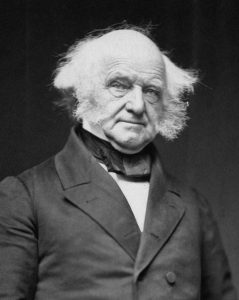
While Andrew Jackson was the fiery populist who shattered the old political order, his successor, Martin Van Buren, was the consummate manager who built the infrastructure of modern American politics. The first president not born a British subject, Van Buren was raised in a small Dutch village in New York, the son of a tavern keeper. Possessing none of Jackson’s natural magnetism, Van Buren was instead a brilliant tactician—a man whose political guile earned him the nickname “the Little Magician”. Today, as we grapple with intense hyper-partisanship, the purging of civil servants, the subversion of the judiciary, and the weaponization of the executive branch against vulnerable populations, we are living in the system Van Buren designed.
The Architect of the Mass Party The Founding Fathers generally despised political parties, viewing them as destructive factions that would tear the republic apart. Van Buren fundamentally rebelled against this consensus. He believed that a vibrant, organized party system was a positive good—a necessary mechanism to check the “Money Power” of the wealthy elite and ensure that the government was responsive to the majority.
To this end, Van Buren became the principal founder of the Democratic Party, effectively transforming democracy from an idea into an industry. He built an unprecedented political infrastructure of conventions, platforms, operatives, and party newspapers designed to mobilize the masses and win elections. However, maintaining this colossal machine required strict discipline and raw patronage. It was Van Buren’s “Albany Regency” in New York that pioneered the modern “spoils system,” routinely purging independent officials and replacing them with party loyalists. As his close ally William L. Marcy infamously declared on the Senate floor to defend Van Buren’s tactics: “to the victor belong the spoils of the enemy”. By replacing the Founders’ ideal of disinterested statesmanship with a fiercely loyal, patronage-driven partisan apparatus, Van Buren created the blueprint for the modern political machine.
The Panic of 1837 and the Dogma of Austerity Van Buren’s commitment to party ideology faced a catastrophic test the moment he assumed the presidency. He inherited the disastrous consequences of Jackson’s financial policies, particularly the “Specie Circular,” which mandated that federal lands be purchased exclusively with hard currency (gold and silver). This reckless experiment with the nation’s money market triggered a massive liquidity crisis known as the Panic of 1837. Across the country, banks suspended specie payments, businesses collapsed, and working people faced starvation as the price of flour and coal skyrocketed.
Despite desperate public outcry, Van Buren stubbornly refused to repeal the Specie Circular, calculating that abandoning Jackson’s policy would fracture his party’s western base. Instead, he pushed for an “Independent Treasury” to completely divorce banking from the federal government. Rather than using the power of the state to provide relief to a desperate populace, the president abandoned laissez-faire only to prescribe severe government austerity. He coldly declared that “the less government interfered with private pursuits the better for the general prosperity,” attempting to use the crisis to draw a stark partisan line against those who wished “to enlarge the powers of government”.
Authoritarian Compliance: Indian Removal and the Amistad The darkest aspect of Van Buren’s devotion to party unity was his willingness to appease his Southern base by prioritizing imperial expansion and the protection of slavery over basic human rights. Under his administration, the forced expulsion of America’s Indigenous populations east of the Mississippi River reached terrifying new levels of brutality. Van Buren ruthlessly executed the Trail of Tears and the Second Seminole War, recognizing that clearing Native lands for white settlement and slave plantations was essential for maintaining his political coalition.
Even more chilling in its modern parallels was Van Buren’s subversion of the rule of law during the Amistad affair. When captive Africans mutinied on the Spanish slave ship Amistad and ended up in U.S. custody, the case became a massive flashpoint. Terrified of antagonizing the Southern “Slave Power,” Van Buren’s administration actively sided with the slaveocracy against the captives. In a shocking violation of due process, the president colluded with his Secretary of State to secretly order a Navy schooner, the USS Grampus, to wait off the coast of Connecticut; if the judge ruled against the Africans, the administration planned to instantly deport them to Cuba before an appeal could even be filed. This “cunningly devised fraud,” as one newspaper accurately termed it, demonstrated a terrifying willingness by the executive branch to bypass the federal courts and execute unilateral deportations purely for political expediency.
The Fracture of the Machine and the Rise of Free Soil Ultimately, the political machine Van Buren built consumed him. During his presidency, he resisted the immediate annexation of Texas, correctly foreseeing that adding a massive new slave territory would spark furious sectional conflict and potentially trigger a war with Mexico. Because of this restraint, Southern expansionists betrayed him at the 1844 Democratic convention, denying him the nomination and handing it to James K. Polk.
Disgusted by the aggressive imperialism of the Polk administration and the growing dominance of the slaveocracy within his own party, the architect of the Democratic machine finally broke ranks. In 1848, Martin Van Buren stunned the nation by running for president as the candidate of the newly formed Free Soil Party, a breakaway third party dedicated to stopping the expansion of slavery.
Conclusion Martin Van Buren was America’s first true professional politician. He recognized that the aristocratic, antiparty consensus of the Founding era was obsolete, and he successfully engineered a system of mass democratic participation. Yet, his legacy serves as a profound historical warning. Van Buren proved that a political party, while necessary for organizing democracy, can easily become a vehicle for sinister forces—orchestrating imperial conquest, protecting systemic atrocities like slavery, and demanding blind loyalty at the expense of justice. When modern political leaders utilize raw patronage to enforce ideological purity, or attempt to circumvent the courts to execute politically motivated deportations, they are wielding the very machinery that Martin Van Buren invented over a century and a half ago.