

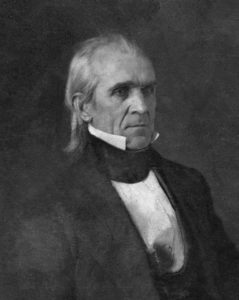
To understand the most terrifying aspects of the modern American executive branch—a president who unilaterally launches foreign strikes without congressional approval, utilizes secretive slush funds to achieve political goals, aggressively invokes “executive privilege” to hide documents from Congress, and manipulates the public into supporting wars of choice—one must examine the administration of the eleventh president, James K. Polk.
While history books often lazily dismiss Polk as a “dark horse” candidate who unexpectedly rode into the White House, the reality is far more calculated. Polk was the original architect of the modern imperial presidency. He fundamentally shifted the constitutional power to make war away from the legislative branch and into the hands of the executive, proving that a president could manufacture a crisis, deploy the military, and coerce Congress into rubber-stamping a war.
The Myth of the Dark Horse and the Micromanager in Chief When James K. Polk won the Democratic nomination in 1844, the Whig party mockingly campaigned on the slogan, “Who is James K. Polk?”. But Polk was no unknown commodity. He had served fourteen years in Congress—four of them as Speaker of the House—and had been the governor of Tennessee. More importantly, he was “Old Hickory’s boy,” the handpicked protégé of Andrew Jackson. When Martin Van Buren committed the fatal political error of publicly opposing the annexation of Texas, Jackson summoned Polk to the Hermitage and orchestrated Polk’s nomination to ensure the United States would pursue a ruthless policy of continental expansion.
Upon taking office, Polk was determined to wield absolute control. “I intend to be myself President of the United States,” he vowed, telling Jackson that he “must be the head of my own administration” and would not be controlled by anyone. In an unprecedented move, Polk required his cabinet members to sign pledges that they would support his policies and resign if they chose to run for president. He was a notorious micromanager who supervised the executive budget, directed the strategies of his generals in the field, and demanded to oversee the minute details of all executive departments. As historian Arthur M. Schlesinger Jr. later noted, Polk was arguably “the only President who clearly died of overwork”.
Manufacturing a War: “American Blood Upon American Soil” Polk came to the presidency with four explicit goals: settle the Oregon boundary dispute with Great Britain, lower the tariff, establish an independent treasury, and acquire California from Mexico. He accomplished the first three through fierce political maneuvering, but acquiring California required a darker strategy.
When Mexico refused to sell its northern provinces, Polk decided to force the issue. In early 1846, he ordered General Zachary Taylor to march American troops south of the Nueces River to the Rio Grande—a historically disputed territory inhabited and controlled by Mexicans. Colonel Ethan Allen Hitchcock, an officer in Taylor’s command, confided in his diary: “We have not one particle of right to be here… It looks as if the government sent a small force on purpose to bring on a war, so as to have a pretext for taking California and as much of this country as it chooses”.
Hitchcock was entirely correct. Before news of any military clash even reached Washington, Polk and his cabinet had already decided to ask Congress for a declaration of war based merely on unpaid commercial claims. But just hours after that cabinet meeting, dispatches arrived reporting that Mexican cavalry had ambushed an American patrol in the disputed territory.
Polk instantly seized on the skirmish. He rushed a war message to Congress, brazenly declaring that Mexico had “shed American blood upon the American soil” and that “war exists, and, notwithstanding all our efforts to avoid it, exists by the act of Mexico”.
This was a watershed moment in the degradation of American constitutional law. The Founders had explicitly vested the power to declare war in Congress to prevent a single executive from plunging the nation into conflict. James Madison had agonized over his war message in 1812, allowing Congress to debate for weeks. Polk, however, bypassed deliberation by deploying troops into a powder keg, waiting for a spark, and then demanding that Congress simply recognize that a state of war already existed. The House of Representatives was allowed only two hours to debate the measure before passing it. Polk proved that a president could unilaterally initiate a war and then brand any congressman who hesitated to fund the troops as unpatriotic.
Dissent, Executive Privilege, and the Slush Fund Polk’s authoritarian maneuvers did not go unchallenged. A young, freshman Whig congressman from Illinois named Abraham Lincoln saw exactly what Polk was doing. Lincoln introduced the “spot resolutions,” challenging the President to name the exact “spot” where American blood had been shed, suspecting rightly that the land was not actually American soil.
When Lincoln’s own law partner questioned his strident opposition to the president during wartime, Lincoln issued a warning that rings terrifyingly true today. “Allow the President to invade a neighboring nation, whenever he shall deem it necessary… and you allow him to make war at pleasure,” Lincoln wrote. Granting the executive branch that kind of unchecked military power, Lincoln warned, places the president “where kings have always stood”.
To shield his machinations from Congress, Polk aggressively expanded the use of “executive privilege.” When the Senate demanded to see the instructions Polk had given to his diplomats regarding the annexation of Texas and negotiations with Mexico, Polk flatly refused, claiming that releasing the documents would endanger the public interest.
Furthermore, anticipating the exact kind of opaque, executive-controlled finances we see in modern politics, Polk asked Congress for a $2 million appropriation—essentially a presidential slush fund—so he could secretly negotiate a peace treaty and buy Mexican territory. This request, known as the “Two Million Bill,” immediately provoked the Wilmot Proviso, igniting the fierce debate over the expansion of slavery into new territories that would ultimately tear the nation apart.
The Legacy of the Imperial Commander in Chief True to a pledge he made before taking office, James K. Polk stepped down after a single term. Exhausted by his unrelenting micromanagement of the government, he died of cholera just 103 days after leaving the White House—the shortest retirement of any president in American history.
Polk’s legacy is monumental, yet deeply chilling. He successfully increased the territorial size of the United States by nearly 40 percent, securing the Pacific coast and stretching the American empire from sea to shining sea. But the price of that expansion was the shattering of constitutional guardrails. James K. Polk taught future generations of executives that the constitutional requirement for Congress to declare war was merely a procedural inconvenience. He proved that a determined president could deliberately provoke a foreign conflict, hide the details behind a veil of executive privilege, and dare the legislature to stop him. When modern presidents bypass Congress to unilaterally bomb foreign nations or claim unchecked authority as Commander in Chief, they are standing precisely where James K. Polk placed them.