

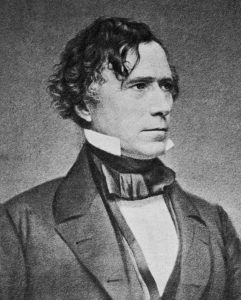
To understand the most destructive dynamics of modern American politics—where leaders place absolute loyalty to their political party above the stability of the nation, where extreme and uncompromising factions hold the government hostage, and where the rights of minorities are readily sacrificed to maintain political coalitions—one must look to the tragic and catastrophic presidency of Franklin Pierce.
Widely considered one of the most amiable, congenial, and handsome men ever to occupy the Oval Office, Pierce enjoyed a meteoric political rise. He was elected president in 1852 in a massive landslide, carrying twenty-seven of the thirty-one states, and became the youngest man yet elected to the White House. Yet today, historians consistently rank Pierce among the absolute worst presidents in American history. He holds the ignominious distinction of being the only elected president in the nineteenth century to be denied renomination by his own beloved party. To understand how such a promising, charismatic leader became a catalyst for the American Civil War, we must examine the fatal flaw that destroyed his administration: an absolute, blinding obsession with party unity.
The Clubhouse Politician and the Illusion of Unity Unlike the fiercely independent Zachary Taylor or the visionary John Quincy Adams, Franklin Pierce was the ultimate partisan loyalist. Born in New Hampshire in 1804 to a Revolutionary War hero, Pierce was not a natural scholar. At Bowdoin College, he spent his first two years drinking in taverns, wrestling in dormitories, and skipping classes to hike in the woods, ranking dead last in his class before reforming his habits to graduate fifth. What he lacked in academic rigor, he made up for in pure personal magnetism. Pierce possessed a clubhouse politician’s instinct, an astonishing memory for names and faces, and a deep-seated eagerness to please those around him.
However, Pierce’s political worldview was shaped by the unique environment of New Hampshire, a state utterly dominated by the Democratic Party. Astute political observers of the era recognized a profound truth about partisanship: a political party’s internal cohesion relies entirely on the strength of its external rivals. Because the opposition Whig party was virtually nonexistent in New Hampshire, Pierce’s state Democratic party was constantly in danger of fracturing from within.
To combat this, Pierce became the ruthless enforcer of Democratic unity. Serving as the de facto boss of the state party throughout the 1840s, he demanded total ideological purity and ruthlessly purged anyone who displayed antislavery sentiments from the state ticket. He detested the abolitionists, viewing their moral crusade as a fanatical threat to the Union his father had fought to build. For Pierce, preserving the machinery and unity of the Democratic Party was not just a political strategy; it was a sacred obsession, virtually a “be-all and end-all”.
Tragedy and the Executive Agenda When Pierce won the presidency as a compromise candidate in 1852, his victory was shadowed by unimaginable personal horror. Just shortly before his inauguration, Pierce and his wife, Jane, were in a train accident that killed their only surviving son, eleven-year-old Benjamin, before their eyes. Jane, a frail, deeply religious woman who already loathed politics and Washington’s drinking culture, was consumed by grief and essentially abandoned her public duties, leaving Pierce to shoulder the burdens of the presidency largely alone.
Upon taking the oath of office—which he delivered astonishingly from memory without glancing at notes—Pierce immediately signaled his commitment to an aggressive, expansionist agenda driven by the “Young America” wing of his party. Promising to vigorously enforce the draconian Fugitive Slave Act to appease the South, Pierce boldly declared that “The policy of my Administration will not be controlled by any timid forebodings of evil from expansion”.
This aggressive posture manifested quickly. Pierce’s administration sought to acquire new territory, resulting in the Gadsden Purchase from Mexico and a highly controversial diplomatic memo known as the Ostend Manifesto. The Manifesto brazenly suggested that if Spain refused to sell Cuba to the United States, America would be justified in wrestling it away by force—a position that horrified northern voters who viewed it as a blatant attempt to expand the empire of slavery. His administration even failed to stop the infamous American filibuster William Walker from launching an illegal invasion to take over Nicaragua.
The Kansas-Nebraska Act: The Fatal Compromise Pierce’s overarching desire to keep his fractured national party together led directly to the greatest blunder of his career. Lacking a strong Whig opposition to unify them, national Democrats were splintering into warring factions. Desperate to appease southern Democrats and secure the votes needed for his foreign policy treaties and patronage appointments, Pierce threw the full weight of the presidency behind the Kansas-Nebraska Act of 1854.
This disastrous legislation, championed by Senator Stephen A. Douglas, effectively repealed the sacred Missouri Compromise of 1820, opening up the western territories to the possibility of slavery. Pierce’s decision to endorse the bill and enforce it as a test of party loyalty was a monumental miscalculation. It instantly destroyed the fragile sectional peace of the Compromise of 1850. The result was “Bleeding Kansas,” where heavily armed pro-slavery “Border Ruffians” from Missouri clashed violently with antislavery settlers, leading to massacres and a fraudulent territorial government that Pierce stubbornly refused to dismantle.
By valuing the short-term appeasement of his party’s southern wing over the long-term stability of the nation, Pierce ignited a political firestorm. The backlash to the Kansas-Nebraska Act absolutely decimated the northern Democratic party in the 1854-1855 midterm elections and birthed the modern Republican Party, fundamentally setting the United States on the irreversible path to the Civil War.
The Dissenting Ex-President Rejected by his own party in 1856 in favor of James Buchanan, a bitter Pierce returned to New Hampshire. When the Civil War erupted, Pierce’s legacy grew even darker. While he supported a defensive war to protect the North, he vehemently opposed Abraham Lincoln’s efforts to subjugate the South, privately writing to Jane that the war was “cruel, heartless, aimless, unnecessary”.
However, Pierce’s wartime retirement offers a fascinating historical perspective on the limits of executive power during national emergencies. Pierce was utterly outraged by Lincoln’s suspension of habeas corpus and the application of military law to northern civilians. When Lincoln defended the military arrest of Ohio Peace Democrat Clement L. Vallandigham for criticizing the war, Pierce took to the stage at a massive July 4th rally in 1863 to fiercely defend the First Amendment. “Who,” Pierce thundered to the crowd of 25,000, “has clothed the President with power to dictate to any of us when we may or must speak… By what right does he presume to prescribe a formula of language for your lips or mine?”.
Pierce remained defiant to the end. Following Lincoln’s assassination, an angry mob surrounded Pierce’s home, demanding to know why he was not flying the American flag in mourning. The old clubhouse politician stood his ground, reminding the crowd of his family’s military service and his own combat record in Mexico, stating that if his decades of service had left his devotion to the flag in doubt, “it is too late now to remove it”.
Conclusion Franklin Pierce died in 1869, struggling with severe alcoholism and mourning the loss of his wife and his closest friend, the novelist Nathaniel Hawthorne. His life serves as a blaring historical warning for the modern political era. Pierce was not a malicious tyrant; he was an amiable, accommodating man who believed that maintaining the political machinery of his party was the highest form of patriotism. Yet, by prioritizing partisan loyalty and unity above all moral considerations—willingly sacrificing the rights of the enslaved and ignoring the rising tide of northern conscience just to keep his political coalition intact—Franklin Pierce fractured the very republic he had sworn to preserve. His presidency proves that when leaders govern exclusively to appease their party’s extremes, they risk losing the nation entirely.