

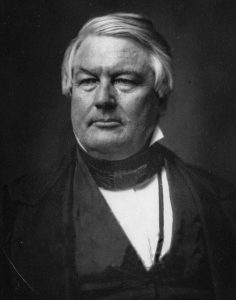
To fully comprehend the fragility of our modern political landscape—where leaders frequently mistake capitulation for statesmanship, where the rights of marginalized groups are routinely bargained away for short-term political stability, and where rabidly anti-immigrant, xenophobic movements can capture significant swaths of the electorate—one must examine the life and legacy of America’s thirteenth president, Millard Fillmore. Though frequently relegated to the status of obscure historical trivia, Fillmore’s administration and his subsequent post-presidential career provide a profound and chilling mirror for the current crises facing the American republic.
The Tyler Precedent and the Reversal of Power Millard Fillmore’s ascent to the presidency hinged on the sudden and tragic death of Zachary Taylor on July 9, 1850. As vice president, Fillmore had been kept at arm’s length by Taylor; for reasons never fully explained, the general-turned-president simply did not care for Fillmore and refused to include him as a partner in governing, causing Fillmore immense personal anguish.
However, when Taylor succumbed to a mysterious gastrointestinal illness, Fillmore seamlessly assumed power. Operating under the constitutional norm established a decade earlier by John Tyler, Fillmore sent a message to Congress proposing to take the oath of office the following day at noon in the Hall of the House of Representatives, decisively reaffirming the “Tyler precedent” that the vice president fully inherits the office, not merely its acting duties.
But Fillmore’s accession meant an immediate and drastic shift in the trajectory of the nation. Taylor, though a Southern slaveholder, had stubbornly refused to appease the Southern fire-eaters, famously threatening to hang secessionists if they rebelled. Fillmore, conversely, was a “true Whig” from New York who believed heavily in legislative compromise. Upon taking office, he immediately reshuffled the cabinet, bringing in Senator Daniel Webster as his Secretary of State, and abandoned Taylor’s unyielding stance in favor of a desperate bid to appease all factions.
The Compromise of 1850 and the Moral Cost of Stability At the time Fillmore took the oath, the nation was tearing itself apart over the expansion of slavery into the territories acquired during the Mexican War. Henry Clay’s massive “omnibus bill” had failed, but a younger generation of legislators, led by Senator Stephen A. Douglas of Illinois, devised a strategy to break the legislation into five separate bills.
President Fillmore strongly sympathized with this legislative maneuvering, and as Congress passed the bills one by one, Fillmore signed them all into law in September 1850. Collectively known as the Compromise of 1850, the legislation admitted California as a free state, allowed New Mexico and Utah to decide the slavery issue via popular sovereignty, abolished the slave trade in the District of Columbia, and paid Texas to relinquish its western land claims.
But the darkest and most consequential element of the compromise was the stringent Fugitive Slave Act, a draconian law that legally compelled Northern citizens to actively assist in the capture and return of runaway slaves. Historians generally concede that Zachary Taylor would have vetoed this cruel measure, but Fillmore signed it in the name of preserving the Union.
This presents one of the most enduring and disturbing lessons of the Fillmore presidency. By signing the Fugitive Slave Act, Fillmore demonstrated that political leaders obsessed with maintaining “order and harmony” are often willing to sacrifice the basic human rights and physical safety of a vulnerable minority. He bought the nation a temporary, ten-year truce, but he did so by legally federalizing the terror of the slave catchers, proving that political appeasement in the face of grave moral injustice only deepens the eventual catastrophe.
Economic Expansion and the Imperial Vision While he focused on domestic compromise, Fillmore also continued the grand American tradition of economic and territorial expansion. Like his predecessors, he understood the necessity of securing American dominance in the Pacific and Latin America. Fillmore publicly endorsed the “Tyler Doctrine,” reiterating that the United States would protect the independence of the Hawaiian Islands and strictly insisting that they not fall under the control of any other great maritime state.
Furthermore, Fillmore recognized that a growing industrial and agricultural empire required raw resources. In his first annual message, he addressed the skyrocketing demand for Peruvian guano—a vital, miraculous agricultural fertilizer monopolized by British firms. Asserting the aggressive economic posture of the American executive branch, Fillmore declared it the “duty of the Government” to secure the fertilizer at a reasonable price, promising that “nothing will be omitted on my part” to achieve it.
The Know-Nothings and the Allure of Nativism Perhaps the most potent historical warning from Fillmore’s life comes not from his presidency, but from his attempt to reclaim it. Denied the Whig nomination in 1852, Fillmore returned to politics in 1856 amidst the collapse of his old party and the terrifying rise of extreme political factionalism.
Rather than joining the newly formed, progressive Republican Party, the former president accepted the presidential nomination of the American Party—infamously known as the “Know-Nothing” movement. This party was built entirely upon a foundation of rabid anti-immigrant and anti-Catholic bigotry.
In a political dynamic that strongly echoes the modern rise of right-wing, xenophobic populism, Fillmore legitimized a fringe hate movement by placing the prestige of a former president at the top of its ticket. Running on this nativist platform, Fillmore siphoned off 21.6 percent of the popular vote in the 1856 election. By splitting the opposition to the Democrats, Fillmore’s third-party run significantly aided the election of James Buchanan, a weak and disastrous executive whose term directly precipitated the Civil War.
Conclusion Millard Fillmore’s public life reveals the inherent dangers of a politics devoid of a moral compass. He was a man who prized procedural compromise over fundamental justice, willing to sign the draconian Fugitive Slave Act to appease extremists, and later willing to embrace a fiercely anti-immigrant hate group to satisfy his own political ambitions. As modern Americans confront leaders who bargain away civil liberties for political convenience or ride the dark waves of xenophobia to capture power, they are witnessing the exact political forces that Millard Fillmore championed and succumbed to more than a century and a half ago.