

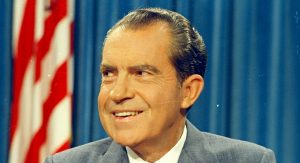
To comprehend the structural transformations of the modern American state—the rise and perils of the “imperial presidency,” the execution of cold-blooded realpolitik on the global stage, the weaponization of domestic cultural grievances, the creation of the modern administrative economy, and the systemic breakdown of constitutional checks and balances—one must examine the tumultuous presidency of Richard Milhous Nixon. Serving as the thirty-seventh chief executive from January 1969 until his dramatic resignation in August 1974, Nixon stands as one of the most enigmatic, brilliant, and deeply destructive figures in the nation’s history. His political career provided a masterclass in strategic resilience and electoral realignment, but his profound paranoia and disregard for the rule of law ultimately triggered the gravest constitutional crisis since the Civil War.
The Inquisitor’s Ascent and the Media Age Before seizing the presidency, Nixon established his political reputation in the late 1940s as a relentless anti-communist crusader while serving as a young California congressman on the House Un-American Activities Committee (HUAC). His aggressive prosecution of former State Department official Alger Hiss catapulted him to national prominence, demonstrating a shrewd, populist instinct for tapping into public anxieties. Impressed by his partisan effectiveness, General Dwight D. Eisenhower selected the thirty-nine-year-old Nixon as his vice-presidential running mate in 1952. When allegations of an illicit political fund threatened to knock him off the ticket, Nixon saved his career by delivering the historic, televised “Checkers” speech, appealing directly to millions of ordinary citizens over the heads of party elites.
After serving two terms as vice president, Nixon secured the 1960 Republican presidential nomination, engaging John F. Kennedy in the first televised presidential debates. The debates marked a watershed moment in American political communication: while radio listeners believed the experienced Nixon had won, television viewers were captivated by Kennedy’s youthful, composed visual image, contributing to Nixon’s razor-thin election defeat.
The 1968 Comeback, the “Silent Majority,” and Social Realignment Following a bitter loss in the 1962 California gubernatorial race, Nixon executed an astonishing political comeback, capturing the White House in 1968 amid a nation fractured by antiwar demonstrations, race riots, political assassinations, and cultural chaos. Nixon built his campaign on a firm “law and order” platform, appealing to what he termed the “silent majority”—working-class, law-abiding citizens who felt alienated and threatened by the rapid social upheavals and permissiveness of the 1960s.
Nixon systematically exploited domestic social fractures for strategic political gain. A seminal moment in this strategy occurred during the May 1970 “Hard Hat Riot” in New York City, where construction workers violently attacked antiwar student demonstrators. Nixon enthusiastically embraced the hard-hat workers, utilizing the event to launch a deliberate “blue-collar strategy” designed to detach traditional trade unionists and white industrial workers from the Democratic coalition. Concurrently, Nixon perfected his “Southern Strategy,” courting conservative Southern whites and Sunbelt voters by attacking court-ordered school busing, delaying federal desegregation orders, and appointing conservative jurists like William H. Rehnquist to the Supreme Court. This strategic pivot broke the post-New Deal political alignment and constructed a durable Republican majority that reshaped American politics for a generation.
Realpolitik, Triangular Diplomacy, and the Ending of War In foreign affairs, Nixon and his National Security Advisor, Henry Kissinger, rejected traditional moralistic approaches to international relations in favor of realpolitik—a pragmatic philosophy centered on balance of power, national interest, and great-power equilibrium. Recognizing that the monolithic communist bloc was an illusion, Nixon executed a masterstroke of “triangular diplomacy” by initiating a covert opening to the People’s Republic of China. In February 1972, the former ardent anti-communist made a historic week-long visit to Beijing, meeting Chairman Mao Tse-tung and Premier Zhou Enlai. By establishing formal contact with Red China, Nixon successfully leveraged American diplomatic flexibility against the Soviet Union, inducing Moscow to pursue détente and sign major nuclear arms limitation agreements.
In the Vietnam War, Nixon sought to achieve “peace with honor” while extricating the nation from an exhausting quagmire. He introduced “Vietnamization,” gradually withdrawing U.S. ground combat troops while shifting the burden of ground fighting to South Vietnamese forces. However, to force North Vietnam into concessions, Nixon simultaneously employed the “Madman Theory,” seeking to convince Communist leaders that he was unhinged enough to unleash unrestricted military force. He dramatically escalated aerial bombardments, culminating in the 1972 Christmas bombings, and secretly expanded the war into neutral Cambodia through massive bombing raids and a 1970 ground incursion without congressional knowledge or approval. Although the Paris Peace Accords were finally signed in January 1973, allowing American forces to withdraw, the prolonged conflict exacted a staggering toll of over twenty-one thousand additional American lives during Nixon’s tenure.
The “Nixon Shock,” Economic Management, and Domestic Governance Domestically, Nixon inherited an economy burdened by rising inflation and slowing growth, an unprecedented condition that challenged traditional economic models. On Friday, August 13, 1971, Nixon gathered his top economic advisers for a secret weekend retreat at Camp David to engineer a radical shift in global economic policy. On August 15, 1971, in a televised address that stunned the world, the president unveiled his New Economic Policy—popularly known as the “Nixon Shock”.
Nixon took the extraordinary step of unilaterally severing the dollar’s link to gold, effectively dismantling the post-World War II Bretton Woods international monetary system. To curb domestic inflation and protect American exports, he instituted an unprecedented 90-day peacetime freeze on all wages and prices and imposed a temporary 10 percent surcharge on foreign imports. Despite his conservative rhetoric, Nixon displayed a flexible approach to governance, signing landmark environmental legislation, overseeing the ratification of the 26th Amendment lowering the voting age to eighteen, launching a federal “War on Cancer,” and initiating the nationwide “War on Drugs” in 1971 by declaring drug abuse “public enemy number one”.
The Shadow State, the “Plumbers,” and the White House Horrors Beneath the public achievements of the Nixon administration lay an aggressive, clandestine war against domestic political opponents. Viewing antiwar protesters, political adversaries, and journalists as active threats to national security, Nixon cultivated an insular, bunker mentality within the White House. His administration routinely engaged in systematic abuses of executive authority, deploying the Internal Revenue Service (IRS) to audit political foes, conducting illegal wiretaps on government officials and reporters, and compiling an official White House “enemies list”.
This culture of illicit operations intensified in June 1971 following the unauthorized publication of the classified Pentagon Papers by former defense analyst Daniel Ellsberg. Furious over the leak, Nixon authorized the creation of a secret internal investigative unit known as the White House “Plumbers”. Led by E. Howard Hunt and G. Gordon Liddy, the Plumbers engaged in illegal covert actions, including the September 1971 burglary of the office of Ellsberg’s psychiatrist in Beverly Hills in a failed attempt to gather incriminating material to destroy Ellsberg’s public reputation.
Watergate, the Taping System, and the Fall of a President The systemic criminality of the Nixon White House culminated on June 17, 1972, when five men working for Nixon’s Committee to Re-Elect the President (CREEP) were caught red-handed breaking into the Democratic National Committee headquarters at the Watergate office building in Washington, D.C., to install wiretaps. Although Nixon may not have directly ordered the initial break-in, he instantly orchestrated a massive, illegal White House cover-up. On June 23, 1972, in the infamous “smoking gun” conversation, Nixon instructed the CIA to intervene and order the FBI to halt its investigation into Watergate under the false pretense of protecting national security secrets. Over the next nine months, the administration paid over $450,000 in secret hush money to the burglars and dangled promises of executive clemency to ensure their silence.
The cover-up unraveled in 1973 following relentless reporting by investigative journalists, trial proceedings led by Federal Judge John Sirica, and explosive testimony before the Senate Watergate Committee. The investigation took a decisive turn on July 16, 1973, when former White House aide Alexander Butterfield revealed the existence of a voice-activated, secret White House tape recording system that Nixon had installed in 1971 to record all Oval Office conversations.
When Special Prosecutor Archibald Cox subpoenaed the recordings, Nixon claimed absolute executive privilege, leading to the October 1973 “Saturday Night Massacre,” in which Nixon ordered the firing of Cox, prompting the resignations of Attorney General Elliot Richardson and his deputy. The legal battle reached the Supreme Court in the landmark 1974 case United States v. Nixon, where a unanimous Court rejected the president’s claim of absolute privilege and ordered the production of the White House tapes. The released recordings revealed the June 23 “smoking gun” conversation, exposing an 18.5-minute erasure on a crucial tape and confirming Nixon’s direct personal role in obstructing justice.
Facing inevitable impeachment and conviction on charges of obstruction of justice, abuse of power, and contempt of Congress, Richard Nixon resigned the presidency on August 9, 1974, departing on Marine One as the only chief executive in American history to resign from office. One month later, his successor, Gerald Ford, granted Nixon a full and unconditional presidential pardon for any crimes he might have committed while in office, a decision that deeply divided the nation but formally closed the legal proceedings against the former president.
Conclusion and Contemporary Resonance Richard Nixon’s presidency permanently altered the American political landscape, leaving a legacy defined by structural transformation and deep public cynicism. His administration illustrated the immense power of the executive branch to reshape global diplomacy, restructure the economy, and re-engineer political coalitions. Yet his catastrophic downfall exposed the terrifying ease with which an unconstrained executive could weaponize government agencies against citizens and subvert democratic elections.
Decades after his fall, the precedents set during the Nixon era continue to echo through modern American law and politics. His “law and order” rhetoric, blue-collar appeals, and Southern Strategy served as the blueprint for contemporary conservative populism. Furthermore, his expansive claims of presidential power birthed the legal framework for the modern “unitary executive” theory and sparked ongoing constitutional battles over executive privilege and presidential immunity. In the Supreme Court’s landmark Nixon v. Fitzgerald ruling, the Court granted former presidents absolute civil immunity for official acts within the outer perimeter of their duties, a principle that remains central to modern debates over executive accountability. Richard Nixon’s life stands as an enduring, tragic warning to the republic: the ultimate test of American democracy lies not merely in the grand achievements of a leader, but in the willingness of the political system to enforce the constitutional boundaries of power.