

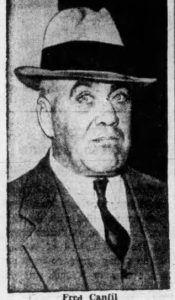
In the late 1930s, as the federal government turned its sights on the corrupt Pendergast political machine of Kansas City, Missouri Senator Harry S. Truman found himself in an increasingly defensive and politically precarious position. Truman had long faced accusations from critics who viewed him as a mere creature of the machine, a stereotype he vigorously rejected through his personal integrity and his meticulous work as a county judge and senator. However, in early 1939, Truman sparked immediate and intense local outrage by announcing his intention to have his close, controversial associate Fred Canfil, then serving as the Building Director (custodian) of the Jackson County Courthouse, appointed as the United States Marshal for the Western District of Missouri. The nomination of a man widely viewed as a typical machine operative to a premier federal law enforcement post was met with immediate public backlash. Recognizing a major political opportunity and a potential security risk, the Federal Bureau of Investigation (FBI), directed by J. Edgar Hoover, intervened. Across a key interdepartmental memorandum, Hoover personally scrawled a direct, unyielding instruction: “I want to make certain a very complete and thorough investigation is made of this man.”
The Public Myth of “Whispering Fred”
The ensuing FBI investigation uncovered a vast chasm between Canfil’s dark, intimidating public reputation in Kansas City and the actual reality of his life. To the general public and Pendergast’s political opponents, Canfil seemed to embody everything corrupt and threatening about local machine politics. He was a physical giant—standing six feet tall, built like a heavyweight wrestler, and possessing a dark, glowering expression. He typically wore his hat brim pulled low over his eyes and stood with his legs planted wide apart, looking like a brute braced to block a doorway. His loud, booming voice earned him the ironic neighborhood nickname “Whispering Fred”.
In the testimonies compiled by FBI agents, local figures denounced Canfil as a “Pendergast roughneck,” a “low ward heeler of the worst type,” and a “loudmouthed, profane, vulgar, and uncouth person”. Rumors swirled through the city that he was a secretive, dangerous “mystery man” who possessed a criminal record. For years, he had kept an office in the Board of Trade Building that bore no name on the door and had no telephone line listed. Although he drove a high-end car and wore expensive, custom-tailored suits, no one seemed to know how he made his living. One suspicious Kansas City Democrat had even asked the local police commissioner to put a tail on Canfil to discover his source of income. After several days of surveillance, however, the police could report only that Canfil spent his time eating lunch in a regular booth at the Savoy Grill with Harry Truman and his tailor, Ted Marks.
The True Character of a Bulldog
When the FBI stripped away the rumors, they discovered that the “mystery man” was not a gangster but a deeply eccentric, database-confirmed veteran whom Truman trusted implicitly. Contrary to persistent local rumors, the FBI confirmed that Canfil had no criminal record. He had grown up on a farm in Kansas, remained unmarried, and lived quietly with his sister in a modest home on East 77 Terrace in Kansas City. His custom suits were made by Ted Marks, and his Board of Trade office was simply used for his legitimate work as a rent collector for a local landlord. He had also worked briefly as a circus treasurer and run the service department of a Cadillac agency in Shreveport, Louisiana.
Furthermore, Canfil’s relationship with Truman was rooted not in backroom political deals, but in shared military service. The two men had met during World War I. While some critics in Kansas City viewed Canfil as a brainless thug, his official military record at the War Department revealed a superb soldier who had risen from sergeant to lieutenant by sheer merit. His files documented a tireless, exceptionally efficient officer, with one entry praising his “excellent” character and another noting that “he generally worked twelve to fifteen hours a day” with relentless enthusiasm.
After Truman was elected to the Jackson County Court, he hired Canfil as a tax investigator, and later relied on him as a driver and companion during his grueling, multi-thousand-mile cross-country automobile trips to inspect public courthouses. While Canfil’s blustery, uncouth habits—such as scattering cigarette ashes all over Truman’s hotel rooms—often exasperated other politicians, Truman respected his work ethic and absolute fidelity. Truman frequently defended his rough associate to skeptical colleagues, declaring: “Fred’s a little rough, but Fred’s all right; he’s as loyal as a bulldog.”
Defiance and Rejection
The climax of the 1939 investigation exposed the deep factional divide between local reformers and Senator Truman’s camp. Just five months prior to the public announcement, in November 1938, Truman had been quietly assured by high-ranking officials in the Justice Department that Canfil was acceptable and that his appointment as U.S. Marshal would be formally approved. Believing the path was clear, Truman was blindsided by the explosive public backlash and the FBI’s subsequent hostile dragnet.
As J. Edgar Hoover’s agents systematically gathered every scrap of negative gossip, Pendergast-linked rumor, and unfavorable opinion in Kansas City, the tide of political and administrative opinion turned decisively against the nomination. Truman, however, reacted with characteristic stubbornness and intense loyalty to his friend. Refusing to back down in the face of federal pressure or local outrage, Truman defiantly proclaimed to his political advisors: “I am for Canfil, first, last, and all the time.”
Ultimately, Truman’s defiance was not enough to overcome the mountain of negative evidence compiled by the FBI. The sheer volume of adverse rumors and negative testimony made the nomination politically impossible for the Roosevelt administration to support, especially as federal prosecutors prepared their tax-evasion indictment against Tom Pendergast himself. The Justice Department officially found Canfil unsatisfactory for the post of U.S. Marshal and rejected the nomination.
Although the 1939 rejection was a stinging public defeat for the Missouri senator, Truman refused to discard his loyal associate. When the Truman Committee was established in 1941 to investigate defense contract waste, Truman immediately hired Canfil as one of his principal field investigators. Canfil continued to serve Truman loyally throughout World War II, even traveling secretly to Walla Walla, Washington to inspect the Manhattan Project’s Hanford Works, and eventually served as a personal bodyguard to President Truman at the Potsdam Conference. The 1939 Marshal investigation ultimately illustrated the complex, fraught boundaries of political patronage during the decline of the machine era, showcasing both the ruthless efficiency of J. Edgar Hoover’s early FBI and the unyielding, often blind loyalty that Harry S. Truman maintained toward his closest political associates.