

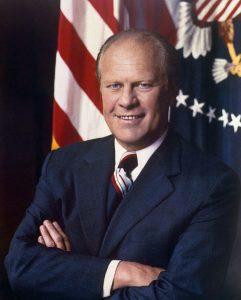
To understand the subtle, structural resilience of the American constitutional order—the crucial mechanisms for maintaining executive continuity during moments of total institutional breakdown, the delicate balance between systemic pardon powers and public accountability, the emergence of post-New Deal economic deregulation, and the birth of human rights as an explicit instrument of global diplomacy—one must examine the 895-day presidency of Gerald Rudolph Ford. Serving as the thirty-eighth chief executive from August 1974 to January 1977, Ford occupies a singular place in the annals of the American presidency. He remains the only individual in United States history to accede to both the vice presidency and the presidency without ever winning a single national electoral vote. Elevated to power amid the unprecedented wreckage of the Watergate scandal and the Vietnam War, Ford served as an indispensable constitutional bridge, guiding a deeply disillusioned republic through its worst crisis of legitimacy since the Civil War.
The circumstances of Ford’s rise were as unprecedented as they were swift. A highly respected twelve-term congressman from Grand Rapids, Michigan, and House Minority Leader, Ford had spent a quarter-century on Capitol Hill as a pragmatic, center-right legislator and master of budget appropriations. In October 1973, when Vice President Spiro Agnew was forced to resign amid a federal corruption scandal, President Richard Nixon utilized the newly ratified Twenty-Fifth Amendment to nominate Ford as vice president, a choice enthusiastically confirmed by a bipartisan Congress that valued his personal probity and lack of factional malice. Ten months later, on August 9, 1974, following Nixon’s own resignation under the threat of imminent impeachment, Ford took the oath of office in the East Room of the White House. In his inaugural remarks to a shell-shocked nation, Ford famously reassured the public by declaring, “Our long national nightmare is over. Our Constitution works; our great Republic is a Government of laws and not of men”, adding with characteristic self-deprecation, “I am a Ford, not a Lincoln”.
Yet, the fragile national consensus and personal goodwill that greeted Ford’s arrival collapsed almost overnight. On September 8, 1974, Ford delivered a televised address granting Richard Nixon a full and unconditional presidential pardon for any federal crimes he committed while in office. The decision provoked an explosive political firestorm; public anger was immediate, and Ford’s approval rating experienced an unprecedented single-day collapse of twenty-two percentage points, fueling widespread accusations that a corrupt “quid pro quo” bargain had been struck. In reality, Ford acted out of a pragmatic, albeit politically disastrous, desire to purge Nixon from the national consciousness. He recognized that a prolonged criminal trial and potential imprisonment of a former commander-in-chief would consume twenty-five percent of his presidential bandwidth, paralyze the executive branch, and prevent the country from confronting its mounting economic and foreign crises. Although the pardon effectively doomed his short-term political standing and wrote the opening sentence of his historical obituary, it succeeded in its primary goal of allowing the nation to move forward.
Domestically, Ford inherited an economy suffering from the unprecedented scourge of “stagflation”—a toxic combination of stagnant economic growth, rising unemployment, and double-digit inflation fueled by the 1973 OPEC oil shock. Initially rejecting traditional Keynesian deficit spending, Ford launched a voluntary grassroots public relations initiative known as “Whip Inflation Now” (WIN), encouraging citizens to save energy and curb personal spending. When the program was mocked as naive amid a deepening recession, Ford demonstrated pragmatic flexibility by signing major tax cuts and extending unemployment benefits. To enforce fiscal discipline against a heavily Democratic, post-Watergate Congress elected in 1974, Ford deployed his executive power aggressively, issuing thirty-nine vetoes during his brief tenure to block federal spending bills.
Despite his conservative fiscal stance, Ford established the foundational framework for modern economic deregulation. Recognizing that rigid federal oversight artificially inflated consumer prices and stifled market competition, Ford initiated sweeping regulatory reforms across the railroad, trucking, aviation, and financial services industries—initiatives that laid the direct groundwork for the deregulatory policies later expanded by the Carter and Reagan administrations. Furthermore, when New York City teetered on the edge of municipal bankruptcy in 1975, Ford famously took a firm line against unconstrained federal bailouts, forcing city and state officials to enact rigorous fiscal reforms and restructuring before providing federal loan guarantees, demonstrating his commitment to fiscal responsibility over political convenience.
In foreign affairs, Ford presided over the bitter, tragic conclusion of the Vietnam War. In April 1975, as North Vietnamese armies launched a final offensive toward Saigon, Ford executed Operation Frequent Wind, orchestrating a massive helicopter evacuation of thousands of American military personnel, diplomats, and South Vietnamese allies. Speaking at Tulane University days before Saigon fell, Ford officially closed a painful chapter in American history, declaring that the Vietnam War was “finished as far as America is concerned”. Overcoming fierce domestic opposition and xenophobic fears, Ford authorized the resettlement of over 100,000 Indochinese refugees across the United States, insisting that America had a moral obligation to harbor its former allies.
Ford’s most enduring global legacy, however, was his signing of the Helsinki Accords in August 1975. Though initially criticized by conservative hardliners as a capitulation that legitimized Soviet control over Eastern Europe, the treaty embedded crucial “Basket III” provisions guaranteeing freedom of speech, conscience, movement, and human rights. These human rights clauses provided a vital moral shield and legal mechanism for dissidents like Václav Havel and Andrei Sakharov within the Soviet bloc, serving as an ideological catalyst that ultimately eroded totalitarian control and hastened the collapse of the Soviet Empire. Simultaneously, to restore public confidence in the intelligence apparatus following bombshell investigative reports of illegal domestic CIA spying, Ford established the Rockefeller Commission under Vice President Nelson Rockefeller, establishing formal civilian oversight over intelligence agencies.
Ford’s presidency was also profoundly shaped by cultural shifts and personal drama. His wife, First Lady Betty Ford, revolutionized the role through her extraordinary candor and authenticity, publicly discussing her battle with breast cancer, supporting the Equal Rights Amendment (ERA), expressing pro-choice views on abortion, and openly confronting her own substance dependence. Her openness humanized the White House during a time of deep national cynicism. Furthermore, the physical danger surrounding the presidency became starkly apparent in September 1975, when Ford survived two separate assassination attempts by Lynette “Squeaky” Fromme and Sara Jane Moore in California within seventeen days.
Heading into the 1976 presidential election, Ford faced a fierce primary challenge from former California Governor Ronald Reagan, whose campaign reflected a rising, insurgent conservative movement within the Republican Party. Although Ford narrowly secured the Republican nomination at the Kansas City convention, the bruising primary battle exposed deep ideological fractures between traditional pragmatic moderation and conservative populism. In the general election against Democratic nominee Jimmy Carter, Ford mounted a remarkable autumn comeback, closing a thirty-point polling deficit. However, a disastrous debate error in which Ford stubbornly asserted that “there is no Soviet domination of Eastern Europe” derailed his momentum. Carter narrowly won the presidency, capitalizing on post-Watergate voter disillusionment.
Gerald Ford left office in January 1977 having earned the enduring affection and respect of a nation he had quietly rescued. Free from ideological fanaticism or personal vanity, Ford approached the presidency not as a grand performance, but as a duty to be performed with honesty, decency, and common sense. By restoring the integrity of the executive branch, enforcing the rule of law, and steadying the ship of state through a period of historic upheaval, Gerald Ford proved that a leader’s character and commitment to constitutional principles remain the ultimate safeguards of the American republic.