

In the middle of 1943, as the United States military-industrial powerhouse surged to meet the global demands of World War II, a profound constitutional friction began to brew in the shadows of the nation’s wartime bureaucracy. At the center of this tension was the Special Senate Committee to Investigate the National Defense Program, popularly known as the Truman Committee. Chaired by the meticulous and relentless Senator Harry S. Truman of Missouri, the committee had built a towering reputation as the nation’s premier watchdog, systematically rooting out unconscionable waste, corruption, and profiteering across hundreds of defense contracts. Truman’s operational philosophy was straightforward: rather than digging up the “dead horses” of corruption after the war was already over, his investigators worked in real-time to correct administrative errors and preserve public funds while combat was still raging. However, the committee’s commitment to total transparency was soon set on a direct, volatile collision course with the most closely guarded secret of the twentieth century: the creation of the atomic bomb.
The first tremors of this conflict surfaced in June 1943, when the committee’s staff investigators began picking up puzzling, fragmented hints of an extraordinary, borderless enterprise that dwarfed conventional military programs. Clues in the auditing records pointed to massive, unexplained expenditures of millions of dollars earmarked for a highly classified project identified only by the cryptic designation of the Manhattan Project. Alarmed by the sheer scale of these unaccounted-for funds, Senator Truman took the direct step of telephoning the Secretary of War, Henry L. Stimson, on June 17, 1943. During their brief conversation, Stimson refused to provide any details, telling the senator that the project was a highly sensitive development known only to “two or three men in the whole world”. Appealing to Truman’s patriotism and personal trust, Stimson asked the chairman to cease all inquiries. Truman, respecting the senior statesman’s gravity, initially capitulated, declaring that if the Secretary of War personally assured him the project was for a vital, unique purpose, the committee would “not have to say another word”.
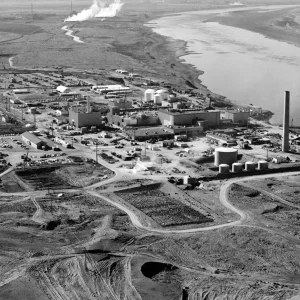
Yet, the sheer physical and economic footprint of the Manhattan Project made absolute, hermetic secrecy an administrative impossibility. By July 1943, more details slipped through the cracks of the security apparatus. Truman’s attention was drawn to a sudden, colossal federal land condemnation for the DuPont Company along the Columbia River in Washington State, near a desolate railroad outpost called Hanford. The acquisition of nearly half a million acres of land provoked intense concern in the region, prompting Truman’s close friend, former Senator and newly appointed federal district judge Lewis Schwellenbach, to write to the chairman demanding to know what the government was doing. On July 15, 1943, Truman wrote back to Schwellenbach in an offhand letter that constituted a stunning, historic breach of military security. In the letter, Truman openly confessed that he knew about the “tremendous real estate deal,” explicitly informing Schwellenbach that the site was “for the construction of a plant to make a terrific explosion for a secret weapon that will be a wonder”. Truman had dictated this highly classified revelation directly to his secretary, Mildred Dryden, leaving a paper trail of a secret that generals and admirals were risking their careers to conceal.
Curiosity and political pressure surrounding the Hanford Works continued to mount through the autumn of 1943. Senator Elbert Thomas of Oklahoma formally requested a congressional inquiry into the site, having heard a steady stream of rumors regarding administrative chaos. Simultaneously, a senior staff investigator on the Truman Committee delivered a confidential memorandum to the chairman, warning that complaints of gross waste, inefficiency, and labor idleness at the Hanford plant had become “chronic”. The investigator presciently warned Truman that the War Department was abusing the “guise of secrecy” to cover up what would likely prove to be a shocking example of financial mismanagement once the truth was finally revealed. Driven by his constitutional mandate to investigate waste and feeling the heavy pressure of these persistent reports, Truman chose to bypass his verbal agreement with Stimson. On November 30, 1943, he notified Senator Thomas that he had quietly dispatched one of his most aggressive, overly efficient investigators to Washington State to uncover what was wrong at Hanford.
The investigator Truman chose for this sensitive mission was his trusted Kansas City associate, Fred Canfil. Upon arriving in Washington, however, Canfil ran headfirst into an unyielding wall of military-industrial security. When Canfil attempted to enter the Hanford Works, Colonel Franklin Matthias, the commanding military officer of the DuPont plant, flatly turned him away. Colonel Matthias informed the investigator that the President and the Secretary of War had an explicit, binding understanding that barred any member of the Senate from setting foot on the property. Desperate to fulfill his assignment, Canfil conducted off-site intelligence gathering, discovering through an adjacent federal agency that the War Department had issued a highly confidential directive ten days prior. Hand-delivered to all army officers and high-level civilian engineers at the plant, the directive ordered all personnel to ensure that absolutely “no Senator or anyone connected with the Senate was to be given any information about the project”.
Canfil immediately detailed this wall of silence in a collect telegram sent to Senator Truman from a Western Union office in Walla Walla, Washington. Realizing that the military was prepared to enforce total non-cooperation to protect the secret of the weapon, Truman decided to de-escalate. Following Canfil’s telegram, the committee’s active interest in Hanford cooled, and Truman chose to honor his original gentleman’s agreement with Stimson once more. While Truman would periodically attempt to pierce this veil—even provoking Stimson’s intense personal fury in 1944 by demanding that committee staff member General Frank Lowe be taken into the department’s confidence—the secret of the uranium-fission and plutonium separation processes remained safe from congressional scrutiny. Indeed, Truman never learned the technical mechanics of the project, remaining entirely ignorant of the separation of plutonium from U-238 until after he assumed the presidency following Franklin D. Roosevelt’s death in April 1945.
For the modern reader, the 1943 Hanford investigation remains a compelling historical case study in the delicate, eternal struggle between democratic congressional oversight and the demands of national security during an existential global conflict. Truman’s pursuit of Hanford demonstrated that in a free society, the sheer scale of a multi-billion-dollar industrial project will inevitably attract public scrutiny, making absolute secrecy nearly impossible to sustain without bypassing standard constitutional checks. Ultimately, the episode illustrated that while the Truman Committee successfully checked rampant waste across the broader conventional war effort, saving the nation billions of dollars, the executive branch was willing to construct an unprecedented, ironclad fortress of secrecy to protect the development of the atomic bomb, proving that some wartime priorities would always remain locked away from the eyes of Congress.