
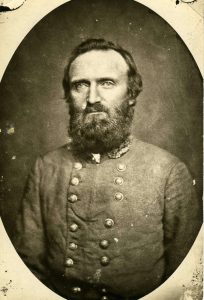
On May 23, 1862, Confederate Major General Thomas “Stonewall” Jackson struck a sudden and devastating blow in the Shenandoah Valley, capturing Colonel John R. Kenly and cutting his regiment at Front Royal to pieces. Jackson’s overwhelming forces then routed the Union troops commanded by Major General Nathaniel P. Banks, driving them in a disorganized, pell-mell retreat down the valley toward the Potomac River. The retreat was so chaotic and resulted in the abandonment of such vast quantities of military equipment that Confederate General J. E. B. Stuart mockingly declared Banks to be the “best supply officer” in Jackson’s entire corps. In the North, the unexpected disaster provoked immediate consternation and alarm, prompting prominent figures like journalist George William Curtis to lament how thoroughly the Union forces had been “out Generaled!”.
The news of Banks’s rapid flight triggered a severe wave of panic in the federal capital, which suddenly seemed in imminent danger of falling to the enemy. While anxious residents began fleeing Washington, President Abraham Lincoln refused to deflect blame to his subordinates or cabinet members. Instead, Lincoln accepted direct personal responsibility for the military debacle, flatly stating, “I did it!”. Lincoln recognized that by previously detaching Brigadier General James Shields’s division from Banks’s command to reinforce Major General Irvin McDowell near the Rappahannock, he had thinned the Union line on the upper Potomac and left Banks’s diminished force of only 4,000 men as an extremely tempting and vulnerable target for Jackson’s vastly superior corps.
Once word arrived that Banks’s forces had successfully escaped across the Potomac River, Lincoln’s intense anxiety was replaced by a bold determination to launch a counter-offensive and “entrap Jackson in the Valley”. Acting effectively as both commander-in-chief and general-in-chief, Lincoln spent grueling, long hours at the War Department personally directing the movement of forces via telegraph. He immediately altered McDowell’s orders; instead of marching south to join Major General George B. McClellan’s Peninsular campaign against Richmond, McDowell was commanded to send 20,000 of his men west to block Jackson’s line of retreat. Lincoln emphasized the vital urgency of the movement, telling McDowell that “every thing now depends upon the celerity and vigor of your movement”. McDowell assigned James Shields’s division to lead the western march. Simultaneously, Lincoln ordered Major General John C. Frémont to move his 17,000-man command thirty miles east from Franklin to Harrisonburg, a strategic point on the Valley Turnpike that served as Jackson’s primary escape route, warning the Pathfinder: “Do not lose a minute”. Additionally, the battered remnants of Banks’s army were ordered to regroup and pursue the Confederates from the north, while a separate federal force was sent from Baltimore to occupy Harper’s Ferry to prevent any Confederate crossing into Maryland.
Lincoln understood that the primary Confederate objective in the Valley was to use “constant alarms” to keep three or four times as many federal troops away from Richmond as Jackson actually commanded. Nevertheless, the president decided to take a calculated strategic gamble. He reasoned that if McDowell, Frémont, and Banks could move with maximum speed and coordinate their actions, their combined force of 40,000 troops could easily envelope and “bag” Jackson’s 17,000 Confederates. On May 24, Lincoln reached out to cheer up the badly disappointed McDowell, who viewed the sudden disruption of his southward march as a “crushing blow,” assuring him that “the change was as painful to me as it can possibly be to you or to any one”. The next day, Lincoln wired Treasury Secretary Salmon P. Chase, who was visiting McDowell at Fredericksburg, expressing his belief that the Confederate forces under Richard Ewell, Stonewall Jackson, and Edward Johnson were pouring through the gap at Front Royal, making a dash northward, and declaring that cutting them off would be a “very valuable, and very honorable service”. Simultaneously, the president used the Valley crisis to prod the chronically sluggish McClellan, wiring him on May 25 that the time had come where he must “either attack Richmond or give up the job and come to the defence of Washington”.
The ambitious federal trap, however, was quickly jeopardized by the insubordination of General Frémont. Instead of marching directly to Harrisonburg as Lincoln had explicitly commanded, Frémont chose to proceed far to the north toward Mooresfield to relieve Banks, leaving the Valley Turnpike completely open. Angered and deeply frustrated by Frémont’s failure to obey his direct orders, Lincoln caustically remarked to his associates that “there are three kinds of animals: there is a horse & a mule & a jackass. A horse when he is broken will obey the reins easily, a mule is hard to guide but still you can make him go rightly. But a jackass you can’t guide at all!!”. Lincoln quickly bypassed Frémont’s chosen route and ordered him to proceed south to Strasburg on the Valley Turnpike instead. Lincoln later moderated his harsh public criticism of Frémont, privately explaining to his staff that he had been unaware at the time that Frémont’s supplies had failed to reach him and that the general was physically unprepared to cross the mountains. Nevertheless, he maintained that Frémont “should have notified me” of these logistical impediments rather than silently ignoring his direct instructions.
On May 28, as the window to trap the Confederates rapidly closed, Lincoln desperately spurred McDowell onward, telegraphing: “it is, for you a question of legs. Put in all the speed you can”. As McDowell and Frémont finally converged on Strasburg, it briefly appeared that the Union pincers would successfully close. Yet, the wily Jackson, driving his “foot cavalry” to the absolute limit, slithered directly between the converging federal columns and escaped up the Valley, systematically burning critical bridges behind him to slow down his pursuers. On June 8, Jackson wheeled about and bloodied Frémont’s pursuing force in a fierce rearguard action at Cross Keys. The very next day, Jackson struck Shields’s advanced brigade at Port Republic, administering a second bloody defeat. Shortly thereafter, Jackson left the Shenandoah Valley entirely and rejoined Robert E. Lee’s main army near Richmond completely unmolested.
Following the collapse of the campaign, Lincoln deeply lamented the failure of his generals to capture the Confederate force, reporting that he “felt certain that Jackson should have been captured, and cannot comprehend the excuses made by the generals who should have taken him”. He was especially disappointed in Shields, explaining that if the general had kept his forces concentrated and destroyed the bridge at Port Republic, Frémont would have been able to destroy Jackson’s entire army. Although contemporary critics severely chastised Lincoln for his decision to divert McDowell’s corps from the drive on Richmond, his strategic plan to capture Jackson was not unreasonable. Jackson likely would have been bagged had the amateur Union generals possessed greater tactical competence, and had the federal movements not been severely retarded by torrential rains at crucial moments. The failure of the Valley pincers ultimately prompted Lincoln to fundamentally restructure the Union military command.