

The decade following the fall of Saigon was characterized by a profound, unresolved grief in the American national psyche. Though the Vietnam War had officially ended, the fate of approximately 2,500 American soldiers classified as missing in action (MIA) remained a volatile political and cultural flashpoint. The National League of Families, initially supported by the Nixon administration, evolved into a powerful lobby, prompting widespread public suspicion that successive White Houses had deliberately covered up the existence of surviving prisoners of war (POWs) to put the painful memory of the war to rest.
By the early 1980s, the Reagan administration had elevated the recovery of missing service members to the “highest national priority,” a rhetorical stance that fueled a flourishing ecosystem of rescue fantasies, live-sightings, and Hollywood blockbusters like Rambo. Behind this cultural theater, however, lay a highly classified, chaotic, and legally ambiguous effort by rogue operatives and segmentated military intelligence units to launch actual armed incursions into the jungles of Southeast Asia.
The Genesis of Grand Eagle
In the early 1980s, rumors began to intensify within the American defense establishment that surviving U.S. prisoners were being held in secret, bamboo-walled labor camps inside Laos. Determined to investigate these claims, the head of the Defense Intelligence Agency (DIA) sought to verify the rumors of Laotian prison camps. Due to the extreme political sensitivity of conducting unauthorized, armed operations inside sovereign foreign territory, the military bypassed conventional channels.
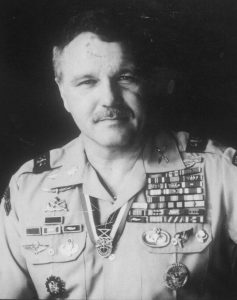
The DIA turned to Lieutenant Colonel James “Bo” Gritz, a highly decorated, larger-than-life former Army Green Beret who had retired from the military in 1979 but maintained deep connections to the special operations community. To facilitate the mission, Gritz began working closely with a highly secretive, newly established Army intelligence unit known as the Intelligence Support Activity (ISA), colloquially referred to in intelligence circles as “the Activity”. Armed with ISA funds and equipment, and supported by a mysterious right-hand man known as “Dr. Death,” Gritz established a covert intelligence-gathering and rescue framework officially code-named “Operation Grand Eagle”.
Bureaucratic Turf Wars and the Transition to Lazarus
Despite its early momentum, Operation Grand Eagle quickly became a victim of the fierce bureaucratic rivalries that plagued the Cold War national security apparatus. A bitter dispute erupted between the command of the ISA and the leadership of the DIA over the control and execution of the operation. Consequently, the official defense establishment chose to pull the plug on the mission. During subsequent congressional hearings, Deputy DIA Director Admiral Allan Paulson testified that while a Department of Defense organization had indeed proposed using Gritz in a collection capacity, the operation had been formally rejected at the very first level of the approval process.
For Gritz and his close operational partner, Scott Weekly—a former Navy SEAL associate and arms dealer who was described as a volatile cross between John Wayne and Rambo—the official rejection was merely a bureaucratic speedbump. Believing they possessed a moral mandate that transcended Pentagon paperwork, Gritz and Weekly chose to bypass the cancellation. Utilizing the tens of thousands of dollars’ worth of cameras, polygraph machines, satellite photos, and specialized radio communication gear already provided by the ISA, they rebranded the rogue venture under an ironic and defiant new code name: “Operation Lazarus”. To prepare for an armed penetration of Laos, Weekly traveled to Oklahoma to have silencers physically altered to fit the 9-mm submachine guns the team planned to carry across the border.
The Incursions and the Mekong Debacle
Operation Lazarus was executed in a series of highly dangerous, clandestine border crossings. In November 1982, Gritz led his heavily armed team across the Mekong River from Thailand into the dense jungles of Laos. The mission immediately went awry. The team was intercepted by Laotian military forces, triggering a chaotic and violent firefight that resulted in the death of one of Gritz’s team members. Forced to retreat back across the Thai border, Gritz began immediately organizing a second, corrective crossing scheduled for early 1983.
However, the operational security of the mission had completely deteriorated. Word of the secret raids leaked to the media, sparking sensational reports in Soldier of Fortune magazine, the Los Angeles Times, and the Boston Globe. On the verge of launching their second incursion in early 1983, Gritz and his squad were arrested by Thai provincial police in Nakhon Phanom, a small village situated directly on the Mekong River.
Among those swept up in the dragnet were Gritz, Weekly, a civilian antiterrorism expert, and the daughter of an American pilot who had gone missing during the war. The Thai government formally jailed the team and charged them with the possession of an illegal radio transmitter. U.S. sources in Bangkok subsequently revealed that the seized radio was actually a highly sophisticated piece of U.S.-made spy gear equipped with a powerful transmitter designed to send encrypted messages from the Laotian wilderness straight to Washington, D.C..
The Fallout of Plausible Deniability
The arrests at Nakhon Phanom triggered an immediate, turgid diplomatic scandal. From his Thai jail cell, Gritz published a letter to the Los Angeles Times asserting that the “CIA-DIA knew” of his missions and had actively facilitated Operation Lazarus by supplying high-tech communications equipment and tactical data. Both the CIA and the DIA issued immediate, categorical disavowals, claiming they had no knowledge of Gritz’s activities.
Yet, these denials were greeted with deep skepticism. The presence of military-grade, state-of-the-art encryption transmitters and satellite imagery in the hands of private citizens made the government’s claims of ignorance highly implausible. Observers increasingly concluded that Gritz’s team had operated as classic “cutouts” for the national security state. This arrangement allowed the White House to harvest any intelligence windfalls if the mission succeeded, while maintaining a shield of plausible deniability and leaving the operatives to rot in a foreign jail if the operation collapsed.
Following his eventual release and return to the United States, Gritz became profoundly radicalized, publicly accusing senior U.S. government officials of maintaining a secret heroin-trafficking network in the Golden Triangle to fund deniable, off-the-books paramilitary activities across Southeast Asia. Ultimately, Operation Lazarus exposed the deep, systemic dysfunction of the early Reagan-era intelligence apparatus. By outsourcing the search for missing servicemen to rogue mercenaries and deniable cutouts, the United States government temporarily bypassed congressional oversight, but ultimately succeeded only in deeper polarization of the domestic debate and leaving the families of the missing without closure.