

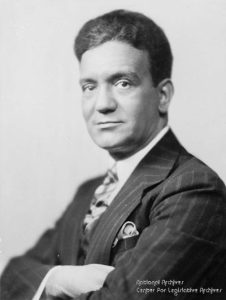
In the dark winter of 1932–1933, as the American financial system ground to a near-complete halt and the Great Depression reached its agonizing depths, the public still largely believed that the nation’s premier financial institutions were capably managed by men of “unimpeachable integrity, possessing almost mythical business genius and foresight”. However, this carefully cultivated veil of respectability was permanently shattered by a historic Senate investigation that exposed systematic self-dealing, massive tax evasion, and political bribery at the highest levels of American finance. At the center of this dramatic exposure was a pugnacious, Sicilian-born prosecutor who transformed a stalled congressional inquiry into a historic reckoning, permanently altering the relationship between the federal government and Wall Street.
The Incorruptible Counsel
The Senate Banking Committee’s inquiry into stock market practices had languished for nearly six months, stalled by a quiet, bipartisan reluctance on Capitol Hill to name politically connected “fat cats”. In January 1933, the outgoing Republican chairman of the committee made a decision that would break this conspiracy of silence: he hired Ferdinand Pecora as the inquiry’s new general counsel at a modest salary of $255 a month.
Pecora was the perfect foil for the aristocratic barons of American commerce. A Sicilian-born, anti-Tammany progressive Democrat with working-class roots, he had built a formidable reputation as an assistant district attorney in New York, where he aggressively targeted bucket shops and crooked banks, posting an impressive 80-percent conviction rate. Fearless, incorruptible, and having repeatedly rejected lucrative offers from elite Wall Street law firms, Pecora brought a seasoned prosecutor’s discipline to Washington. Rolling up his shirtsleeves and smoking blunt cigars, he immediately injected an irresistible, aggressive momentum into the investigation.
Pecora’s objective was unvarnished: to assign blame for the economic crisis to the very men who had manufactured it, stripping away their prestige and addressing them as common financial crooks. He faced immediate, haughty resistance from financial elites. Richard Whitney, the aristocratic president of the New York Stock Exchange, confidently asserted that the exchange was a “perfect institution” and that America had been “built by speculation”. Pecora, entirely unintimidated, resolved to expose the systemic rot beneath this confidence.
Eviscerating “The Superbank” and the Utility Kings
Pecora began his public campaign in January 1933 by exposing the spectacular fraud of Ivar Kreuger, the Swedish match monopolist who had raised $760 million through American banking syndicates, stolen a vast portion of it, and committed suicide. Next, the hearings laid bare the sprawling holding-company empire of Samuel Insull, the utility magnate who had utilized heavily leveraged corporate pyramids to control much of the nation’s electric power before his business collapsed into receivership, wiping out the savings of thousands of middle-class investors.
The investigation’s first major climax occurred in late February 1933, just eleven days before the presidential inauguration of Franklin D. Roosevelt. Pecora launched a devastating, nine-day examination of National City Bank (the precursor to modern-day Citibank), which he labeled “the superbank”. The hearings revealed a shocking history of speculative abuses, exorbitant executive bonuses, and deceptive retail stock sales.
As Pecora later observed, “in those nine days a whole era of American financial life passed away”. The National City revelations dominated front-page news, fueling massive public outrage and providing the incoming Roosevelt administration with the vital political momentum necessary to launch the sweeping reforms of the New Deal.
Challenging the House of Morgan
With National City exposed, Pecora set his sights on the ultimate fortress of American finance: J.P. Morgan & Co.. The House of Morgan initially snickered at the hearings, viewing them as a vulgar political circus designed to “acquaint a curiosity-loving public with the nature and extent” of their private banking operations. Operating with an ancient expectation of absolute secrecy, the bank fiercely resisted Pecora’s intrusion.
On March 22, 1933, Morgan partner Thomas Lamont and the bank’s lead counsel, John W. Davis—the former 1924 Democratic presidential candidate—visited Pecora at his temporary Madison Avenue offices. Davis, who had spent years protecting private banks from state inspections, adamantly refused to disclose the bank’s capital position, examine its private ledger books, or breach the confidentiality of client accounts. Lamont even tried to enlist the Federal Reserve Bank of New York to help withhold their annual financial statements.
Pecora interpreted this resistance as barefaced defiance. He waged a highly coordinated war in the press and successfully pressured the Senate to pass a custom resolution authorizing the committee to investigate private, unregulated banking. Pecora won the standoff; for over six weeks, his team of financial sleuths worked inside J.P. Morgan’s private offices at 23 Wall Street, sifting through records that no outsider had ever been permitted to see.
The senior Morgan partners were thoroughly enraged. Jack Morgan, then sixty-six, interpreted the investigation as a personal, vindictive vendetta and privately dismissed Pecora with bitter, ethnic slurs. Lamont complained to his aristocratic friends of a “Spanish Inquisition” in Washington conducted by a “young native Sicilian”. Despite their inflated sense of virtue, the Morgan partners marched blindly into a public relations catastrophe when they formalised their appearance before the committee in May 1933.
Tax Evasion and “The Preferred List”
When the sweltering Senate Caucus Room opened for the Morgan hearings, crowds ringed Capitol Hill to catch a glimpse of the financial titan on the stand. Under John W. Davis’s careful instruction, Jack Morgan attempted to remain polite and cooperative, hoping to avoid the public arrogance that had damaged his father’s reputation during the 1912 Pujo hearings. Yet, Pecora’s forensic questioning quickly pried open the bank’s most closely guarded secrets.
The first bombshell emerged when Pecora forced Morgan to admit that neither he nor any of his senior partners had paid a single penny in federal income taxes in 1931 or 1932. While millions of ordinary, struggling Americans were suffering through the desperation of the Depression, the wealthiest financiers in the world had legally bypassed their tax obligations.
The second, even more politically explosive revelation was the discovery of J.P. Morgan & Co.’s “Preferred List”. This was a highly secretive registry of prominent political, military, and financial leaders—including former Democratic National Committee Chairman John J. Raskob—to whom the Morgan firm routinely offered newly issued corporate stocks at prices far below their open market value. Recipients could immediately resell these shares for an instant, risk-free profit.
Pecora produced damning correspondence from Raskob explicitly thanking the firm for the financial windfall and expressing his hope to “reciprocate” in the future. This system of sub rosa influence peddling, which effectively hid bribery within the swirling transactions of the financial markets, shocked even seasoned members of Wall Street.
Political Backlash and the Legacy of Reform
The findings of the “Pecora Commission” unleashed a massive tidal wave of public anger across the United States. The term “banksters”—combining bankers with gangsters—was coined by the public and widely popularized in the press. Senator Burton Wheeler of Montana captured the national mood, declaring that the best way to restore confidence in the financial system was to “take these crooked presidents out of the banks and treat them the same way we treated Al Capone”.
Despite intense resistance from conservative pro-business Democrats like Senator Carter Glass—who repeatedly tried to restrict the scope of the inquiry and keep documents secret—the public pressure was too great to withstand. Pecora’s sensational findings successfully broke the back of the Wall Street lobby, forcing the rapid passage of the landmark Glass-Steagall Act of 1933, which mandated the absolute separation of commercial and investment banking.
Ferdinand Pecora’s investigation officially concluded in May 1934, leaving behind ten thousand pages of public testimony that filled eight massive volumes. By systematically exposing the financial elite as “greedy little devils” rather than mythical financial geniuses, Pecora dismantled the ideological foundations of Gilded Age laissez-faire capitalism. Ultimately, the Pecora hearings established the political and moral legitimacy of the modern regulatory state, proving that the unchecked concentration of private corporate power remained a formidable rival to democracy itself.