

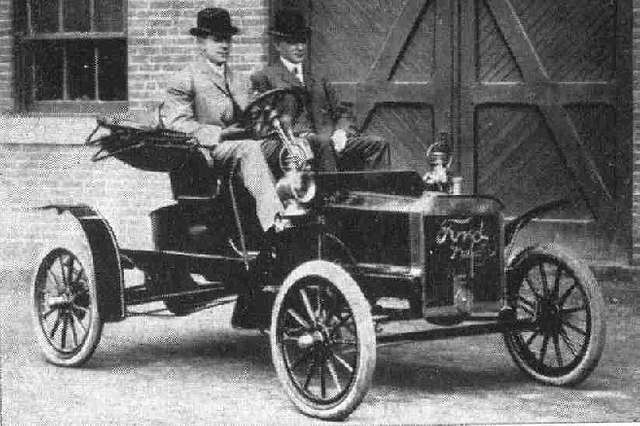
It is indeed fascinating to delve into the year 1906 and the pivotal moment of Henry Ford’s Model N. This introduction marks a significant step in the trajectory of Ford’s vision and the burgeoning automobile industry, laying crucial groundwork for the future of mass production.
The Model N, launched in 1906, was a genuine turning point for the Ford Motor Company. Priced at a notably affordable $500, it was an immediate improvement over its predecessor, the Model A, while being cheaper. This innovative vehicle featured a vertical four-cylinder, fifteen horsepower (hp) engine positioned in the front, making it both lighter and significantly more powerful than earlier designs, capable of reaching a top speed of forty-five miles per hour. Its enhancements included better brakes, improved springs, and a smoother two-speed planetary transmission, indicating a strong focus on engineering and performance for its time.
Henry Ford’s announcement of a production target of 10,000 units for 1906 was, in itself, a bold declaration, representing more than five times their previous single-year production record. This ambition was not merely a marketing ploy; it was a testament to Ford’s burgeoning understanding of the mass market potential for automobiles. Trade journals, recognizing its significance, lauded the Model N, with one editorialist calling it “distinctly the most important mechanical traction event of 1906”. The market responded enthusiastically, with one dealer, for instance, sending a substantial check for $30,000 to secure an order for three hundred cars. The demand was so high that by May, the company had to return money to customers to manage the order backlog. While they didn’t quite hit the 10,000 mark, producing 8,250 cars that year, all were sold before they even left the factory. This ramp-up was a remarkable accomplishment, particularly given that the same year saw Ford internalize the manufacture of their engines, axles, and transmissions, which necessitated opening a new factory and hiring additional workforce.
This aggressive move into mass production and affordability was a core tenet of Ford’s philosophy. Even from his early days as a machinist at the Detroit Edison generating plant, Ford was obsessed with building a practical, accessible car. His prototype Quadricycle in 1896, and subsequent early ventures, though not always smooth, continuously moved towards this goal. The initial Ford Motor Company, formed in 1903, had a modest start with only $28,000 in cash and averaged 125 employees. However, it quickly demonstrated profitability, selling its first car for $850 in July 1903 and building a factory ten times larger within two years, employing three hundred men and making twenty-five cars a day.
The success of the Model N was also a vindication of the strategic partnership between Henry Ford and James Couzens. Earlier, internal conflicts had threatened the enterprise, particularly Alexander Malcomson’s insistence on building heavier, more upscale cars, which diverged from Ford’s vision. Couzens, a brilliant manager who installed accounting, cost-tracking, and inventory-control systems and built a formidable sales and dealership network, aligned with Ford’s mass-market ambition. Their decision to “brutally squeeze out” Malcomson solidified their control and allowed them to pursue the direction epitomized by the Model N.
This period marked Ford’s determination to redefine mass production, leading to what would later be termed “Fordism”. While mass manufacturing had existed for everyday items like stoves, shoes, clothing, and packaged foods, Ford aimed to apply it to a complex product like the automobile, insisting on driving the price down so that nearly any working family could afford it. The Model N was a crucial step in this direction, demonstrating that high volume at a lower price point was achievable and desirable, paving the way for the truly transformative Model T that would arrive two years later. The Model N’s success, even amidst a banking crash in 1907, showcased Durant’s (of Buick, soon to be GM) counter-cyclical strategy of maintaining production and building inventory when others cut back, which allowed Buick to gain market share when the economy rebounded. This underscores the dynamic and competitive nature of the emerging automotive industry, where strategic decisions in 1906, such as Ford’s bold production targets, could significantly impact a company’s standing.