

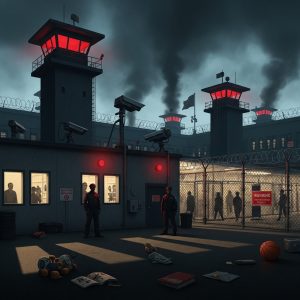
As the United States embraced neoliberal economic policies in the 1970s and 1980s—slashing the social safety net and deregulating industries—it simultaneously engineered a profound and devastating shift in its criminal justice system. The cornerstone of this transformation was the modern “War on Drugs.” In June 1971, President Richard Nixon held a press briefing declaring drug abuse “public enemy number one” and called for a worldwide, government-wide “all-out offensive” to defeat it. While framed as a crusade for public health and safety, the War on Drugs was actually designed as a powerful mechanism for social and racial control.
The true motivations behind this domestic war were explicitly political and highly racialized. Nixon’s chief of staff, H. R. Haldeman, documented the president’s underlying strategy in a 1969 diary entry: “You have to face the fact that the whole problem is really the blacks. The key is to devise a system that recognizes this while not appearing to”. By campaigning heavily on a platform of “law and order,” the Nixon administration successfully masked its racist political agenda behind the virtuous ideals of crime control, effectively laying the groundwork for the mass incarceration of Black Americans.
To wage this war, the nation’s criminal justice system abandoned previous ideals of rehabilitation in favor of harsh, uncompromising punishment. Throughout the 1960s, a majority of Americans believed the primary goal of the prison system should be to rehabilitate offenders. This consensus was shattered in 1974 when sociologist Robert Martinson published a highly influential study concluding that “nothing works” when it comes to prisoner rehabilitation. Embracing this cynical view, policymakers transformed the justice system into an apparatus of sheer retribution. The Nixon administration introduced aggressive police tactics, such as the “no-knock” warrant, which allowed heavily armed law enforcement officers to forcefully enter homes unannounced.
The drug war escalated dramatically during the presidency of Ronald Reagan in the 1980s. Congress passed the Comprehensive Crime Control Act of 1984 and the Anti-Drug Abuse Act of 1986, which established severe mandatory minimum prison sentences for drug offenses. Most notoriously, the 1986 law created a 100-to-1 sentencing disparity between crack cocaine and powder cocaine. Because crack cocaine was cheaper and predominantly used in poor Black communities, while the purer powder form was the drug of choice for wealthier whites, this policy ensured that African Americans served the same lengthy prison sentences for possessing tiny amounts of crack as white dealers did for massive quantities of powder cocaine. Furthermore, the government implemented asset forfeiture laws, allowing police departments to seize and pocket cash, cars, and real estate from suspected drug offenders, creating a perverse financial incentive to hyper-police minority neighborhoods.
This massive influx of prisoners birthed what is now known as the Prison-Industrial Complex (PIC). First popularized by social theorist Mike Davis in 1995 to describe the explosive growth of prisons in California, the PIC functions as an “iron triangle” between government agencies, private industries, and politicians. As neoliberal policies led to the deindustrialization of the American economy, the PIC stepped in to fill the void, turning the warehousing of human bodies into a multi-billion-dollar enterprise. Private companies, such as the Corrections Corporation of America (CCA) and The GEO Group, were awarded lucrative government contracts to build and operate for-profit prisons, earning billions of dollars while lobbying heavily for stricter sentencing laws to maintain a steady “demand” for their cells. The exploitation extended far beyond private prison walls; telecom giants like AT&T and Sprint gouged inmates with exorbitant phone rates, and massive corporations utilized ultra-cheap, unprotected prison labor to manufacture goods.
The societal outcome of these punitive domestic policies has been catastrophic. The United States now holds the highest incarceration rate in the world. Despite containing just 4 percent of the global population, the U.S. houses 20 percent of the planet’s prisoners. In the early 1970s, American prisons and jails held fewer than 350,000 people; today, that number has swelled to roughly 2.3 million.
This staggering expansion of the carceral state has fallen disproportionately on marginalized communities. Black Americans make up just 13 percent of the U.S. population, yet they constitute over 40 percent of the nation’s prisoners. The lifetime probability of being incarcerated is one in three for Black American men, compared to just one in seventeen for white men. Ultimately, the War on Drugs functioned not to eradicate drug abuse, but to replace the overt racial caste systems of slavery and Jim Crow with a legally sanctioned regime of mass criminalization, permanently altering the demographic and democratic landscape of the United States.