

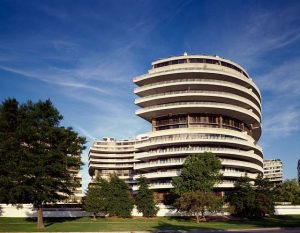
The Watergate Break-in: A Seed of Scandal
On Saturday, June 17, 1972, five burglars were apprehended in the act of breaking into the offices of the Democratic National Committee, located within the Watergate apartment complex in Washington, D.C.. These individuals were found with wiretapping and photo equipment, signaling a clandestine operation.
The immediate connections to the Nixon administration and its re-election campaign were swift and alarming. One of the arrested men, James McCord, Jr., was the “security” officer for the Committee to Re-elect the President (CREEP), an entity central to Nixon’s campaign. Another burglar carried an address book listing the name and White House address of E. Howard Hunt, an assistant to President Nixon’s special counsel, Charles Colson. Hunt, an ex-CIA operative and a veteran of the 1961 Bay of Pigs invasion, had been recruited by Colson in July 1971 to join the White House “Plumbers” unit, formed to plug government leaks. Three of the Watergate burglars were also veterans of this ill-fated Cuba invasion. The chief of CREEP, John Mitchell, who was then the Attorney General of the United States, was also implicated. Sources indicate that Mitchell later authorized a series of cash payments to the burglars to keep them silent.
The purpose of this break-in was to gather actionable intelligence against the Democratic Party, including installing audio bugs and photographing sensitive campaign documents. It was part of a broader, aggressive intelligence-gathering program approved by Nixon’s chief of staff, Haldeman, during the run-up to the 1972 election campaign. This “whatever it takes” culture within the administration led to massive lawbreaking in pursuit of political intelligence and to settle scores with “leakers” and “traitors”. For instance, a precursor to Watergate was the July 1971 break-in at the office of Daniel Ellsberg’s psychiatrist in Beverly Hills, an attempt to find incriminating material on the individual who leaked the Pentagon Papers.
Following the arrests, the Nixon administration immediately initiated a cover-up. Mitchell publicly denied any connection, and President Nixon, five days after the event, stated that “the White House has had no involvement whatever in this particular incident”. Nixon secretly pledged executive clemency to the imprisoned burglars and suggested providing them with up to a million dollars to maintain their silence, with $450,000 eventually being paid out. A fateful decision made by Nixon on June 23, 1972, was to instruct the CIA to tell the FBI to steer clear of the Watergate investigation, presenting it as a national security matter. The acting FBI director, L. Patrick Gray III, who had taken office after J. Edgar Hoover’s death in May 1972, even turned over FBI records on the investigation to Nixon’s legal assistant, John Dean, and was ordered by Attorney General Richard Kleindienst not to discuss Watergate with the Senate Judiciary Committee. These actions illustrate the immediate and intense efforts to contain the scandal in 1972.
The Broader 1972 Context: A Year of Perceived Success
Despite the underlying machinations of Watergate, 1972 was, on the surface, a year of significant triumphs for President Nixon. His political strategy aimed to build a consensus that would ensure his re-election.
Political Dominance: In the November 1972 presidential election, Nixon and his Vice President Spiro Agnew achieved a landslide victory, securing 60% of the popular vote and carrying every state except Massachusetts, decisively defeating the antiwar candidate Senator George McGovern. This overwhelming mandate made the rationale behind the Watergate break-in particularly puzzling to some observers.
Foreign Policy Achievements: Nixon’s administration pursued a “realpolitik” approach to foreign policy. A major diplomatic breakthrough was his historic visit to China in February 1972, the first by a U.S. president in office, which he famously compared to “going to the moon”. This trip laid the groundwork for normalizing relations between the two countries. Additionally, Nixon achieved détente with the Soviet Union. These high-profile trips and the substantial troop withdrawals from Vietnam were widely publicized and significantly contributed to his landslide re-election. Even when Nixon thwarted a massive North Vietnamese offensive in 1972 with devastating airpower, neither Beijing nor Moscow exacted a price, and the domestic response was not as explosive as previous military actions.
Economic Strategy: On the domestic front, Nixon was acutely focused on ensuring a strong economy for his re-election. He relentlessly pressured Federal Reserve Chairman Arthur Burns to expand the money supply by lowering interest rates, aiming for strong economic growth and lower unemployment. The economy indeed experienced a resurgence in 1972, with booming housing and consumer spending, fueled by fiscal and monetary stimuli. Nixon also imposed price controls to curb inflation, a move that earned him public trust on economic matters. John Connally, a key economic advisor, resigned as Treasury Secretary in May 1972 and was replaced by George Shultz, which, combined with Nixon’s focus on the election, led to a sagging U.S. leadership in international monetary negotiations, contributing to the unraveling of the Smithsonian Agreement, with the British formally breaking away by floating the pound in June 1972.
FBI and CIA Context: While the FBI’s Domestic Intelligence Division would eventually be dissolved in the aftermath of the Watergate investigations, 1972 marked a transitional period for the agency following the death of its long-serving director, J. Edgar Hoover, in May. The investigations by congressional committees into foreign and domestic intelligence, including covert actions and unlawful wiretaps by the FBI, expanded after 1972, in the wake of the Watergate scandals.
In essence, 1972 for Nixon was a year marked by a public narrative of powerful diplomatic achievements and economic prosperity, carefully orchestrated to secure a massive re-election victory. However, beneath this veneer of success, the administration engaged in unprecedented abuses of power, as exemplified by the Watergate break-in and the subsequent cover-up, the true extent of which would only become fully apparent in the years that followed.