

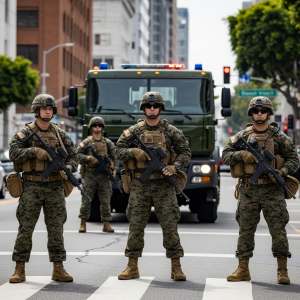
To observe the deployment of federal military forces onto the streets of American cities, often against the express will of elected local leaders, is not merely to witness a fleeting news cycle; it is to engage in a chilling dialogue with the deepest historical tensions in the United States. As chronicled by current events, the aggressive deployment of National Guard troops and Marines, especially in cities like Los Angeles, under the guise of quelling a supposed “rebellion” or “foreign invasion” instigated by political opponents, rips open old constitutional wounds and forces us to confront the fragility of democracy itself.
The narrative surrounding these deployments, where the Secretary of Homeland Security openly declares the military’s presence is to “liberate” a city from its “socialist” leadership, transforms a legal debate into a high-stakes struggle over national identity and the role of the state. This moment demands that citizens look beyond the sensational headlines and recognize the historical precedents being threatened, ignored, and deliberately invoked.
The Spectre of Posse Comitatus and the Militarization of Civil Life
The most immediate historical implication of deploying active-duty military personnel, such as the Marines, within the U.S. interior centers on the Posse Comitatus Act, a core legal barrier against the use of military might for civilian law enforcement. This protection is “baked right into our constitution,” stemming from the founders’ fears of abuses committed by the British army against American colonists.
The current justification for domestic military deployment rests precariously on exceptions to this act, specifically the Insurrection Act of 1807, which allows the president to deploy troops to suppress rebellion or obstruction of federal law. However, the administration’s application requires characterizing protests and civil disobedience—even those where witnesses reported the events as “largely peaceful”—as acts of “rebellion against the authority of the government of the United States”. Historically, the activation of federal troops domestically, such as when Presidents Eisenhower and Kennedy used Section 253 of the Insurrection Act, was done to protect constitutional rights, particularly during school desegregation in hostile states. The current use, aiming to suppress protest and support aggressive immigration enforcement against local wishes, is a stark reversal of that history.
The dangers inherent in this approach are tragically evident in our past. Military troops are often trained to kill enemies, not to engage in the de-escalation tactics required for dealing with civilian resistance. The memory of the Kent State shootings in 1970, where Ohio National Guard soldiers fired on unarmed student protesters, resulting in deaths and permanent injury, serves as a grim reminder of the potentially lethal outcome when military training confronts civilian dissent. The mere presence of 4,000 troops “loitering around federal buildings while wielding assault rifles” adds an “air of menacing authoritarianism” that alienates citizens from their government and sets a “terrible precedent”.
Executive Ambition and the Erosion of Checks and Balances
The unilateral deployment of troops against a governor’s objections is emblematic of an unchecked assertion of executive power. This action occurs amid broader legal confrontations where the executive branch consistently argues that the president has an inherent, flexible authority under Article II of the Constitution to protect “national interests” without congressional or judicial restraint.
Historically, this reliance on expansive executive discretion has been the mechanism by which presidents bypassed congressional war-making authority in foreign conflicts, justifying military actions in Korea, Somalia, and Libya by asserting the need to enforce UN resolutions, promote regional stability, or support NATO credibility. Now, this legal rationale—often articulated via the executive branch’s own Office of Legal Counsel (OLC)—is being imported into the domestic arena, empowering the president to take over a state’s police power if he is dissatisfied with how vigorously the state is enforcing its laws. As noted by the Governor of California, once the military is “turning the military against the American people,” the consequences for truth and trust are profound, and the possibility of returning the “gen[ie] to the bottle” is slim.
The Manufacture of Unreality and the Political Weaponization of History
Central to the current crisis is the systematic effort to shape public perception through rhetoric that is “shocking,” “incendiary,” and “unhinged crazy”. The administration and its allies consistently promote a dark vision of cities as “lawless hellscapes” where federal agents are being “beaten” and “shot at” to justify the use of force.
This reliance on fear and the invention of a fictional crisis aligns with historical patterns of fascist politics and the use of propaganda as a mechanism to achieve and consolidate power. Fascist tactics characteristically dismantle public unity by creating a narrative of “us and them,” where an aggrieved dominant group is victimized by a dangerous, non-compliant “other”.
In this case, the “other” is often specifically targeted ethnic groups and political opponents in “blue states”. The focus on increasing daily quotas for arresting immigrants, regardless of their serious criminal history, feeds a paranoid sense of a “fifth column” and “Muslim colonization,” echoing historical campaigns of xenophobia and anti-immigrant propaganda. The administration seeks to replace the actual complex historical record with a simplistic, mythical vision of American identity and national purity—a tactic known to authoritarian regimes which find history profoundly threatening to their goals.
The Last Stand of Democracy
The brazen nature of these actions—including the physical assault and handcuffing of a sitting U.S. Senator who attempted to ask questions at a federal press conference—highlights the escalating stakes in the battle to defend core democratic institutions: the legislature, the courts, and the press.
A crucial lesson from modern history is that democracy is not an unsinkable ship protected automatically by heritage. When citizens lose a “common shared reality” due to political spectacle and misinformation, the ground for democratic deliberation is lost, and they are left looking for “tribal identifications, for addressing personal grievances, and for entertainment,” paving the way for the strongman.
The history of resistance to authoritarianism emphasizes the essential role of democratic institutions, notably the media, universities, and courts, as centers of resistance. The ongoing legal battles challenging the legality of the troop deployments, the refusal of journalists to passively accept hyperbolic government narratives, and the work of historians to provide context that resists politically motivated amnesia demonstrate that the struggle to maintain a “flawed but hopeful liberal democracy” continues. As has been noted, what we do in moments of crisis will be remembered, and our legacy will be inextricably intertwined with how we exercise our commitment to impartial justice and the truth.