
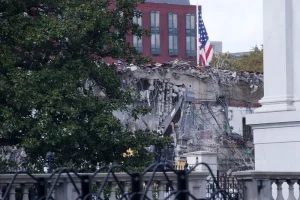
The history of the White House, the very symbol of the American executive branch, is one defined by deliberate, often painstaking construction and reconstruction, rooted firmly in Congressional appropriations and tempered by established architectural traditions. Yet, the images that emerged in October 2025—heavy machinery ripping into the facade of the East Wing—present a jarring departure from this history, forcing a high-stakes conversation about the true extent of presidential authority, the sanctity of national landmarks, and the power of the purse.
Acting as both a centerpiece for national discourse and a physical manifestation of governance, the White House has always been a battleground where political ideals clash with physical reality. The recent demolition of the East Wing for the proposed White House State Ballroom, a project estimated to cost upwards of $300 million to $350 million, provides historians with a stark illustration of how rapidly constitutional guardrails and long-standing norms can be bypassed.
The East Wing: History, Heart, and Habitat
To understand the weight of the East Wing’s demolition, we must appreciate its historical evolution. The original White House residence, constructed between 1792 and 1800, lacked the prominent wings we recognize today. Thomas Jefferson, the second resident, added low colonnades to conceal domestic operations like stables and storage.
The structure of the modern White House complex developed in response to the demands of an expanding government and the changing role of the presidency. Overcrowding in the main residence led President Theodore Roosevelt to relocate executive offices to the newly constructed West Wing in 1901. That same year, the first small East Wing was constructed, primarily serving as a ceremonial entrance for visitors during large social gatherings, equipped with a significant cloakroom.
A pivotal expansion occurred in 1942 under President Franklin D. Roosevelt. The current two-story structure was added primarily to provide clandestine cover for the construction of an underground bunker—the Presidential Emergency Operations Center (PEOC)—designed as a refuge for national leaders during an attack. Beyond housing this crucial emergency facility, the East Wing became known as the “heart” of the White House, in contrast to the West Wing’s reputation as the “mind” of the nation. It served as the public entrance for tours and housed important offices, including the White House Family Theater and, notably, the office space for the First Lady and her staff, a tradition formalized by Rosalynn Carter in 1977.
The demolition, which took place in October 2025, was executed rapidly, with photos confirming the entire East Wing, including the East Colonnade and Family Theater, had been removed within days. This unprecedented destruction drew immediate and widespread condemnation from historians and politicians, being termed a “vanity project” and an “abomination”. This sense of outrage was amplified because the demolition occurred concurrently with the “longest government shutdown in American history,” during which federal employees went unpaid and social services like SNAP benefits faced jeopardy.
President Trump attempted to justify the comprehensive tear-down, claiming that the East Wing “was not much” and that demolition was necessary to “do it properly”. This statement directly contradicted his earlier assurance that the new ballroom “won’t interfere with the current building” and would pay “total respect to the existing building”.
Authority: The Absence of Checks and the Claim of Unilateral Power
The immediate constitutional and legal questions surrounding the demolition centered on oversight and presidential prerogative, particularly concerning historic preservation.
The White House, as a national historic landmark, is typically subject to review processes for construction. However, the East Wing demolition highlighted a critical legal loophole: the White House, along with the U.S. Capitol and the Supreme Court, is explicitly exempt from the Section 106 review requirements of the National Historic Preservation Act (NHPA). Although previous administrations utilized consultation processes with agencies like the National Park Service, even when not legally required, the Trump administration proceeded with demolition without review by the National Capital Planning Commission (NCPC).
Furthermore, the law governing the NCPC, which traditionally reviews construction projects, states that if the agency undertaking the renovation (the White House) disagrees with the commission’s recommendations, they only need to advise the commission of their reasons and may then proceed according to their legal authority. The advice offered by the U.S. Commission of Fine Arts (CFA) is similarly non-binding, and in a striking move that eliminated potential institutional resistance, President Trump fired all six members of the CFA.
The President’s purported authority to act unilaterally was summarized by Trump himself, who claimed unnamed advisors told him: “Sir, this is the White House. You’re the president of the United States. You can do anything you want”. Yet, the National Park Service (NPS) is legally designated as the steward for the White House on behalf of the American people. The demolition proceeded despite a lawsuit filed by citizens seeking a temporary restraining order, arguing the project lacked “legally required approvals or reviews”.
This forceful approach to altering a national landmark reflects a broader pattern in the sources of an expanding and less-constrained executive power. The presidential authority itself, especially since the mid-20th century, has swollen, driven by crisis and necessity, leading scholars to describe the modern presidency as a “constitutional battering ram”. The ability to dismantle a century-old wing of the White House without adhering to traditional checks and balances signals a concerning trend toward executive supremacy.
Appropriations and Corruption: The Price of Unilateral Action
Perhaps the most revealing aspect of the ballroom controversy is the entanglement of funding, transparency, and legal integrity. The Constitution grants the legislative branch the paramount check on the executive through the power of the purse. The Founding Fathers viewed Congressional appropriation as essential to preventing corruption, fearing that an executive holding independent spending power would foster dependency among political leaders.
The Trump administration circumvented the need for Congressional appropriation by claiming the entire $300 million project would be financed by private donors. While the NPS is permitted to accept private donations for the benefit of the national park system, including the White House grounds, those donations must adhere to specific rules, including the requirement of a written contract between the NPS and the donor, with funds in hand prior to execution. The fact that the East Wing was leveled potentially before these funds were cleared and accepted raises questions about the legality of the funding mechanisms.
More seriously, the private financing scheme immediately raised alarm bells regarding the Anti-Deficiency Act and the Emoluments Clauses of the Constitution.
- Anti-Deficiency Act: This act prohibits federal agencies and officers/employees of the U.S. government from accepting voluntary services or outside gifts intended to supplement funds appropriated by Congress. Critics argue the private donations aimed to supplement the government’s operational capacity, violating the spirit, if not the letter, of this foundational fiscal law. Experts worried that this private funding mechanism essentially created an “off-book slush fund” for the president, outside of Congressional oversight.
- Emoluments and Pay-to-Play: The practice of using the White House and access to the President for personal gain has long been scrutinized. The ballroom project involves significant contributions from major corporations, including $10 million from Lockheed Martin and $5 million from Google, among others. Critics noted that these companies, particularly those seeking massive government defense contracts like Lockheed Martin, are paying for direct “access to the president and other high-ranking officials”. Such actions risk violating the Emoluments Clauses, which prohibit the President from receiving benefits from foreign or domestic governments (or in this context, private actors seeking undue favor) without Congressional consent. These clauses are historically linked to preventing the betrayal of public trust through dealings with foreign powers and protecting the President from putting personal financial interests ahead of the nation.
The historical record is clear: the presidency is an institution belonging to the American people. When a president pursues major structural alterations to this historic complex—particularly ones that serve a personal interest in hosting larger events—while disregarding established checks and balances in terms of oversight and appropriations, the act becomes more than just a renovation; it is interpreted as a symbolic tearing down of institutional norms. As constitutional scholars have long emphasized, ignoring the processes intended to check executive power moves a republic perilously close to a dictatorship. The demolition of the East Wing thus stands not merely as an architectural footnote, but as a striking, visible example of executive power overriding tradition, law, and legislative constraint in pursuit of a singular, personalized vision.