

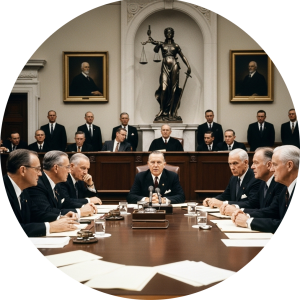
It is with a keen appreciation for the complexities of history that we now turn our attention to February 1937, a pivotal moment when President Franklin D. Roosevelt introduced his audacious “court-packing plan”. This initiative, though ostensibly aimed at judicial efficiency, was in truth a profound attempt to overcome what Roosevelt perceived as the Supreme Court’s obstruction of his New Deal agenda. To truly understand the gravity of this proposal and the ensuing national drama, one must consider the forces that had been building towards this confrontation.
By 1937, the nation was still grappling with the lingering effects of the Great Depression, an economic crisis that had prompted Roosevelt’s administration to engage in “bold, persistent experimentation” since his 1932 election. His first term, characterized by rapid legislative action, saw programs like the National Recovery Administration (NRA) as central to his agenda. However, a conservative Supreme Court, composed largely of men whose legal educations predated the modern industrial age, consistently invalidated key New Deal legislation. Landmark rulings like Schechter Poultry v. United States in 1935, which struck down the NRA, and United States v. Butler in 1936, which dismantled the Agricultural Adjustment Act (AAA), left much of Roosevelt’s program in ruins and were seen as clear repudiations of his policies. Indeed, between 1933 and 1936, the Court overturned acts of Congress at ten times the traditional rate. This judicial resistance created an “impasse” that, in Roosevelt’s view, threatened to paralyze efforts towards social and economic progress and even risked “total social and industrial collapse”.
Fresh off a landslide reelection victory in November 1936, securing 61 percent of the popular vote—the largest presidential mandate in American history at that time—Roosevelt felt emboldened. His confidence was perhaps heightened by the general sense of system stabilization being pursued, as exemplified by the Banking Act of 1935 which centralized control from private bankers to Washington politicians. He viewed his electoral triumph as a clear mandate to address the judicial impediment.
The plan itself, developed covertly by Attorney General Homer Cummings at Roosevelt’s insistence, was a closely guarded secret, even from many within Roosevelt’s cabinet. Revealed in February 1937, it was an audacious gambit: Roosevelt would ask Congress to empower him to appoint an additional justice to the Supreme Court for every sitting justice over the age of seventy who did not retire, with a maximum court size of fifteen justices. Given that six justices were over seventy at the time, this would have allowed Roosevelt to immediately appoint six new justices, securing a sympathetic majority on the Court to uphold New Deal programs.
The official justification for this radical proposal, as presented by Roosevelt, focused on the age and supposed inefficiency of the older justices, claiming they were burdened by crowded dockets and were too slow to keep up with the Court’s workload. He even quipped about a “pre-horse-and-buggy era” to underscore his point. However, the true, underlying motivation, widely understood despite Roosevelt’s attempts to obscure it, was to secure a more liberal judicial interpretation of the Constitution that would validate his legislative agenda. This was a “cleverly camouflaged” proposal designed to make the Supreme Court “amenable to his will”. Roosevelt believed that his landslide victory in 1936 meant the American people would stand behind him in this confrontation. He had even discussed his plans with labor leaders like John L. Lewis of the CIO, implying that a reconstituted Supreme Court would offer a long-term solution to rising labor unrest by affirming workers’ rights.
The reaction, however, was swift and overwhelmingly negative. The plan “burst like a bombshell” in Congress, generating “anguish and acclamation” and dividing even his own party. Critics, including many Democrats, lambasted it as a “court-packing scheme” and a dangerous precedent that threatened the independence of the federal judiciary. Accusations of “dictatorship,” “anarchy,” and a “bloodless coup d’état” became common in the press. Newspapers that had supported Roosevelt’s reelection now opposed him on the Court bill, with opposition papers vastly outnumbering supporters. Telegrams flooded congressional offices, overwhelmingly expressing public opposition. Senators like James A. Reed and Joseph O’Mahoney, usually New Deal allies, condemned the plan as a step towards making Roosevelt “dictator in fact” and a “most terrible threat to constitutional government”. Even prominent progressive Senator George Norris, who generally advocated for constitutional amendments to curb judicial power, opposed the plan, fearing it would lead to repeated packing “until it’s as big as the House of Representatives”.
Roosevelt, initially confident, found himself “startled by the reaction of Democratic leaders” who felt betrayed by his secrecy and high-handed treatment. He had expected congressional leaders to defend his plan on the dubious grounds he provided, but they were publicly “shown up as clear out of step”. Despite the fierce backlash, Roosevelt remained outwardly resolute. He used his fireside chats and public addresses, like the March 4th “Victory Dinner” speech, to try and explain his objectives to the American people, framing his plan as essential to prevent the “hardening of the judicial arteries” and insisting it was “nothing novel or radical”. He even attempted to link the Court’s inaction to the ongoing industrial unrest, stating, “It seems to me…that with a Court dillydallying on this decision, there is something to be said for the proposition that the Court is more responsible than the president for the present industrial unrest”.
A crucial turning point, often referred to as “the switch in time that saved nine,” occurred in the spring of 1937. Justice Owen Roberts, who had previously sided with the Court’s conservative majority in striking down New Deal legislation, began to vote with the liberal minority. On March 29, 1937, the Supreme Court, in a 5-4 decision with Roberts in the majority, upheld a state minimum wage law for women in West Coast Hotel Co. v. Parrish, overturning a previous decision from just months earlier. This was followed by decisions on April 12, 1937, upholding the National Labor Relations Act (Wagner Act) in NLRB v. Jones & Laughlin Steel Corp., and soon after, the Social Security Act. The Court observed that unions were “organized out of the necessities of the situation” and “essential to give laborers opportunity to deal on an equality with their employer”.
The timing of these decisions, coming right after Roosevelt’s court-packing announcement, was widely perceived as a direct response to the political pressure. Though the justices themselves, particularly Hughes, maintained that the Parrish decision was made prior to the announcement of the Court plan and merely delayed due to Justice Stone’s illness, the public and political narrative cemented the idea that Roosevelt’s threat had forced the Court’s hand. This “masterly retreat” by the Court effectively removed the perceived judicial obstacle to the New Deal and, in doing so, largely nullified the stated need for Roosevelt’s plan.
Despite these judicial victories, Roosevelt stubbornly pressed on with his bill. However, opposition in Congress hardened, led by a bipartisan coalition that saw the plan as an assault on constitutional principles. On June 14, the Senate Judiciary Committee issued a scathing “Adverse Report,” denouncing the bill as an attempt to “impose upon the courts a course of action” and reiterating that such an expansion was based on a “futility and absurdity of the devious… method”. The report laid waste to every premise of the bill and granted “nothing to Roosevelt, not even the good faith of his intentions”.
The plan suffered further blows. On May 18, 1937, Justice Willis Van Devanter, one of the conservative “Nine Old Men,” announced his retirement. This provided Roosevelt with his first judicial appointment, allowing him to name a liberal justice without expanding the Court’s size, further undermining the rationale for the bill. Then, in July 1937, Majority Leader Joe T. Robinson, who had been instrumental in trying to shepherd the bill through Congress and was promised a Supreme Court seat by Roosevelt, unexpectedly died. His death removed a key figure and further crippled the bill’s prospects.
Ultimately, the “court-packing plan” died in the Senate in July 1937. Though Roosevelt lost the legislative battle, he famously declared that “We lost the battle… but we won the war”. This seemingly paradoxical statement reflects the widely held belief that his aggressive stance had compelled the Supreme Court to change its interpretive approach, becoming more receptive to federal power and economic regulation. The Court’s subsequent decisions confirmed a permanent shift in constitutional law, fundamentally reshaping the balance of power between the federal government and the states.
However, the political costs were high. The court fight fractured the Democratic Party, emboldened conservatives, and “shattered the myth of Roosevelt’s omnipotence”. It led to a “tremendous debate” that left him weakened on Capitol Hill and contributed to the eventual “purge” attempts in the 1938 midterm elections, which largely failed to unseat opponents and ironically strengthened the conservative wing of the party. The spring of 1937, therefore, was not merely about a legislative proposal; it was a profound moment that redefined the relationship between the executive, legislative, and judicial branches, and left an indelible mark on American political and constitutional history.