

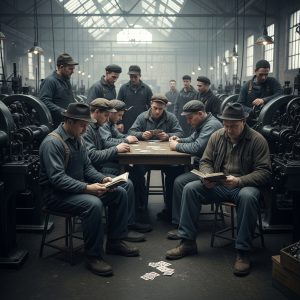
One can scarcely overstate the simmering tensions and seismic shifts occurring across the American landscape in the spring of 1937, even as the previous year’s financial reforms sought to stabilize a fractured nation. While the Banking Act of 1933 began to centralize monetary control, a far more visceral struggle was unfolding on the factory floors, challenging the very notion of who held power in industry. This period saw the burgeoning power of industrial unions, particularly the Congress of Industrial Organizations (CIO), grappling not just with employers but, tellingly, with the very nature of worker militancy itself, leading John L. Lewis to declare that a CIO contract was “adequate protection against sit-downs, lie-downs, or any other kind of strike”.
To truly grasp this dynamic, we must rewind slightly to the profound economic distress that had gripped the nation. By January 1933, bank suspensions were rampant, and industrial employment had plummeted, particularly in sectors like the automobile industry [source from previous essay’s context]. This widespread suffering, combined with revelations of financial malfeasance [source from previous essay’s context], fueled a deep public anger directed at Wall Street and a desperate yearning for stability. Roosevelt’s New Deal, through legislation like the National Industrial Recovery Act (NIRA) in 1933 and subsequently the Wagner Act in 1935, aimed to address this crisis, in part by recognizing labor’s right to organize.
However, the NIRA, while intended to organize the labor market and stabilize output, proved to be a “hopeless mess” in practice, with big businesses dominating “code” setting and unions “badly weakened” and “ignored” until they leveraged its clauses to launch “waves of strikes”. Indeed, a million and a half workers engaged in strikes in 1934 alone, suggesting an undeniable need for legislative action. It was amidst this backdrop of intense labor unrest and a profound sense of system instability that the sit-down strike emerged as a particularly potent tactic.
The sit-down strike, pioneered by rubber workers in Akron, Ohio, in the early 1930s, involved workers remaining inside the plant rather than walking out. This strategy offered distinct advantages: it directly blocked the use of strikebreakers, gave workers immediate control, provided shelter from the elements, and fostered a strong sense of community among thousands under one roof. These strikes spread rapidly throughout 1936, culminating in the monumental forty-day sit-down at Fisher Body plant #1 in Flint, Michigan, from December 1936 to February 1937. This was, as one striker put it, “like war,” forging deep bonds among the participants who organized everything from recreation and classes to sanitation.
The sheer effectiveness and decentralized nature of these sit-downs, however, posed a significant threat to the established industrial order. They were “especially dangerous to the system because they were not controlled by the regular union leadership”. This direct, often spontaneous action, exemplified by the phone call an AFL business agent received in March 1937: “My name is Mary Jones; I’m a soda clerk at Liggett’s; we’ve thrown the manager out and we’ve got the keys. What do we do now?” highlighted the lack of top-down control.
It was precisely this profound labor unrest and the perceived chaos of uncontrolled strikes that drove a sophisticated effort to stabilize the system. The Wagner Act of 1935, which established the National Labor Relations Board (NLRB), was passed with this very goal in mind. While hailed as an aid to union organizing from the trade unions’ perspective, from the government’s standpoint, it was fundamentally “an aid to the stability of commerce”. The Act guaranteed workers’ right to organize and bargain, effectively giving unions legal status and a formal channel for grievances.
In the spring of 1937, as the wave of sit-down strikes continued to “spread like a prairie fire,” particularly paralyzing General Motors in Flint and elsewhere, the need for this stabilization became even more pressing. The Senate, deeply “agitated” by the strikes, overwhelmingly condemned them as “illegal and contrary to sound public policy” on April 7, 1937. Public and political figures alike expressed “hopes and terrors” that the strikes would lead to “revolution” or “anarchy, mob rule, and ruthless dictatorship”. Indeed, even Roosevelt’s silence on the sit-downs was seen by incredulous critics as part of a “Faustian bargain” with labor, in exchange for their support for his Court-packing plan.
It is within this heated atmosphere that the CIO’s stance solidified. Unions, while often unwanted by employers, were nevertheless “more controllable—more stabilizing for the system than the wildcat strikes, the factory occupations of the rank and file”. Thus, in a revealing development, a New York Times article in Spring 1937 carried the headline “Unauthorized Sit-Downs Fought by CIO Unions.” The accompanying story underscored that “Strict orders have been issued to all organizers and representatives that they will be dismissed if they authorize any stoppages of work without the consent of the international officers”.
This policy was directly articulated by John L. Lewis, the dynamic leader of the CIO. He was quoted stating that “A CIO contract is adequate protection against sit-downs, lie-downs, or any other kind of strike“. This statement, far from being a radical call to arms, was a powerful endorsement of the new, more structured approach to labor relations envisioned by the Wagner Act. It signaled a shift from spontaneous, disruptive action to formalized negotiation and grievance procedures. Even the Communist party, whose members played significant roles in organizing CIO unions, reportedly adopted a similar position after the sit-downs, emphasizing the need to “work for regular relations between the union and the employers—and strict observance of union procedure on the part of the workers”.
Essentially, two sophisticated mechanisms for controlling direct labor action emerged in the mid-1930s:
- The National Labor Relations Board (NLRB): It provided unions with legal status and a framework for settling grievances, thereby channeling potentially disruptive energy into elections and formal processes, much as the constitutional system channels political energy into voting.
- The Union Itself (including the CIO): Even militant unions like the CIO began to channel workers’ “insurrectionary energy” into contracts, negotiations, and official union meetings, actively seeking to “minimize strikes” in order to build larger, more influential, and “respectable organizations”.
This historical period, therefore, powerfully illustrates the complex interplay between crisis, reform, and the evolving nature of power. While the immediate economic crisis of the Depression spurred radical changes like the Banking Act of 1933 and the Wagner Act, these reforms, in turn, reshaped the very methods of social and economic protest. The CIO’s efforts to curb “unauthorized sit-downs” and Lewis’s emphatic declaration were not isolated incidents but integral parts of a larger New Deal strategy aimed at stabilizing capitalism by integrating and institutionalizing labor’s power, moving from raw, disruptive force to a more managed, contractual relationship.