

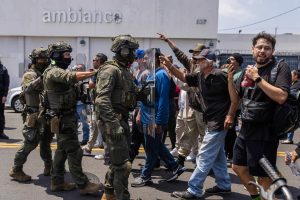
For those of us dedicated to chronicling the human experience, we know that history, far from being a static record of the past, is a dynamic force that shapes our present institutions and informs our understanding of recurring societal crises. The escalating crisis surrounding U.S. Immigration and Customs Enforcement (ICE)—marked by aggressive, military-style operations and challenges to constitutional accountability—is not merely a modern aberration. It represents a worrying confluence of long-standing historical anxieties regarding unchecked state power, the erosion of due process, and deeply racialized enforcement policies.
The core issue illuminated by recent reports on ICE activities, such as the alarming description of night raids in Chicago where agents utilized tactics like repelling onto rooftops, smashing through doors, and deploying flashbang grenades, is a profound breakdown in legal accountability. These actions transform American neighborhoods into what agents treat as a “war zone”, often ensnaring both immigrants and U.S. citizens. This operational style, however, is insulated from the immediate judicial review that might constrain local police.
The Problem of Impunity: An Institutional History
Historically, the concept of a federal police agency combining intelligence gathering and domestic law enforcement functions was met with deep skepticism in the United States, rooted in fears of creating a secret force akin to Hitler’s Gestapo. The Central Intelligence Agency (CIA), established by the National Security Act of 1947, was expressly prohibited from spying on Americans or using intelligence collected abroad to directly support criminal prosecutions in the American court system.
Yet, the history of federal law enforcement is marked by expansion and internal overreach. The FBI, for instance, under J. Edgar Hoover, significantly grew its domestic intelligence portfolio, sometimes using assistance from the CIA and Army Intelligence under dubious legal pretenses. The FBI historically employed illegal tactics, including forging letters, burglaries, and opening mail illegally, often aimed at disrupting radical and left-wing groups.
Today, ICE agents benefit from operating in a sphere of federal authority that, unlike state law enforcement, often lacks a straightforward legal mechanism—a “cause of action”—allowing individuals to sue them for constitutional violations. This impunity allows the agency to act “above the law”.
Furthermore, the bureaucratic culture of secrecy often exacerbates these issues. The capacity of intelligence and law enforcement agencies to restrict information—a practice heightened by Cold War-era “national security” concerns—has historically enhanced the government’s control over certain sectors of society and facilitated violations of individual rights. The CIA, throughout history, has guarded its secrets fiercely, sometimes withholding crucial information even from Congress. This historical precedent for institutional opacity creates an environment where agencies, operating under the cloak of national security, can document their own operations (sometimes “gleeful[ly],” sending camera crews to film and post on social media), effectively shaping their public narrative while avoiding external scrutiny.
From Racialized Drug Wars to Immigration Enforcement
The military-style operations described, involving armored vehicles and paramilitary gear, are not just arbitrary displays of force. They reflect a long, racialized history of federal enforcement that underpins the expansion of the Prison Industrial Complex (PIC). The PIC, which has grown into a behemoth system coloring our perception of criminal justice, often targets young, poor people of color and “foreign” individuals.
The current rhetoric surrounding immigration policy, including the constant invocation of “criminal aliens”, relies more heavily on fear and racist sentiment than on factual reality. This echoes historical drug policies, where anti-opium laws targeted Chinese immigrants, cocaine laws targeted African Americans, and anti-marijuana laws targeted Mexicans and Mexican Americans, utilizing racist propaganda to fuel legal campaigns. The term “criminal” is deliberately used in propaganda to attribute a specific negative character type to immigrants, helping to justify actions that otherwise erode democratic reasonableness.
The Immigration and Naturalization Service (INS), before it was reformed and ultimately folded into Homeland Security, struggled primarily with formidable challenges concerning illegal entry and “criminal aliens”. The aggressive tactics seen today, such as the detention of families and children, including a six-year-old boy with leukemia, are consistent with this legacy, demonstrating a state apparatus focused on managing challenges through punitive, rather than humanitarian, means.
The Disappearing Due Process
Perhaps the most alarming consequence of these accelerated, non-judicial enforcement actions is the systemic erosion of due process. Following the 9/11 attacks, the George W. Bush administration employed a similar strategy of mass detention and secrecy, arresting 768 aliens as “special interest” detainees. Attorney General John Ashcroft implemented a “risk minimization” strategy, closing immigration hearings to the public and ordering the denial of bond until detainees were “cleared” by the FBI. This created a chaotic environment where INS attorneys struggled to get crucial information, and the clearance process was time-consuming.
Today, the stated goal of circumventing judicial review by removing individuals quickly—a policy colloquially described as “whisk[ing] someone away fast enough [so] the judicial system can’t catch up”—is intended to eliminate the very rights guaranteed to criminal defendants: notice of charges, opportunity to be heard, confrontation, cross-examination, and counsel. If U.S. citizens can be labeled “undocumented gang member[s]” and rendered to foreign prisons without a trial, this action likely violates the Fifth Amendment and the Non-Detention Act, which requires an act of Congress for the executive to detain a citizen without due process.
The Historian’s Imperative in a Polarized Era
The public discourse surrounding these events is fractured, taking place within a hyper-polarized media landscape. As political polarization intensifies, partisan media systems have developed that often substitute slogans and nostalgia for genuine engagement with real-world issues.
This is where the historian’s task becomes paramount. In the face of propaganda designed to destabilize the shared reality necessary for democratic contestation, history offers essential tools: providing multiple perspectives on the past, prioritizing information that enhances understanding, and challenging oversimplified narratives that seek to justify atrocities as a “necessary price to pay for progress”. The work of journalists and truth-seekers, adhering to ethical standards, is crucial because the ability to discern facts is what makes an individual, and the collective trust in common knowledge is what holds society together.
When faced with scenes of cruelty and the continuous normalization of extreme actions, citizens must continually ask: “is this okay?”. As countercultural figures throughout history understood, resisting tyranny requires active engagement, bearing witness to injustice, and organizing a platform—a spectacle of positive energy and pageantry—that allows democratic institutions and policymakers to respond effectively. The lessons from history affirm that institutions like the media, universities, and courts are essential defenses against authoritarian tendencies. We tell the truth, after all, because history depends on it.